Father’s side Salander · Keller · Walsh
My Father’s Side
Through Yehuda’s father, Abe Salander: the Solenders of Ryglice and the Scheps family of Tarnów, the Kellers and Rubinsteins of Roś, and Meemaw’s (Mary Salander’s) Walsh, Unger and Lang families. From Galicia and Roś to the Lower East Side, Williamsburg and Rutland, Vermont, and from County Cork and western Hungary to Kansas and Oregon.
Yehuda → Abe → Dr. James Salander & Mary (Walsh) → Lew Salander & June Keller → Abraham Chaim Salander & Jennie Scheps → Yosef Solender & Basche Leder
Western Hungary → Kansas
I. Ryglice, in Austrian Galicia
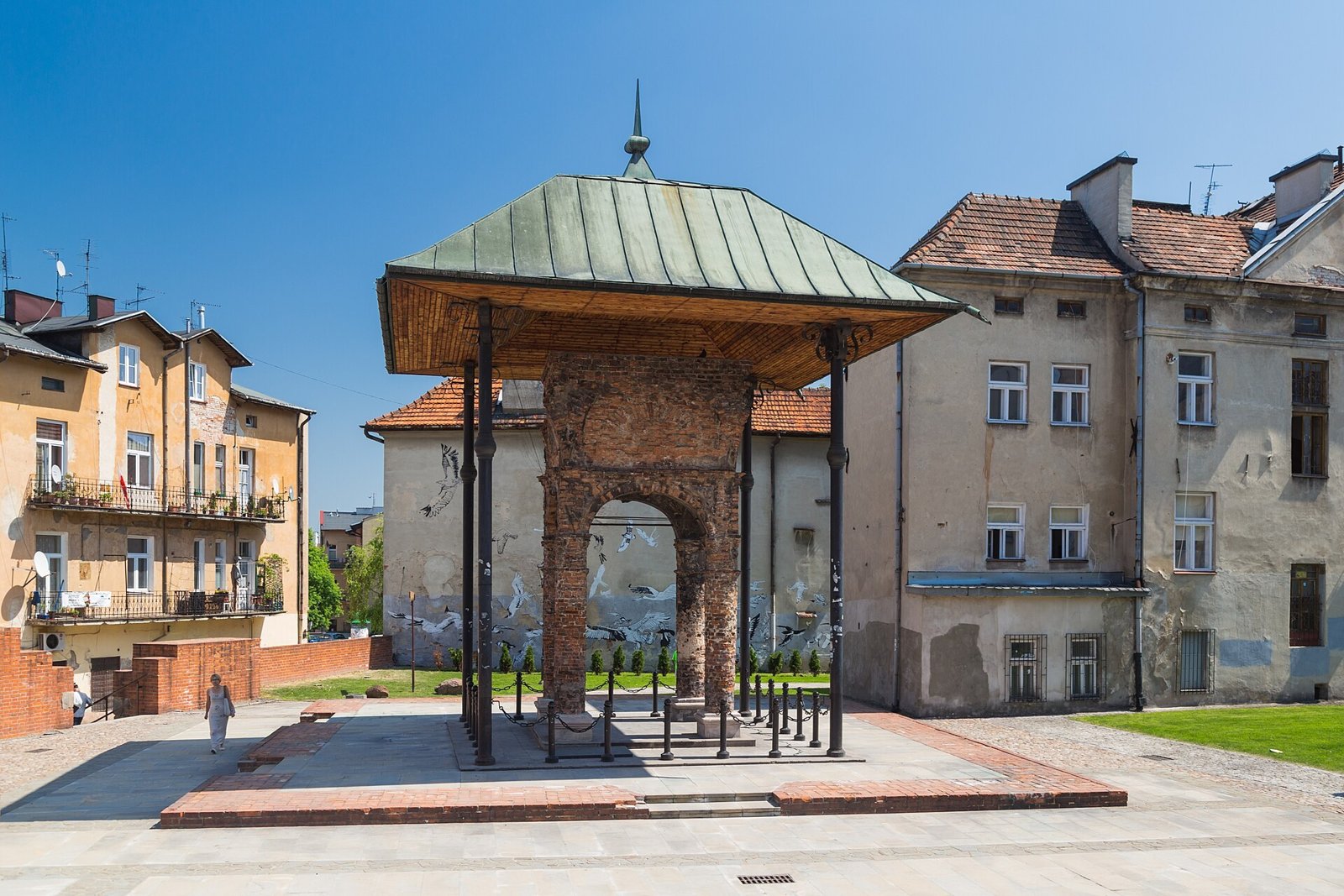
The story starts in Ryglice, a small market town in the hills south-east of Tarnów, in the part of Poland that Austria ruled from 1772 and called Galicia. Jews there lived by trade and craft. Ryglice kept its own Jewish register, separate from Tarnów's. Confirmedpublished
The oldest people this album can name are two couples. The first is Yosef Solender and Basche Leder. The second is Yehuda Leib Scheps and Brandel Baum. We know all four only because their children named them on a New York marriage certificate in 1889. Confirmedrecord When they were born, and when they died, we do not know. The Tarnów registers were read page by page for 1849–1900, and none of the four is in them. Ryglice's own Jewish books from before 1877 have not turned up in any archive list. Openrecord
The name, though, was there. A Lewy Salender lived at house no. 3 in Ryglice in 1841. Confirmedrecord Markus Solender, a melamed (a children's Hebrew teacher), and his wife Lea had a son, Hersz, who married in Tarnów in 1881. Confirmedrecord A Chane Solländer married into the Leder family of nearby Rzepiennik. Confirmedrecord Were these Yosef's brothers and cousins? Probably, but no record says so. Possible Chane turned out to be a daughter of Hersh and Perl Solender of Ryglice: see below.
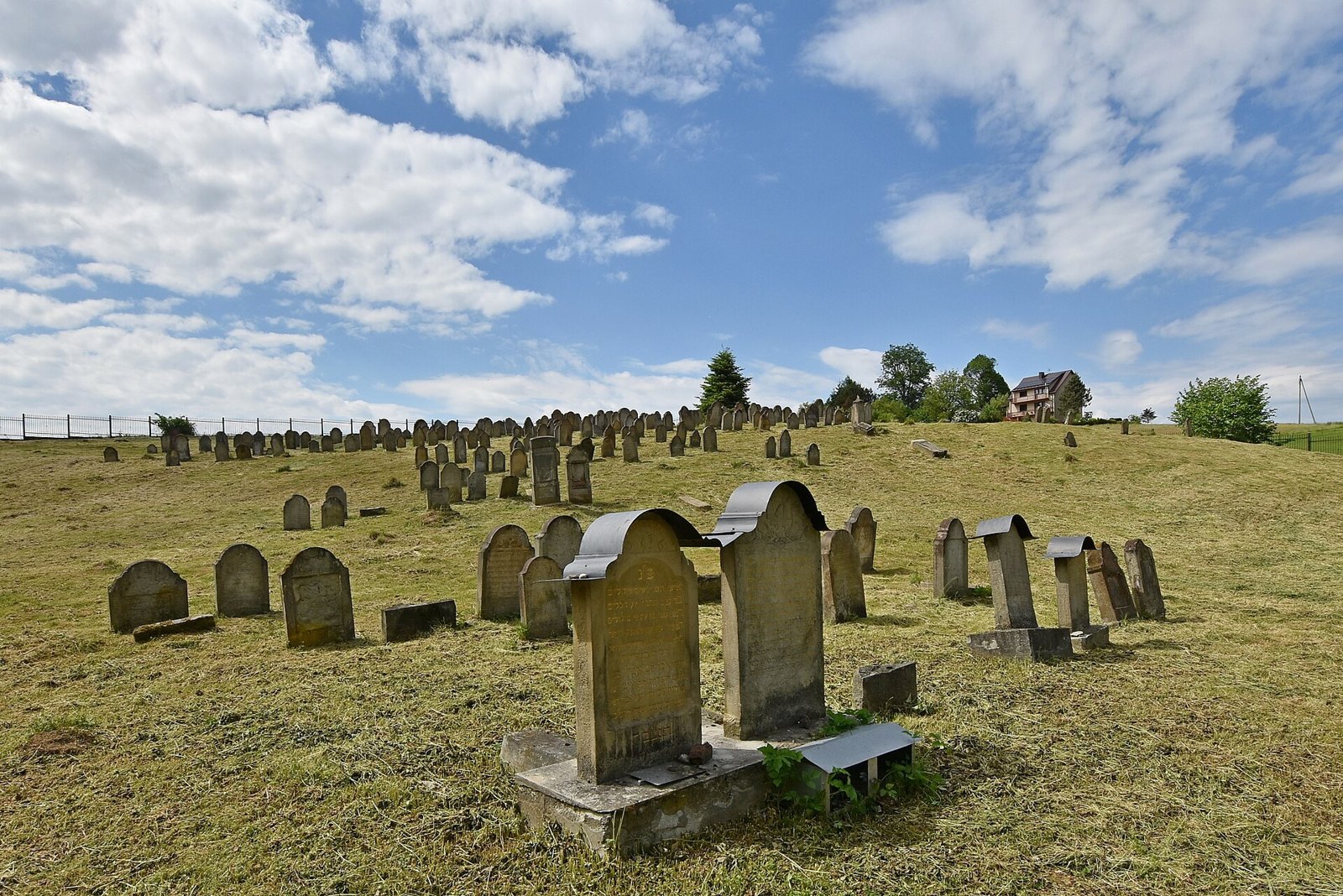
- New, 1 Nov: Ryglice’s Jewish cemetery still stands: about 270 gravestones there have been inventoried, and a book about them is being prepared. Probablepublished
- New, 1 Nov: Ryglice people helped each other to New York: three emigrants from Ryglice who arrived between 1902 and 1911 were all going to the same New York address, a sign of a Ryglice circle (landsmen) in the city. Probableindex
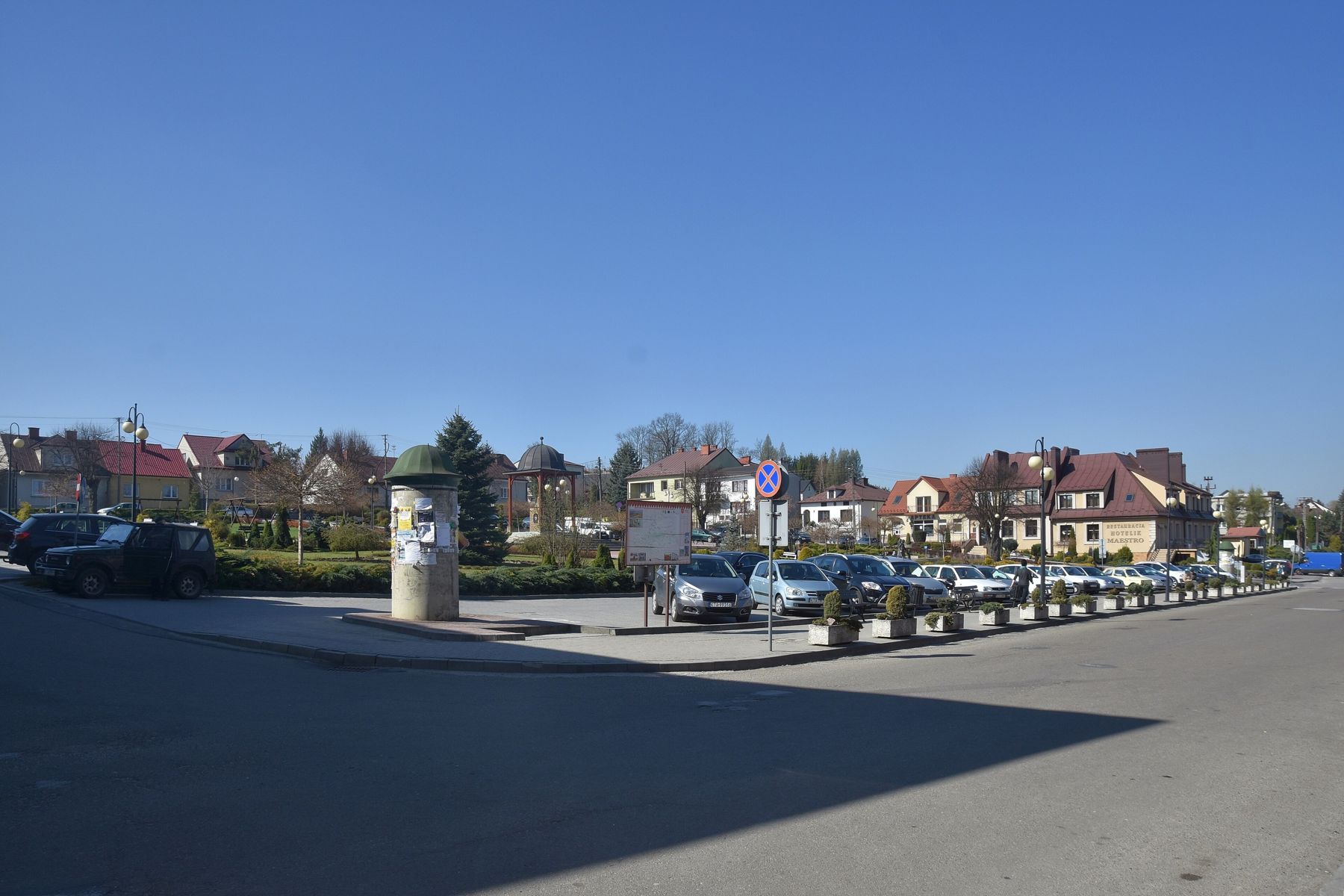
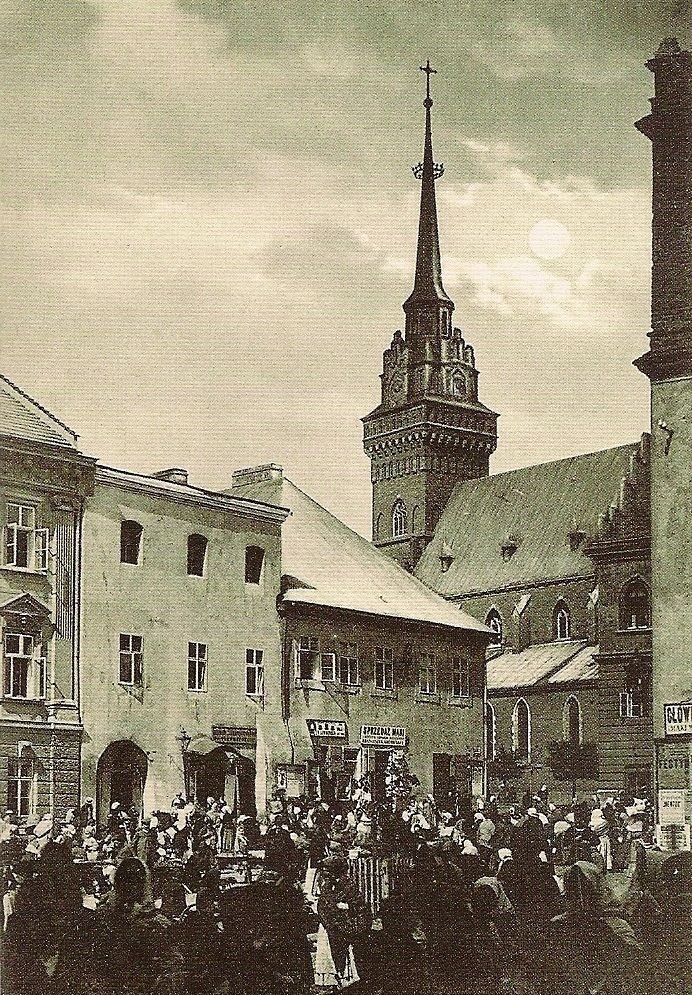

Ryglice, Rzepiennik and the Leder–Solender marriages
Ryglice in Abraham’s boyhood. About 372 Jews lived in Ryglice in 1880 (out of 2,587 people), and 385 in 1900. They lived around the market square and made a living from small trade, peddling, tailoring, sewing and glass-blowing. Abraham became a tailor in New York, which fits. Confirmedpublished The shul was a two-storey building with tall stone stairs on the west side of the market square, with a mikvah and a slaughterhouse nearby. German gendarmes burned it at the end of 1939; a pharmacy stands on the spot today. Confirmedpublished The rov of Abraham’s childhood was probably R’ Nachum Tzvi Horowitz (Tencer) of the Ropshitz family, who died in 1890. Probablepublished All the rabbis, both sides.
On 22 July 1942 the roughly 395 Jews still in Ryglice were sent to the Tuchów ghetto, and from there to Bełżec. About three survived. Confirmedpublished
Two marriages between the same two families
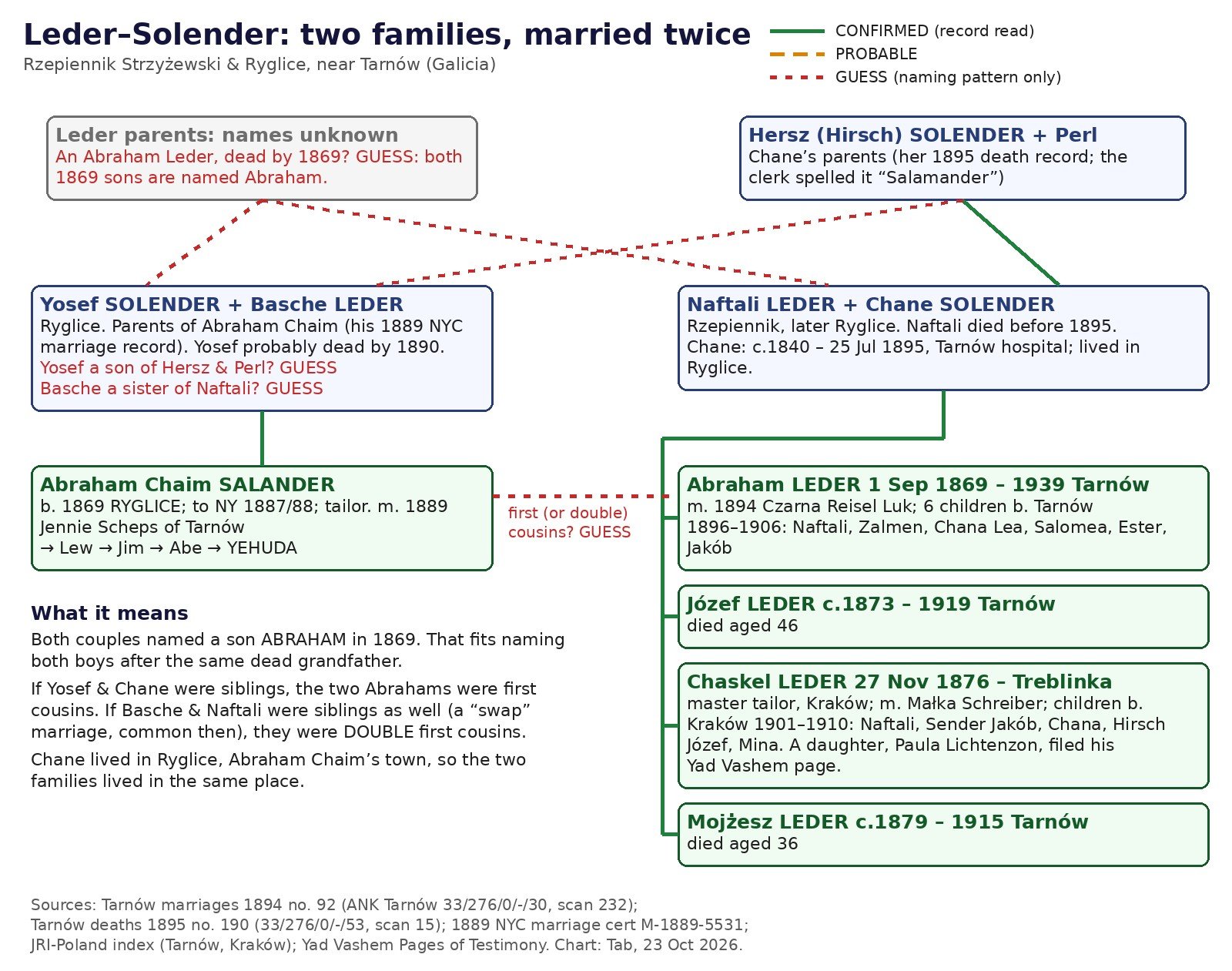
Abraham Chaim’s parents were Yosef Solender and Basche Leder. In Rzepiennik Strzyżewski, about 15 km away, another couple had the same two names the other way round: Naftali Leder and Chane Solender. Both couples had a son named Abraham born in 1869. Confirmedrecordindex
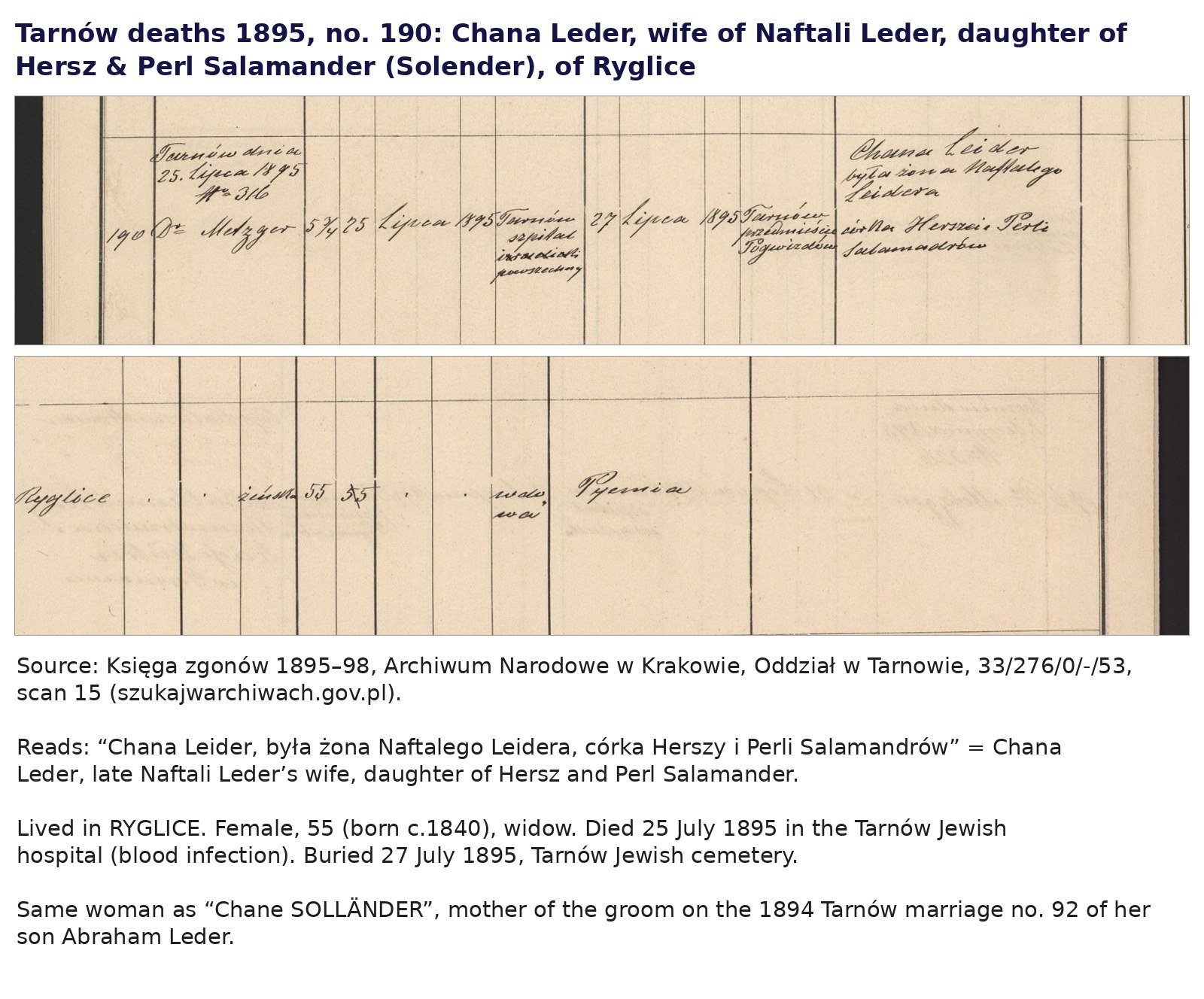
Chane’s own death record has been found. Chane Leder, born Chane Solender, was the wife of Naftali Leder and the mother of Abraham, Józef, Chaskel and Mojżesz Leder. Tarnów deaths 1895, no. 190: “Chana Leider, była żona Naftalego Leidera, córka Herszy i Perli Salamandrów”, meaning Chana Leder, widow of Naftali Leder, daughter of Hersz and Perl Salamander (the clerk’s spelling of Solender). She lived in Ryglice, Abraham Chaim’s own town. She was 55, so born about 1840, and died on 25 July 1895 in the Tarnów Jewish hospital of a blood infection. She was buried in Tarnów on 27 July. Confirmedrecord So Chane’s father was Hersh (Hersz) Solender and her mother was Perl. Confirmedrecord
Was our Yosef her brother? If he was, then Hersh and Perl were Yosef’s parents too, and the two Abrahams of 1869 were first cousins, maybe double first cousins. It fits: same surname, same town, same generation, and both couples named a son Abraham the same year, as if for one grandfather who had died. But no record says so yet, and Ryglice’s own Jewish books from before 1877 are not in any archive catalog (more below). Guess
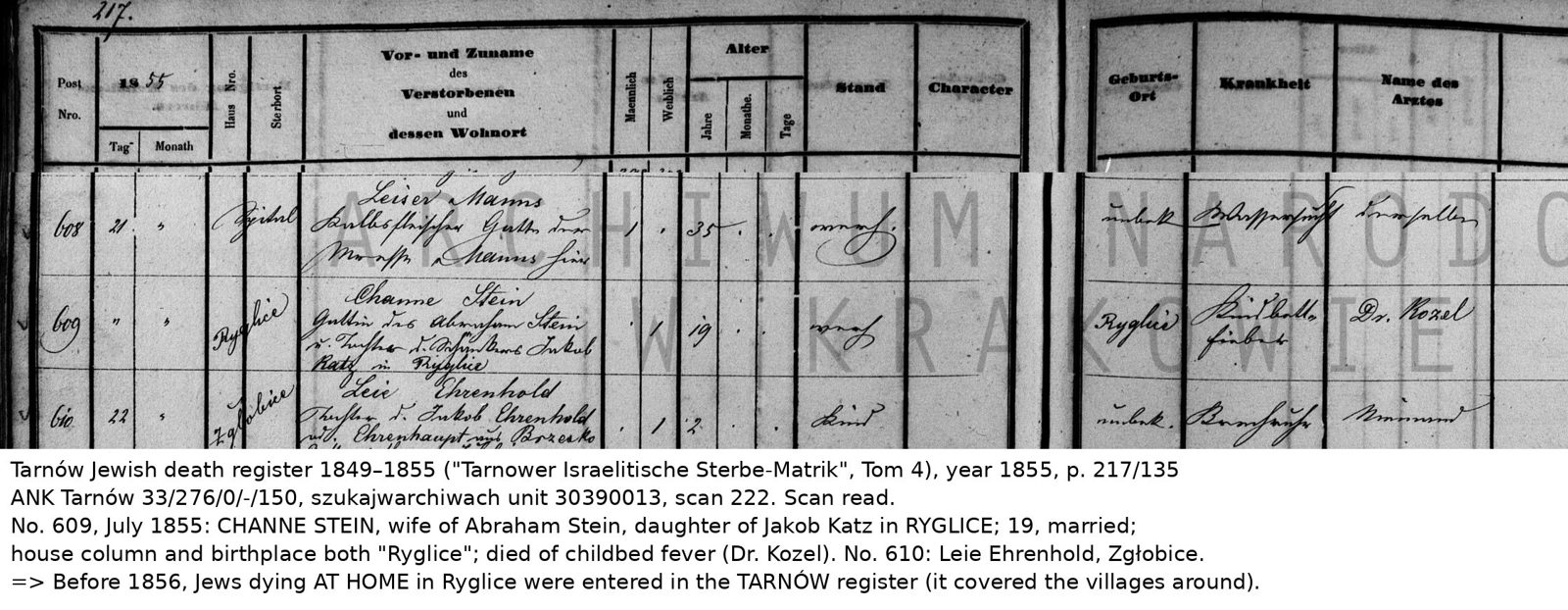
Where Ryglice’s Jews were registered before 1877 Before about 1856 they were written into the Tarnów Jewish books, not Tuchów’s or Jodłowa’s. In July 1855 the Tarnów death register records Channe Stein, 19, daughter of Jakob Katz “in Ryglice”, who died at home in Ryglice of childbed fever. Confirmedrecord She isn’t alone: the same register holds at least 19 Ryglice deaths from 1841 to 1855, babies among them, alongside people from Tuchów, Zalasowa, Zgłobice and other villages around Tarnów. Confirmed (index)index So in those years Tarnów was the registry for the whole area. Probable
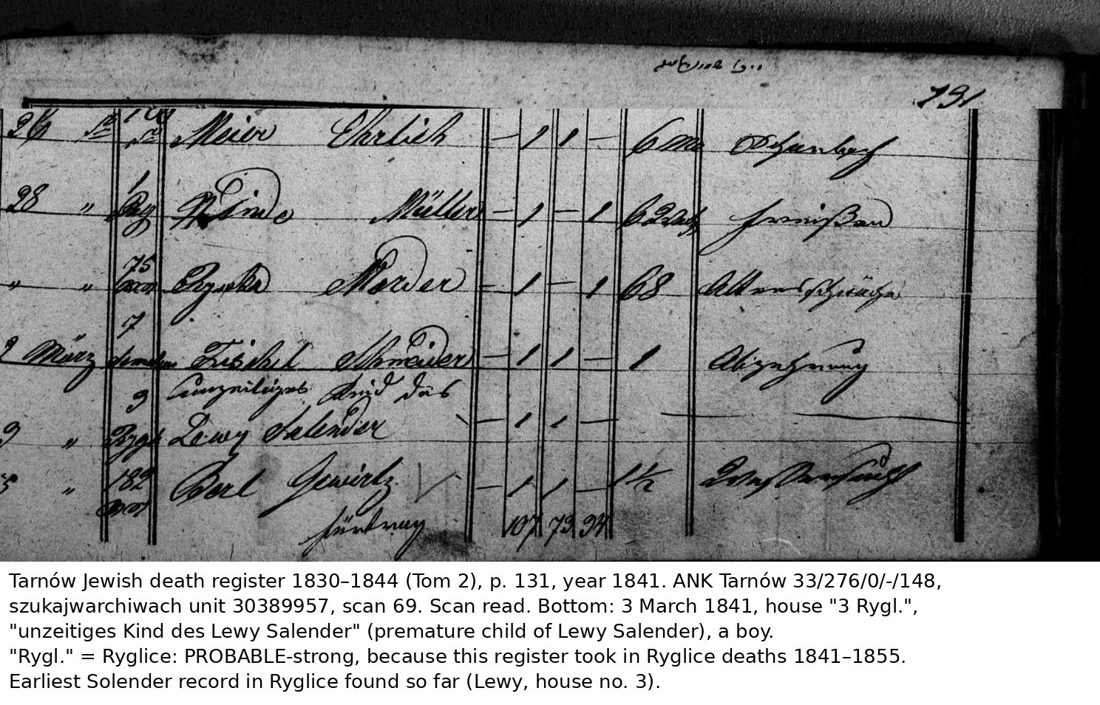
- The earliest Solender in Ryglice. On 3 March 1841 the Tarnów book records the death of a premature child of Lewy Salender, of house no. 3, “Rygl.” That is very probably Ryglice. Probablerecord
- After 1855 Ryglice drops out of the Tarnów books (one Ryglice death in 1867, in Tarnów itself), and Abraham’s 1869 birth isn’t in them. Ryglice may have started its own register around then, or births there often went unregistered. Guess By the official 1876 list, Ryglice was its own Jewish metrical district. Probablesecondary
- What survives: Tarnów’s books before 1856 are online and indexed, and hold no Josef, Basche, Naftali or Mendel. Ryglice’s own books from before 1877 are not in any archive catalog. The Ryglice Catholic parish books (online from 1766) have no Jewish entries. Open
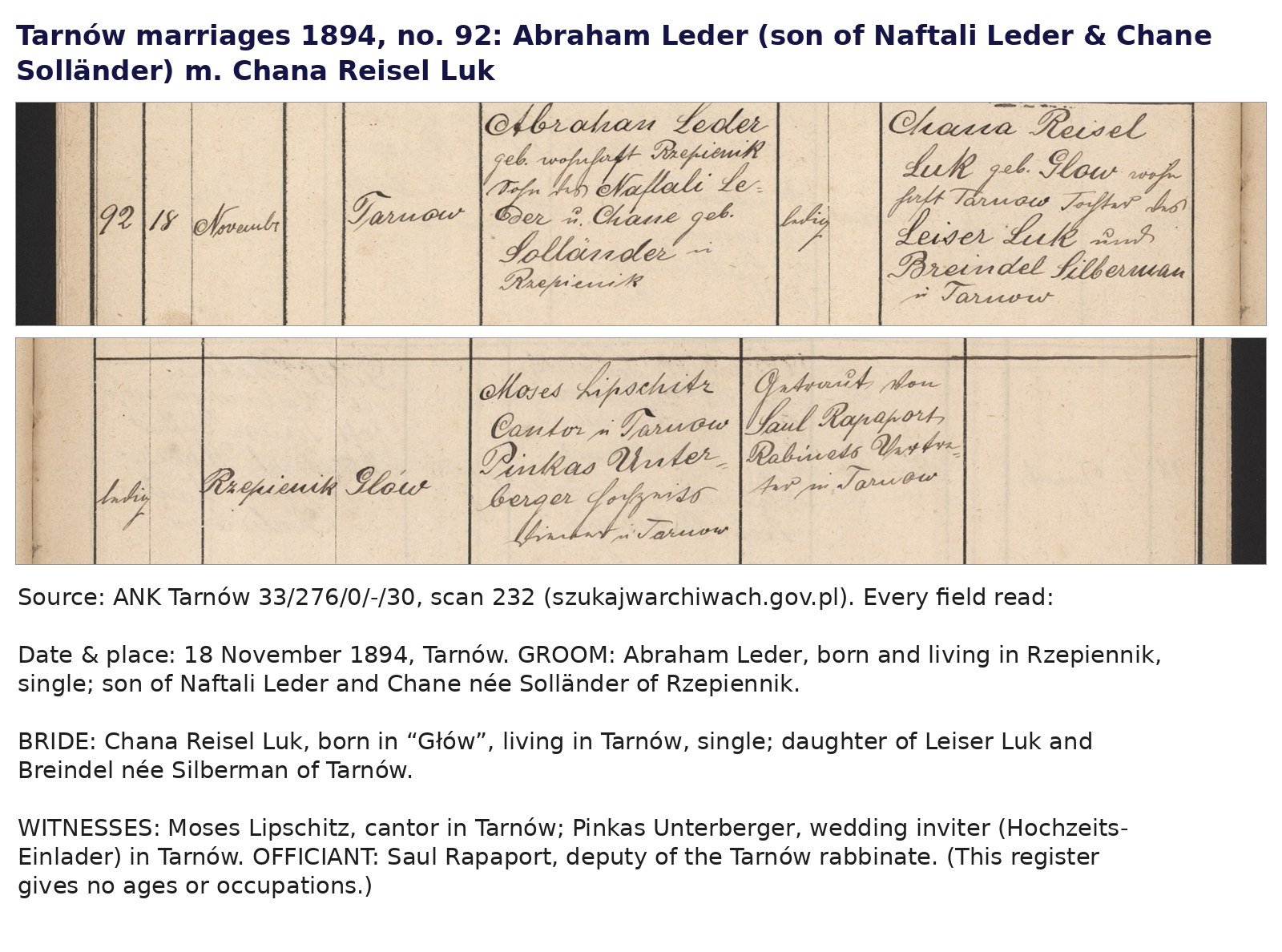
The 1894 wedding, every field
- Date and place: 18 November 1894, Tarnów. Confirmedrecord
- Groom: Abraham Leder, born and living in Rzepiennik, single; son of Naftali Leder and Chane née Solländer. Confirmedrecord
- Bride: Chana Reisel (later Czarna Reisel) Luk, born in “Głów”, living in Tarnów; daughter of Leiser Luk and Breindel Silberman. Confirmedrecord
- Witnesses: Moses Lipschitz, cantor in Tarnów, and Pinkas Unterberger, the wedding inviter (Hochzeits-Einlader). Officiant: Saul Rapaport, for the Tarnów rabbinate. The register gives no ages or trades. Confirmedrecord
Naftali and Chane’s sons and grandchildren
- Abraham (1 Sep 1869 – 1939, Tarnów) married Chana (Czarna) Reisel Luk. Their children, all born in Tarnów: Naftali 1896, Zalmen 1897, Chana Lea 1900, Salomea 1902, Ester 1904, Jakób 1906. Confirmedindex
- Józef died in Tarnów in 1919, aged 46. Confirmedindex
- Chaskel (Yekhezkel), born 27 Nov 1876 in Rzepiennik, was a master tailor in Kraków. He married Małka Schreiber; their children were Naftali 1901, Sender Jakób 1903, Chana 1905, Hirsch Józef 1908 and Mina 1910. He was murdered at Treblinka. His daughter Paula Lichtenzon filed his Page of Testimony. Confirmedindextestimony
- Mojżesz died in Tarnów in 1915, aged 36. Confirmedindex
- Naftali himself died before July 1895; his death record has not been found. Open
Rzepiennik Strzyżewski
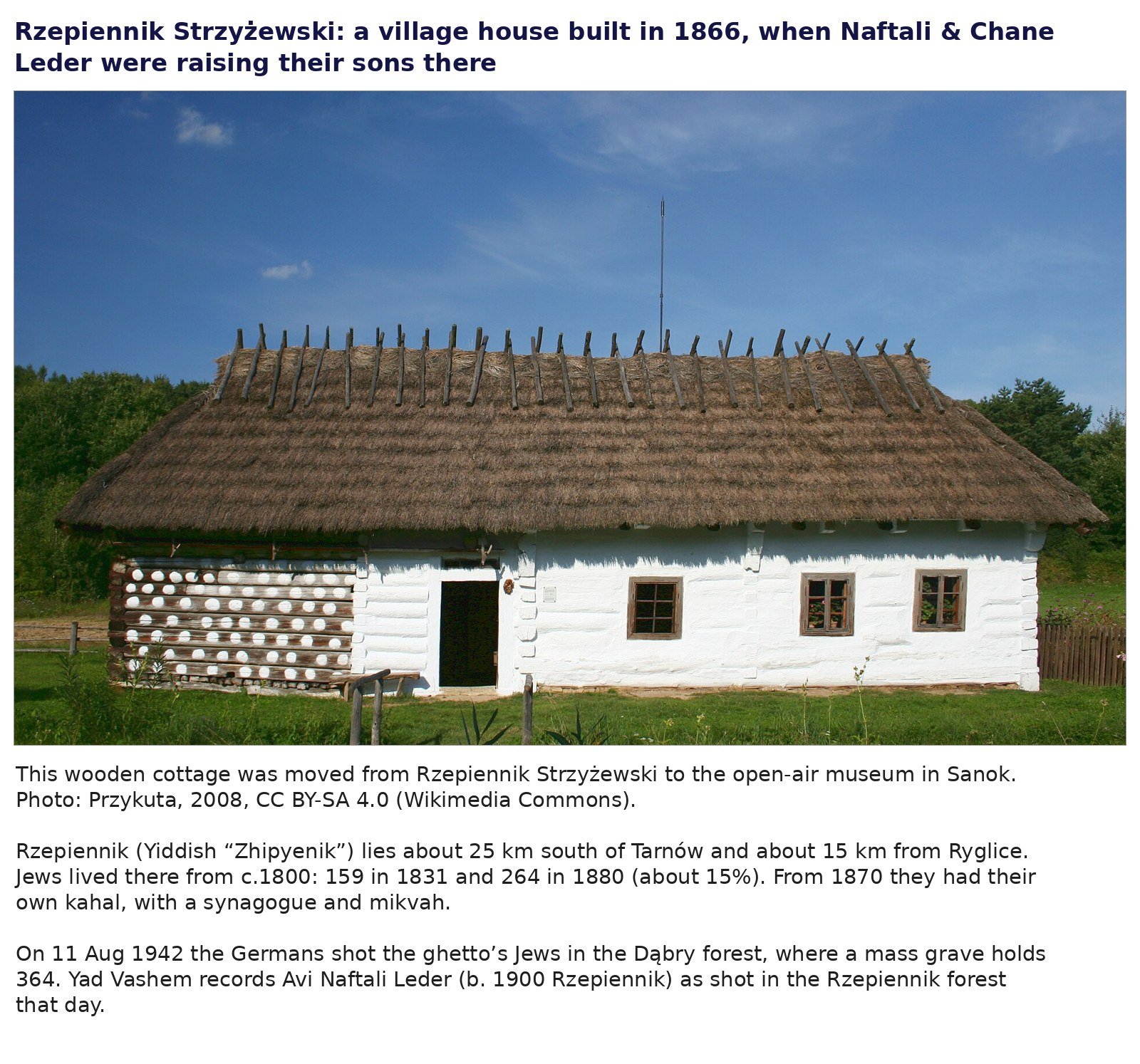
Rzepiennik (Yiddish Zhipyenik) lies about 15 miles south of Tarnów. Jews lived there from about 1800: 159 in 1831, 264 in 1880 and 532 in 1910. The community became its own kahal in 1870, with a synagogue and a mikvah, and people began leaving for America around 1900. Confirmedpublished In the war there was a ghetto, and the synagogue was destroyed. On 11 August 1942 the Germans shot the Jews of Rzepiennik in the Dąbry forest; the mass grave holds 364 people. Avi Naftali Leder, born in Rzepiennik in 1900, was killed that day. Confirmedpublished Who the rov of Rzepiennik was is still unknown. Open
Other Solenders: maybe family

- New, 1 Nov: Chana Pesel Solender, 21, born in Tarnów, daughter of Jakob Solender, a tanner, and Ruchla née Selman, married Leser Keh, 27, of Radgoszcz, in Tarnów in 1887. Another Solender branch in Tarnów; how it connects to Yosef’s is not known. Confirmedrecord
- Rywka Solender, widow of a Hersz Solender, died in Tarnów on 8 January 1880, aged 90 (born about 1790). She was the daughter of Isaak Leib and Sara of Jodłowa. Whether her Hersz is Chane’s father (with Perl as another wife) or a different man is unknown. Confirmedrecord Link to us: Guess
- Herman Solender, born in Ryglice on 1 June 1893, son of a Hersh, was a timber grader in Dubrovitsa (Volhynia). He, his wife Perel Dvoyre and their children Leya, Mordekhay and Adasya were killed in 1942. How he was related to us is unknown. Confirmedtestimony Relationship: Open
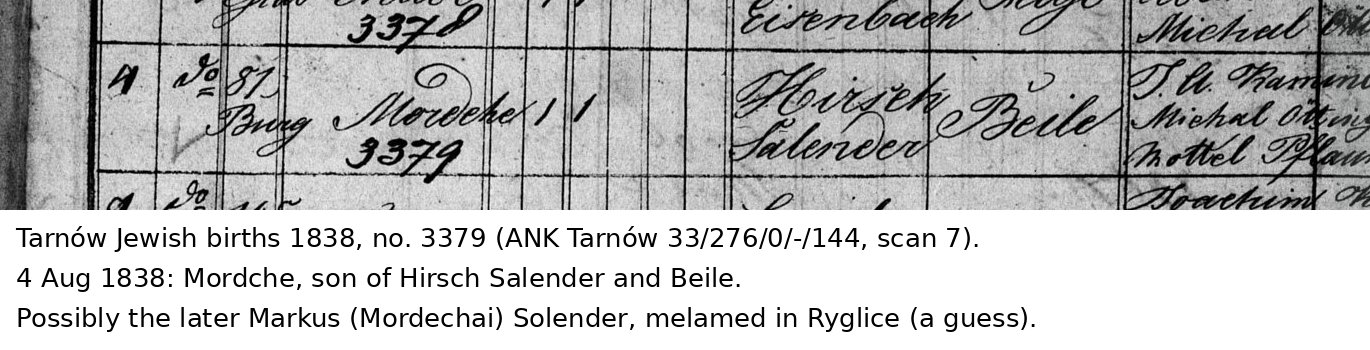
- Hersch Salender of Tarnów and his wife Beile had a son Mordche, born 4 August 1838 (birth entry read), and, by the index, Marjam 1832, Chaje 1834, Frimet 1836 and Jacob 1840. No Yosef and no Chane among them. Confirmedrecord Link to us: Guess
- A Hersch Saalander died in Tarnów on 26 May 1859, aged 60 (born about 1799). The index names his wife as “Riwke”, so he is probably Rywka’s husband above. Probableindex
- Markus Solender, a melamed (private teacher) in Ryglice, and his wife Lea: their son Herz, born about 1858 in Ryglice, married Golde Perl Grzyb in Tarnów on 26 April 1881 (record read). So two Solender households lived in Ryglice in Abraham Chaim’s boyhood. Confirmedrecord
- Our theory, a guess: one Hersch, with wives Beile, Perl and then Rywka, father of Mordche (= Markus?), Jacob, Chane, and perhaps Yosef. It fits the places and the ages. It does not prove anything: no Yosef is in the Tarnów index, Markus named a son Hersch while Hersch was alive, and Chane’s mother was Perl, not Beile. Guess More on Yosef
Jennie’s family, the Scheps of Tarnów
Tarnów had about 11,700 Jews in 1890, 42 per cent of the town; most were Chasidim, many of them Sanzer, and the Tarnów Kloyz was open for learning day and night. Confirmedpublished A Juda Leib Scheps, a porter, son of Szabsa Scheps and Jentel of Dąbrowa, died in Tarnów on 23 August 1898, aged 69. Confirmedrecord Was he Jennie’s father, Yehuda Leib Scheps? It fits: Lew, born 1902, was named Yehuda Leib, so Jennie’s father had died by then. But the death record does not name Brandel Baum, and there were many Juda Leibs. New, 1 Nov: Jennie’s own gravestone calls her the daughter of Yehuda Leib, which fits. And Golda Scheps, née Rosenblum, who died in Tarnów on 9 June 1908 aged 65 at the same house number, is called his widow, so she was most likely his later wife, not Jennie’s mother. He remains a candidate, not proven. Possible (candidate)recordrecord More
- No marriage of Juda Leib Scheps and Brandel Baum is in the indexes (Tarnów, Dąbrowa Tarnowska, Żabno, Brzesko, Nowy Sącz, Kraków, Lwów province). Confirmed (negative)
- The Tarnów Juda Leib had a sister, Sara Nisel Szeps, married to Leib Brand, and four children with Golda Rozenblum, 1882–1894 (Beila, Zysza, Chana, Złata). A first wife Brandel before about 1880 is still possible. Guess (first wife)
- Lead: Lewis Scheps, born in Austria about 1871, lived at 36 Columbia St in 1896, on the same street where Jennie’s son Joseph was born in 1890. His father was Naftali Scheps. A family link to Jennie is a guess. Guess
- Jennie’s ship: not found, after 12 spellings in the New York lists of 1884–1891. Not found
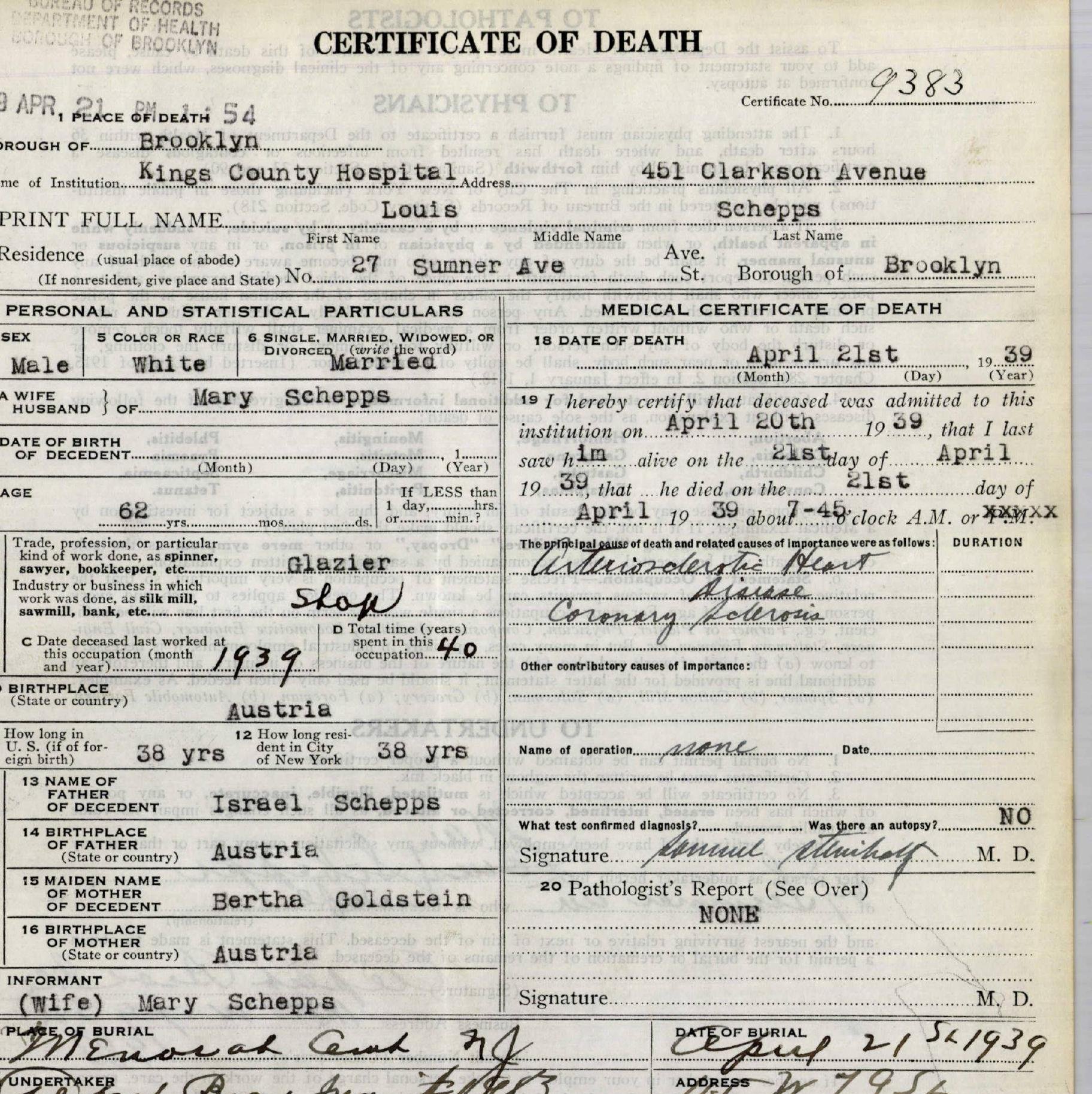
- Louis Sheps (born about 1877 in Austria, came about 1900, wife Mary Goldstein) died in Brooklyn on 21 April 1939 as “Louis Schepps”, a glazier. His death certificate names his father as Israel Schepps, not Juda Leib. Confirmedrecord So Louis was probably not Jennie’s brother. Probable His mother is given as “Bertha Goldstein”, but his wife gave the details and Goldstein was her own maiden name, so that name is shaky.
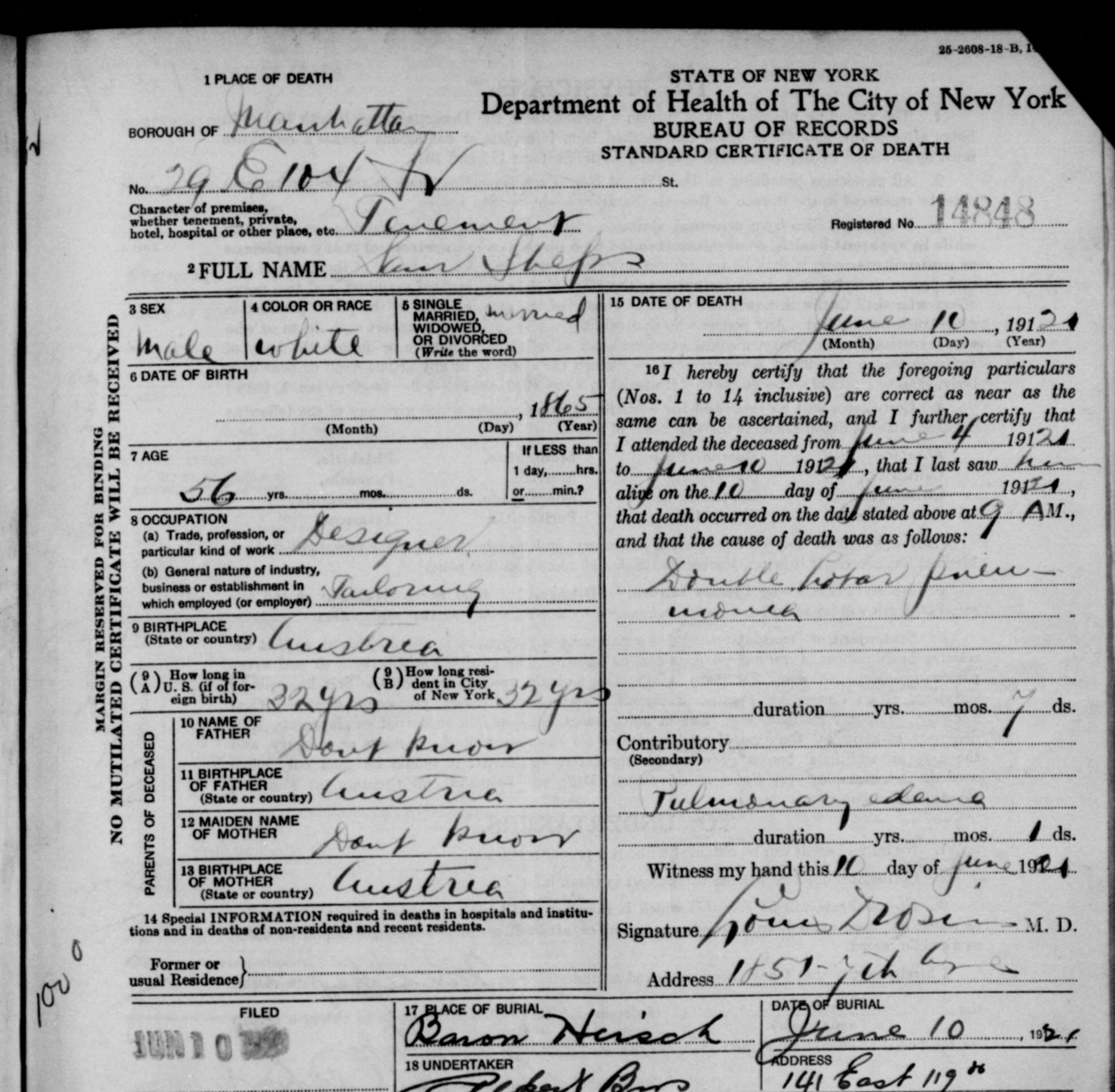
- Sam Sheps was also called Alexander (Sender), born in January 1862 in Austria. He married Ettie Green in the old country about 1886 and came over in 1890, so there is no New York marriage certificate. Confirmedindex He died on 10 June 1921 in Manhattan, a designer in tailoring, buried at Baron Hirsch Cemetery. On his death certificate his father and mother are both “Don’t know”. Confirmedrecord He was about 56 at his death (born about 1865) and had been in America 32 years (since about 1889). New, 1 Nov: a note on the second page of the same certificate gives his mother’s first name as Sarah. Jennie’s mother was Brandel (or Breindel), so Sam was not Jennie’s full brother; a half-brother or cousin is still possible. Confirmed (record seen)record
- His family, from the 1900 and 1920 census sheets and his children’s records: his wife Ettie (Ettel) Green, who died in 1913, and their children Morris (born in Austria in 1887), Jack (1901), George (1903), Bessie (died a baby in 1904), Louis (1906) and Anna (1908). Confirmedrecordrecord
- Baby Berdie (Bertha, “Brandel”) Sheps, who died in 1904, was probably named for Louis’s own mother Bertha, not for Jennie’s mother Brandel. Guess

A Leder from Ryglice on Lewis Street
- Chaje Gittel Leder, 15, single, last home Ryglice, sailed from Rotterdam on the SS Statendam and landed at Ellis Island on 22 December 1901. She was going to her cousin “S. Leder, 59 Lewis St, New York”. Confirmedrecord Her passage was paid by her sister. Confirmedrecord
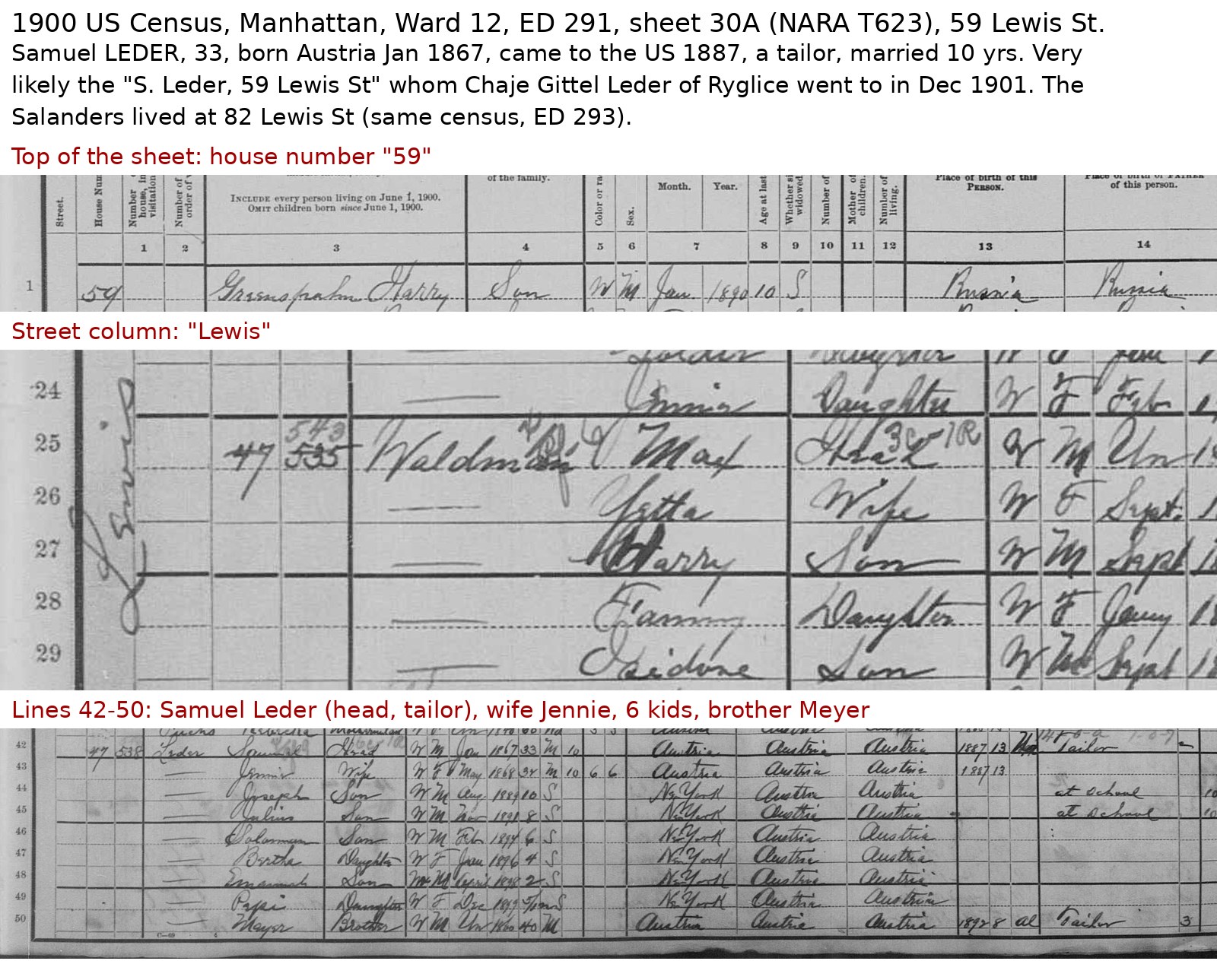
- In the 1900 census, Samuel Leder lived at 59 Lewis Street. He was born in January 1867 in Austria, came to America in 1887 (the same year as Abraham Chaim) and was a tailor (like Abraham). With him were his wife Jennie (maiden name probably Yust), six children born in New York, Joseph, Julius, Solomon, Bertha, Emanuel and Pepi, and his brother Meyer Leder, also a tailor. Confirmedrecord
- He was the only Leder at 59 Lewis Street, so he is very likely the “S. Leder” Chaje Gittel came to. Probable
- The Salanders lived at 82 Lewis Street in the same census, two doors away, and Abraham’s tailor shop was at 91 Lewis. Abraham’s mother was Basche Leder.
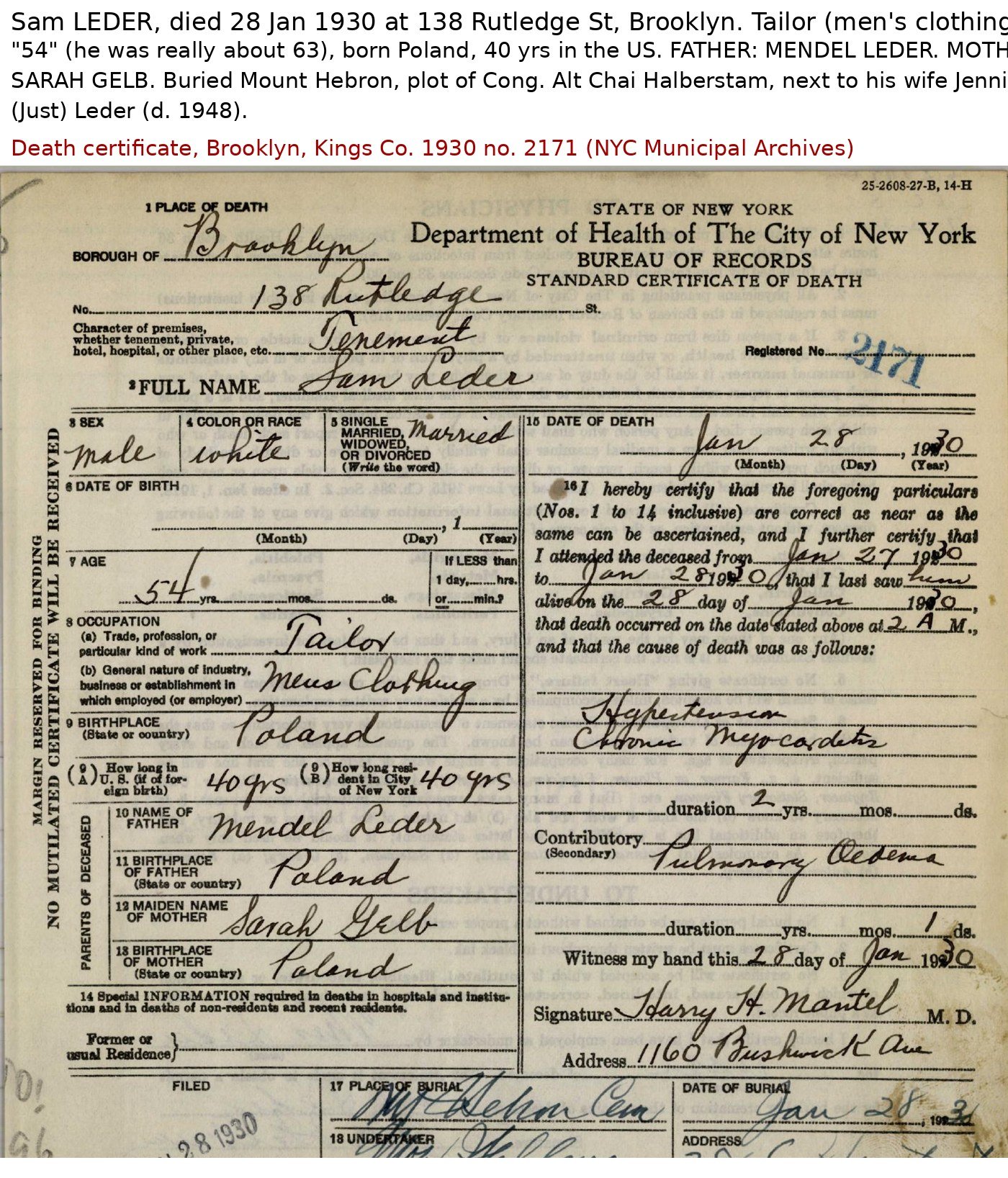
- Samuel died on 28 January 1930 in Brooklyn and is buried at Mount Hebron Cemetery, Queens, beside his wife Jennie. Confirmedrecordindex
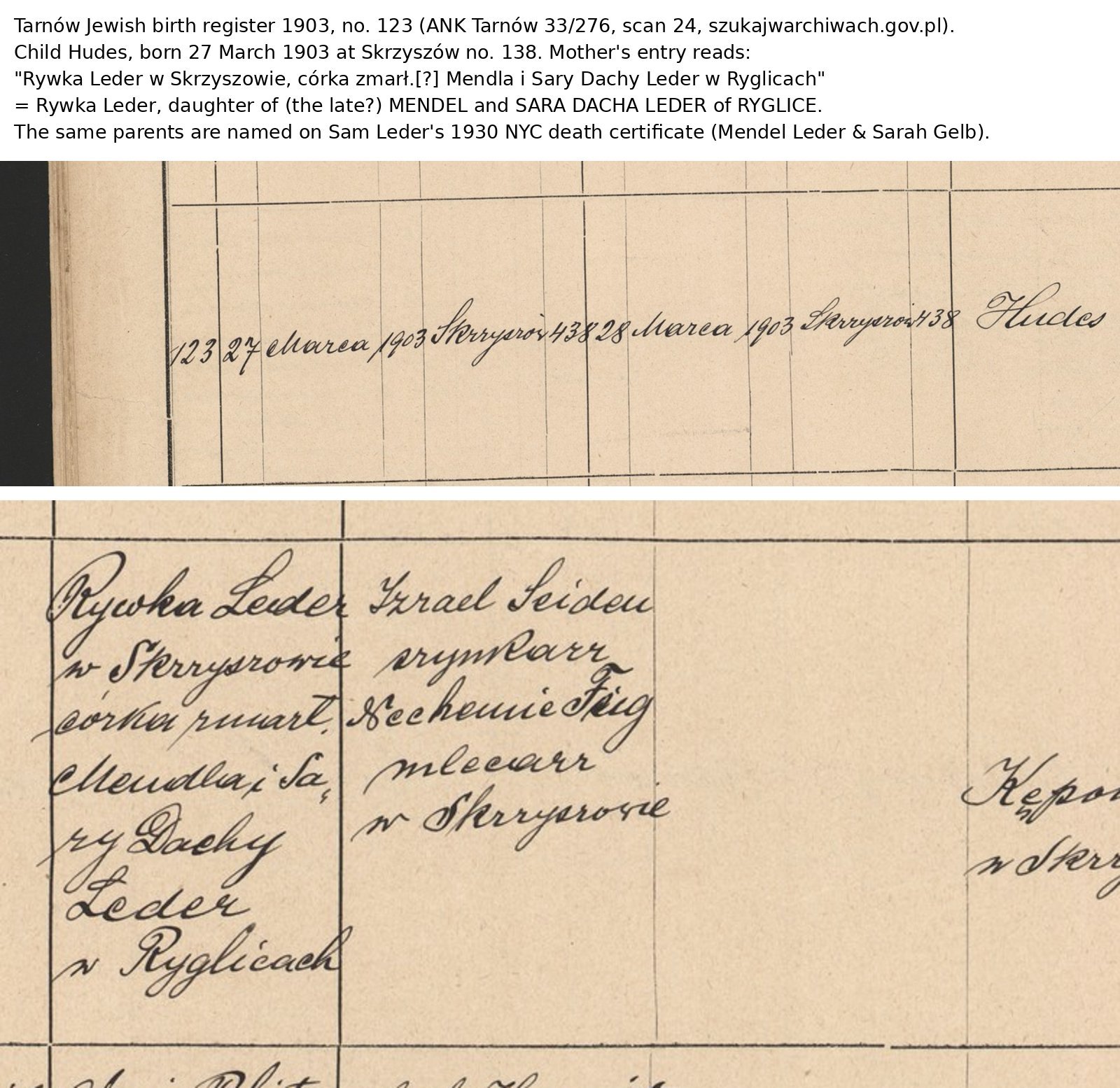
- A 1903 Tarnów birth record names Rywka Leder as the daughter of Mendel and Sara Dacha Leder of Ryglice. Confirmedrecord
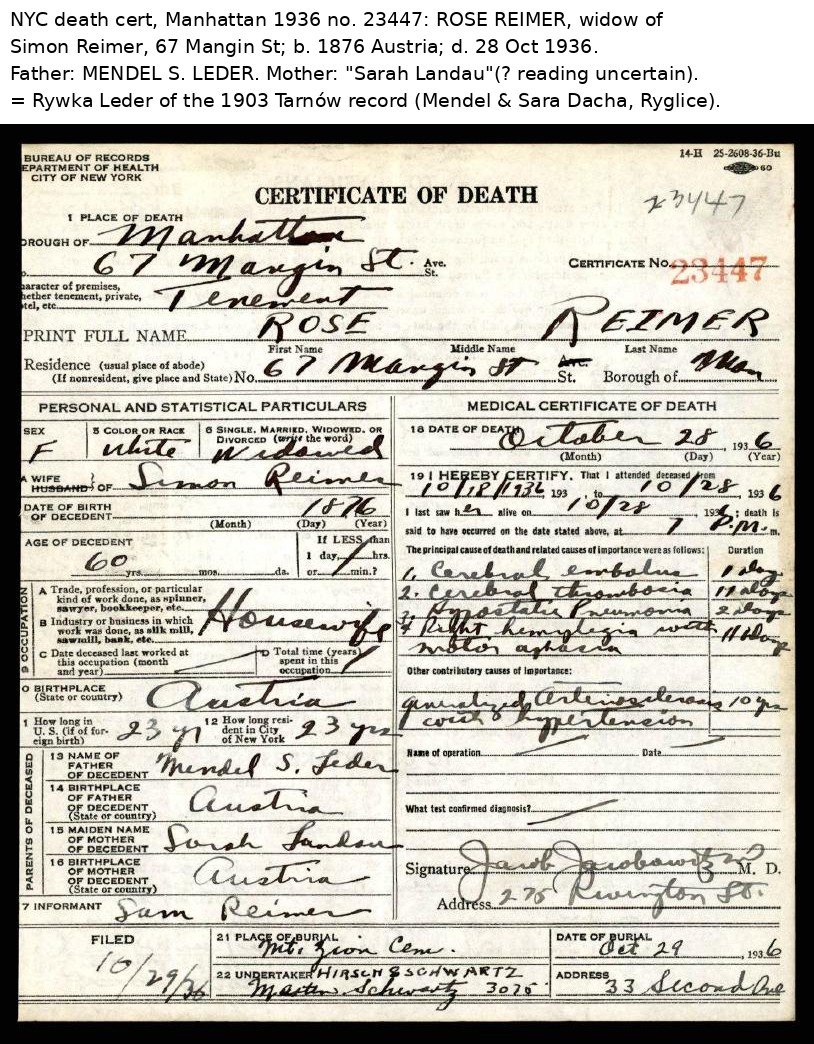
- Rywka came to New York as Rose Reimer and died in 1936. Her death certificate names her father as Mendel Leder. Confirmedrecord
- Samuel was a son of Mendel and Sara Dacha Leder. Guessrecord
- Samuel was close kin to Mendel’s family: an uncle, a cousin or a half-brother. Probable Why only “close kin”: the parents on his 1930 death certificate, and its age of 54, match the younger Samuel Leder (below) exactly, so the informant may have given the younger man’s details.
- So Samuel was not Abraham Chaim’s brother. Abraham’s father was Yosef. Probable
- Mendel may have been a brother of Basche Leder. That would make Samuel Abraham’s first cousin, and explain why a Ryglice girl called him “cousin”. Guess
- Sara’s maiden name: Gelb on Samuel’s certificate, Landau on Rose’s. Open
- The Riemers married into both Leder families: Rose married Simon Riemer, and Samuel’s daughter Julia married Israel Riemer in 1912. How the two Riemers were related is unknown. Guessindex

Two Samuel Leders (and a third)
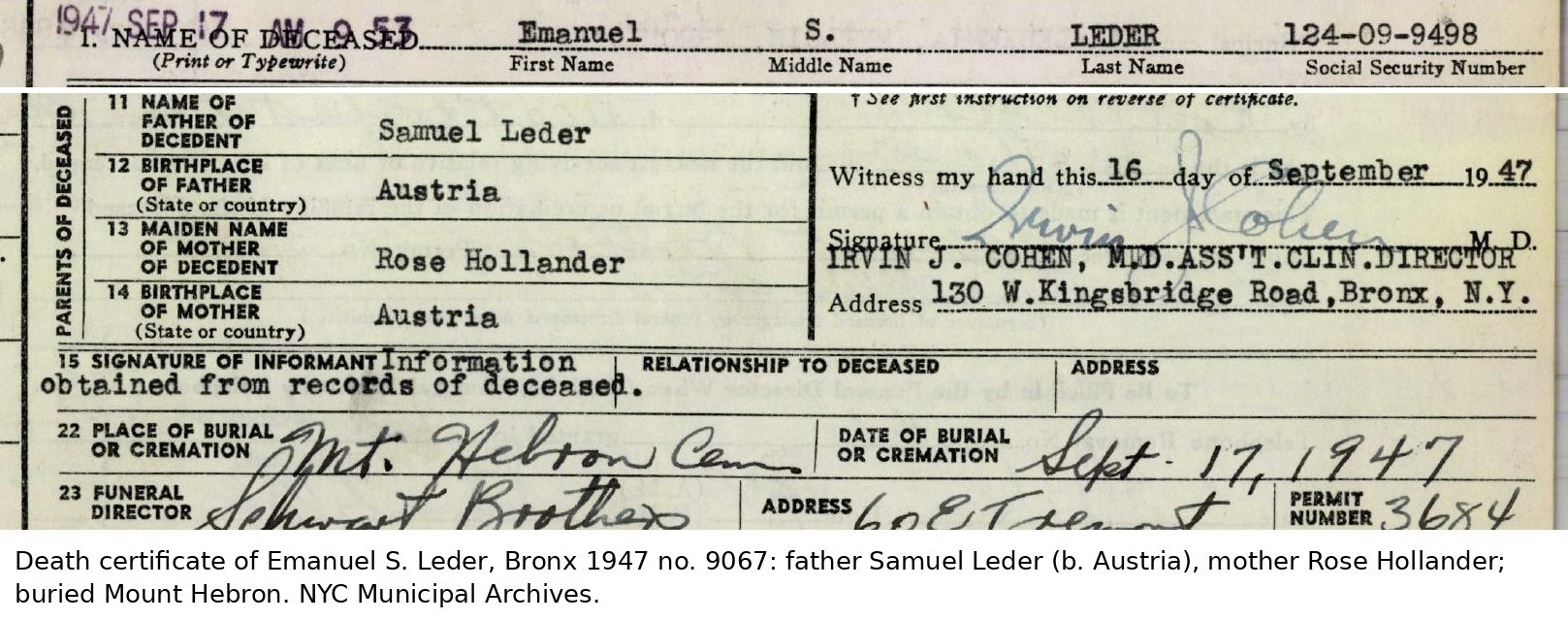
- A second Samuel Leder died on 15 September 1950 and is buried in the same Alt Chai Halberstam society plot at Mount Hebron, beside his wife Rose (née Hollander). Our Samuel (died 1930) lies a few rows away beside Jennie. Confirmedindexrecord
- Their son Emanuel S. Leder (1917–1947), a WWII veteran, has a death certificate naming his parents as Samuel Leder and Rose Hollander. That proves the 1950 Samuel was a different man from Jennie’s husband. Confirmedrecord
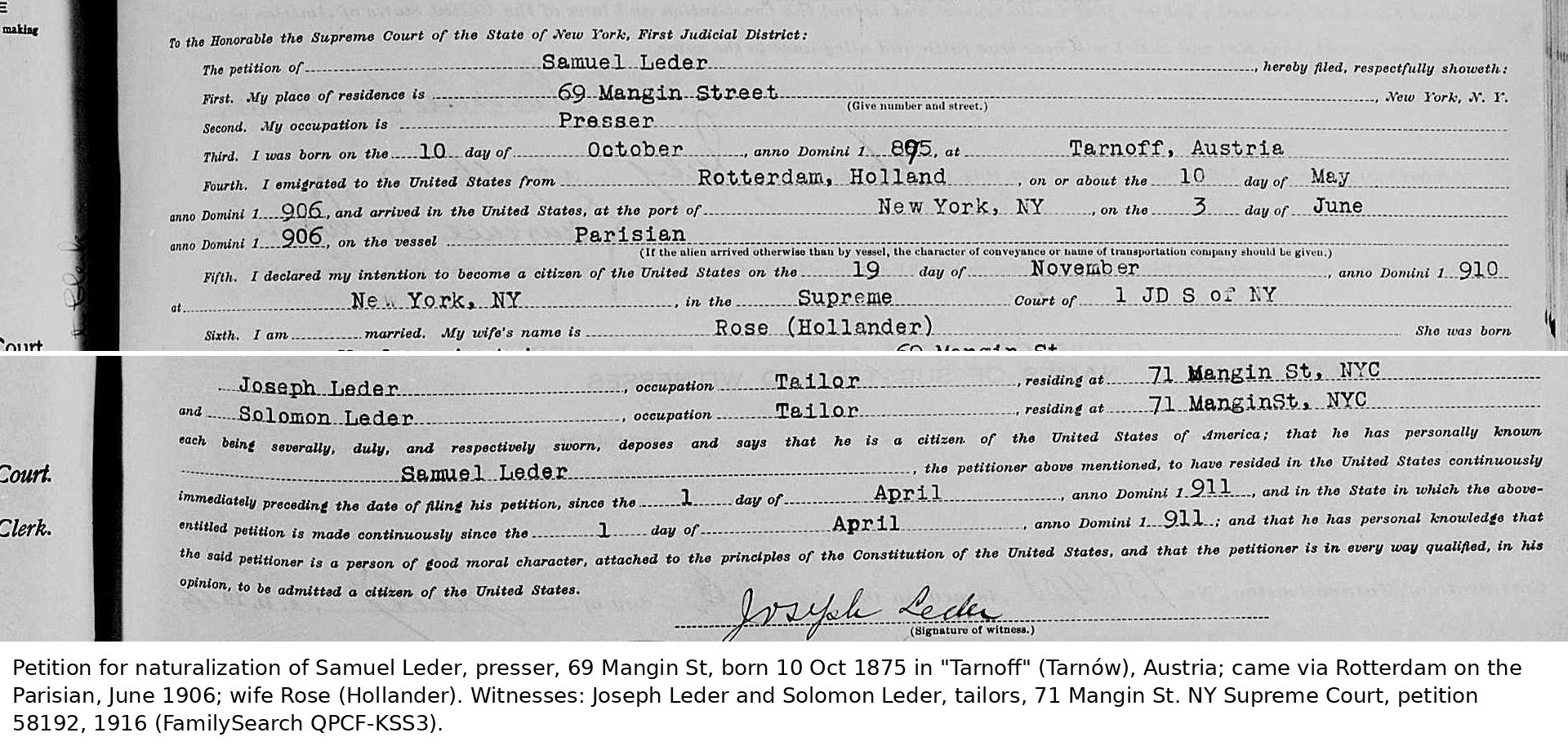
- The younger Samuel’s naturalization (1916): born in Tarnów (1875 per the index), came in 1906 by way of Rotterdam, a presser living at 69 Mangin St. His two witnesses were Joseph and Solomon Leder, tailors, of 71 Mangin St. Confirmedrecord
- The witnesses were our Samuel’s sons Joseph (b. 1889) and Solomon (b. 1894). Probable
- The younger Samuel and Rose Reimer (Rywka) were brother and sister, children of Mendel and Sara Dacha Leder: both were born about 1875–76, and his 1936 Social Security entry names “Mendel Z. Leder & Sara D. Gelb”. Probable
- One block of Leders on Mangin Street, Lower East Side: Rose at 67, the younger Samuel at 69, the Leder witnesses at 71. On the map
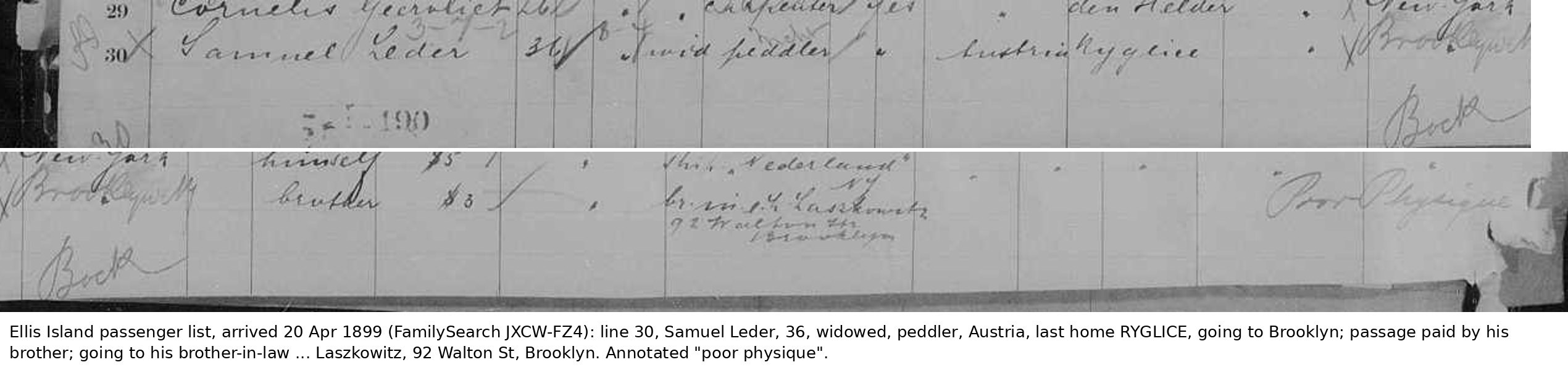
- On 20 April 1899 a Samuel Leder, 36, widowed, a peddler from Ryglice, landed at Ellis Island, his passage paid by his brother. He was going to his brother-in-law Laszkowitz, 92 Walton St, Brooklyn. Confirmedrecord
- He is not our Samuel, who had been in New York since 1887 and was married.
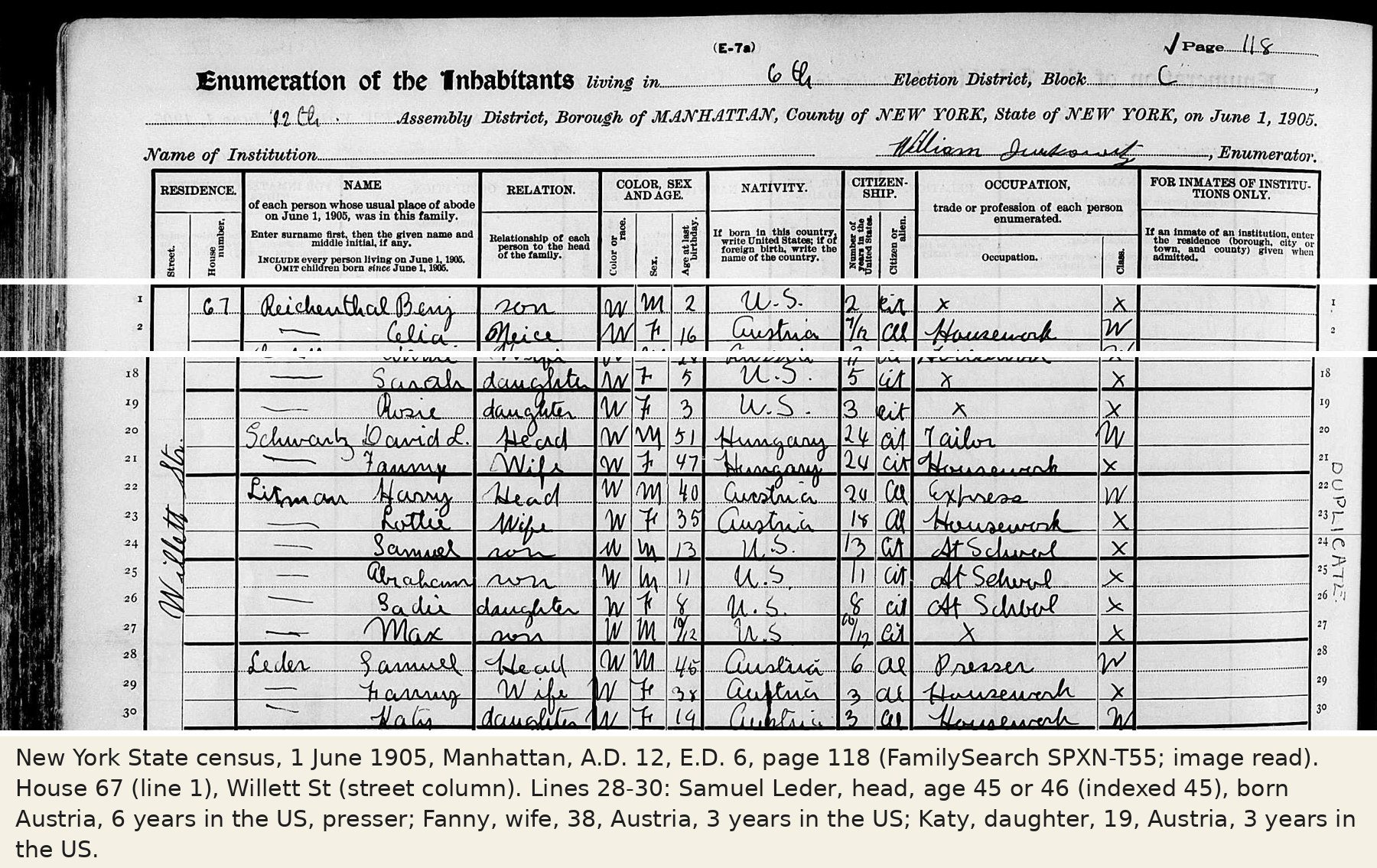
- In the 1905 New York State census, a Samuel Leder, 45, a presser, about 6 years in America, lived at 67 Willett St with his wife Fanny, 38, and daughter Katy, 19; both had been in America about 3 years. Confirmedrecord
- That this Samuel is the 1899 widower from Ryglice (the arrival year fits; he had remarried) Guess
- That Katy is Chaje Gittel: a weak guess, since Chaje Gittel’s ticket was paid by her sister, not a father. Guess
Still open: Yosef Solender’s father; Naftali Leder’s death; the rov of Rzepiennik; Samuel Leder’s headstone at Mount Hebron; how our Samuel was related to Mendel; Sara Dacha Leder’s maiden name (Gelb or Landau). See Open questions.
Abraham’s brothers Max and Moritz, who went first
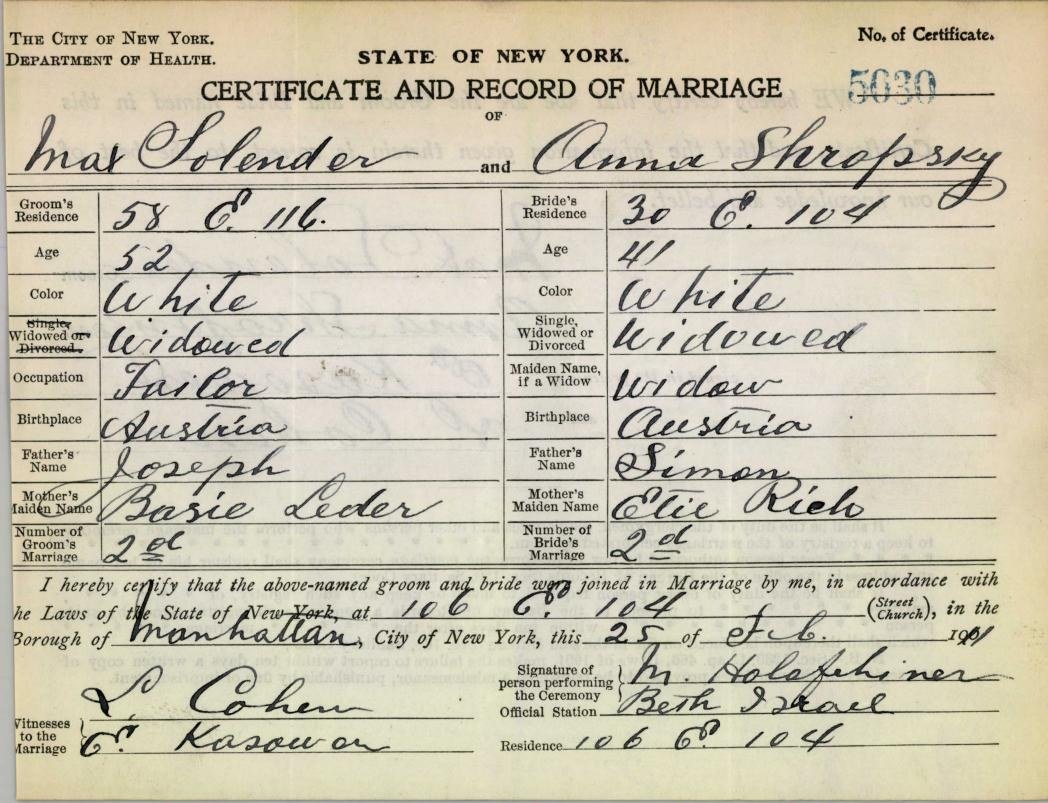
A New York marriage certificate of 1911 names the same parents as Abraham Chaim’s own wedding record: Joseph Solender and Basie (Basche) Leder. The groom was Max Solender, 52, a widowed tailor living at 58 East 116th Street, marrying a widow, Anna Shropsky. Confirmedrecord So Max was almost certainly Abraham’s older brother. Probable
- He came to America in 1880, alone, a married man; his wife Sarah (Sadie) Unger followed in 1883 with their baby Joseph, born in Austria in January 1882. In 1900 the family lived on the Lower East Side; Max was a presser, and the children were Joseph, Annie (1886), Samuel (1888) and Harry (1891). Confirmedrecord
- So Max came about seven years before Abraham and was the first of the brothers to leave. Confirmed In 1900 he was probably still not a citizen (the census mark looks like “Al”, alien). Guess
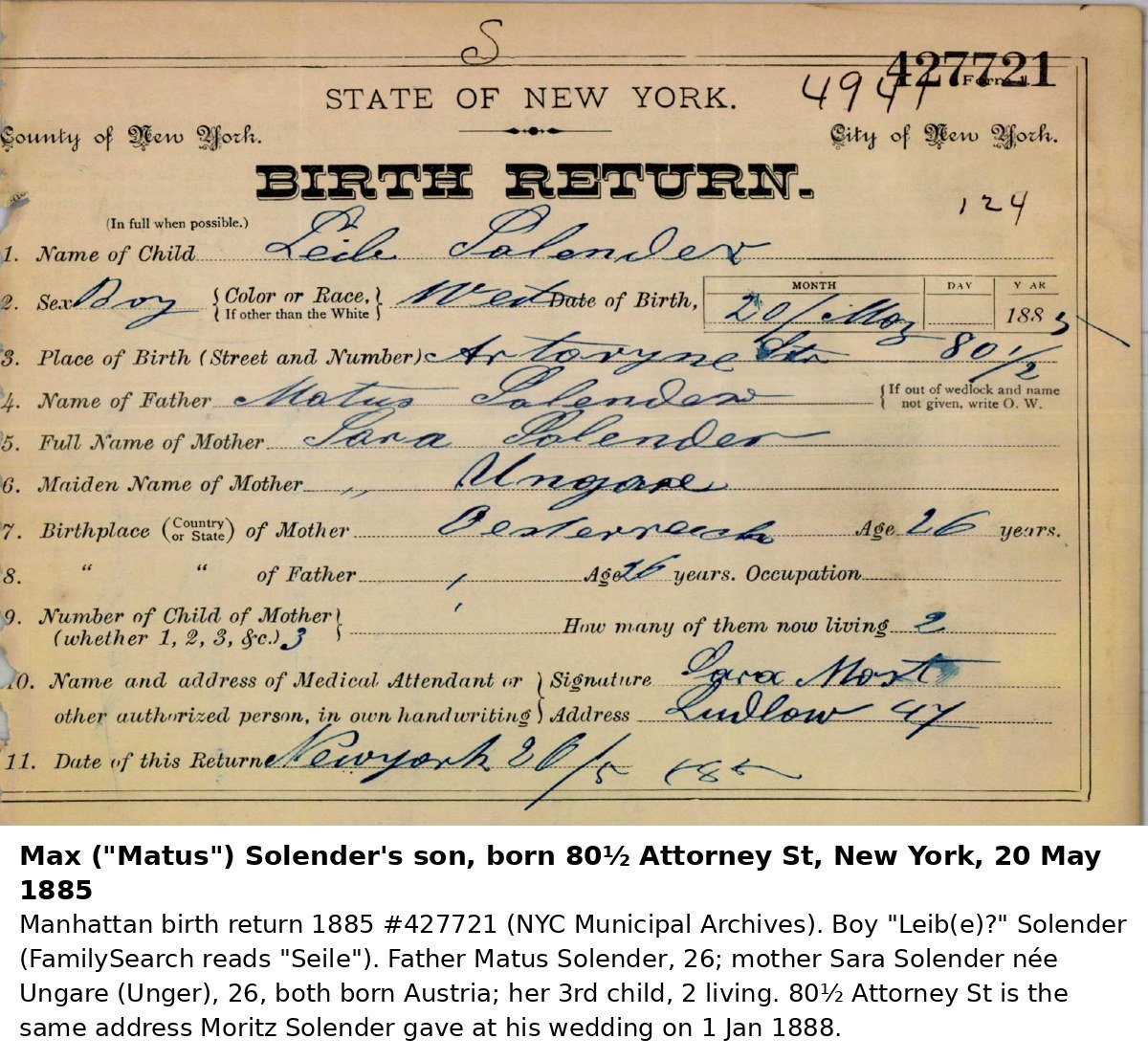
- A birth record of 1885 calls him Motus, a Yiddish form of Mordechai. Harry Lawrence later used the middle name Lawrence. Confirmedindex
- On 20 May 1885 a son was born to “Matus” Solender and Sara née Unger at 80½ Attorney Street on the Lower East Side. Confirmedrecord
- A first son named Joseph in 1882 suggests their father Yosef had died by then, since Ashkenazi Jews name babies after the dead. Guess
- That Max helped bring his younger brother over Guess
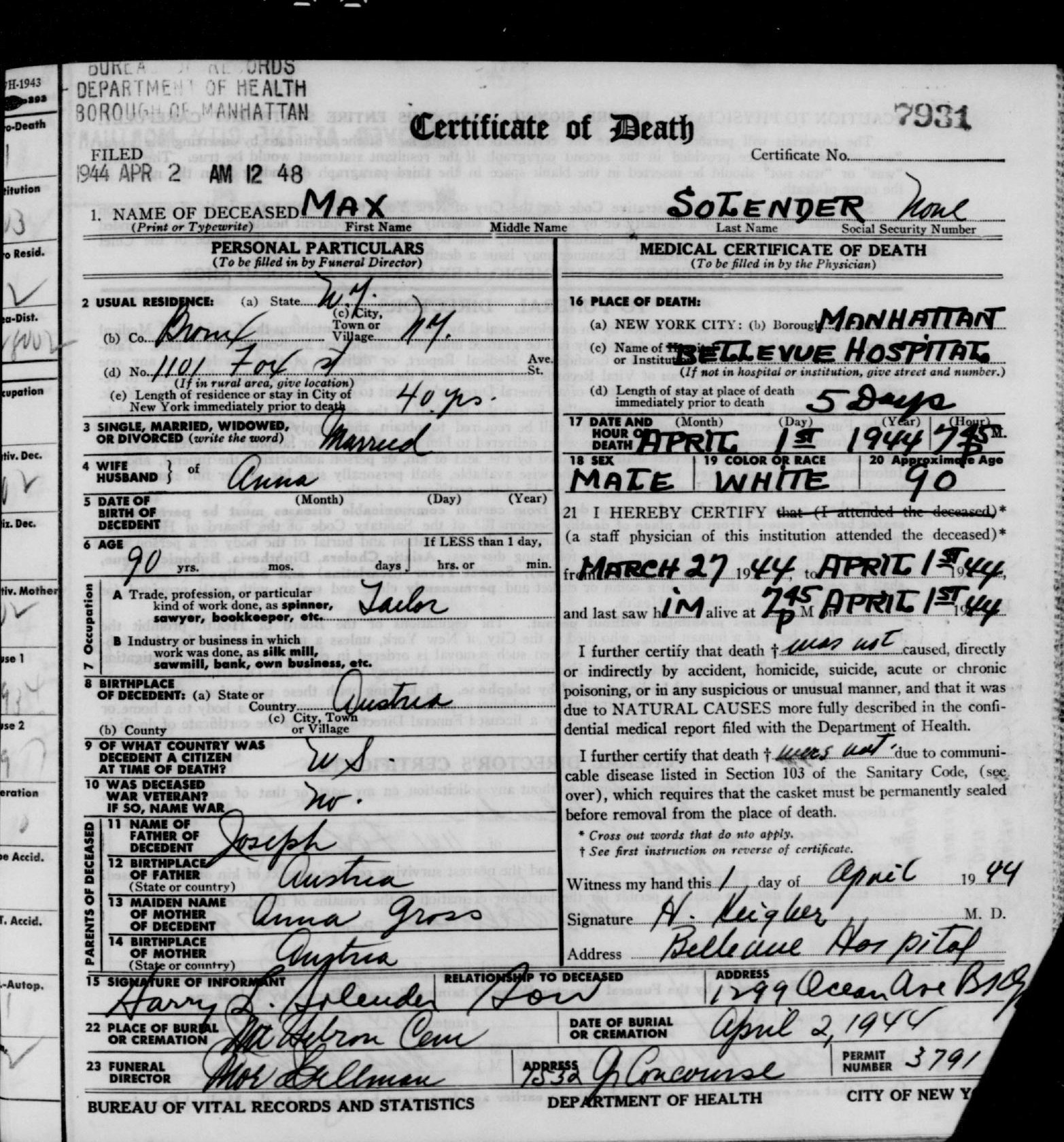
- He died on 1 April 1944, aged about 90, a tailor living at 1101 Fox Street in the Bronx, and was buried at Mount Hebron, Abraham’s cemetery. Confirmedrecord
- New, 1 Nov: At Mount Hebron he lies in the plot of the Bnei Rappaport Anshe Dombrowa society, the burial society of people from Dąbrowa Tarnowska, by the cemetery’s interment record. Confirmedrecord
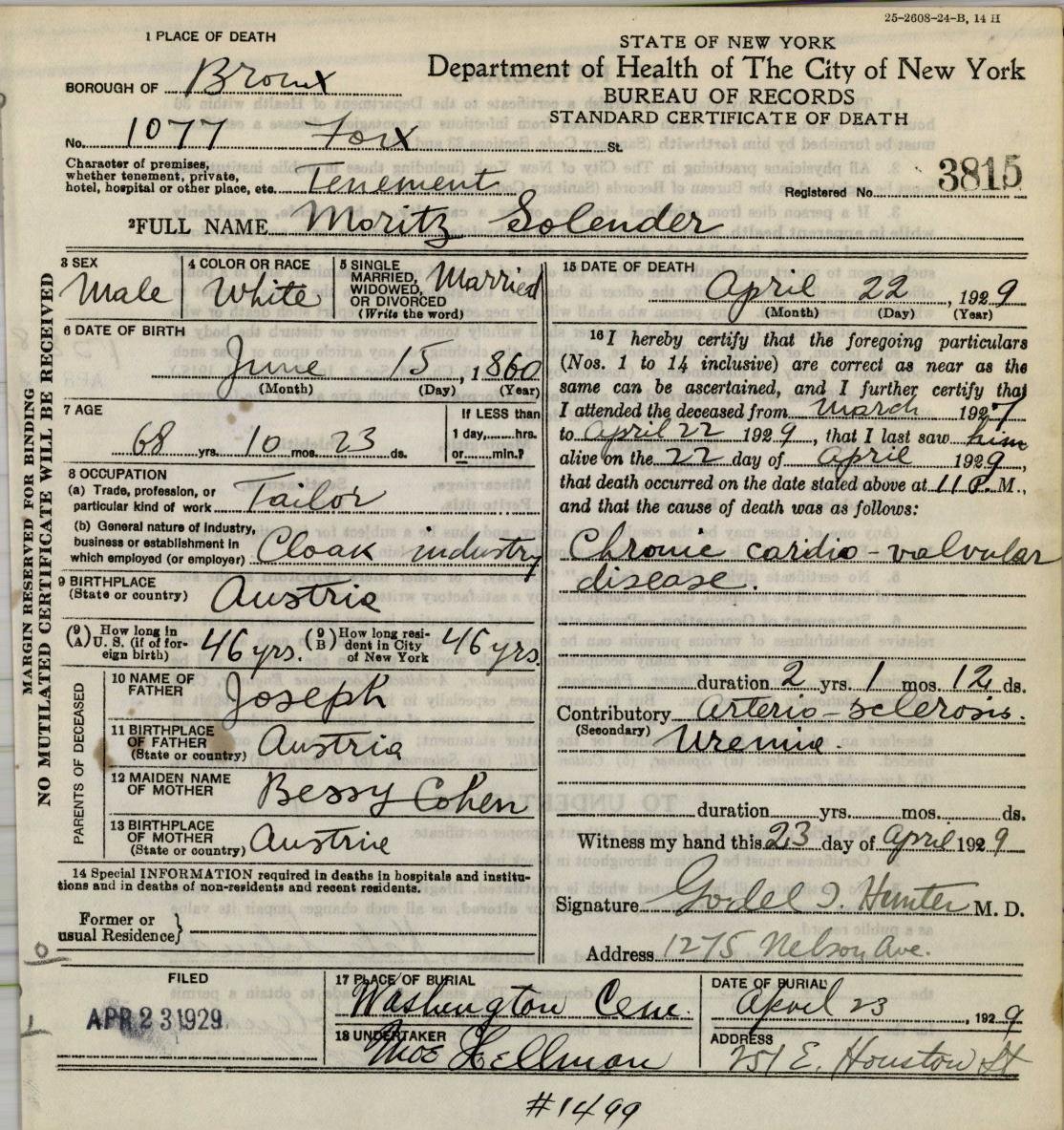
- Moritz, his wife Kate and a Joseph and Sarah Solender lie in the same society’s plot at Washington Cemetery in Brooklyn. Two brothers in Dąbrowa society plots is a hint that the family came by way of Dąbrowa Tarnowska, about 25 km north of Tarnów. A hint, not proof. Possible (hint)index
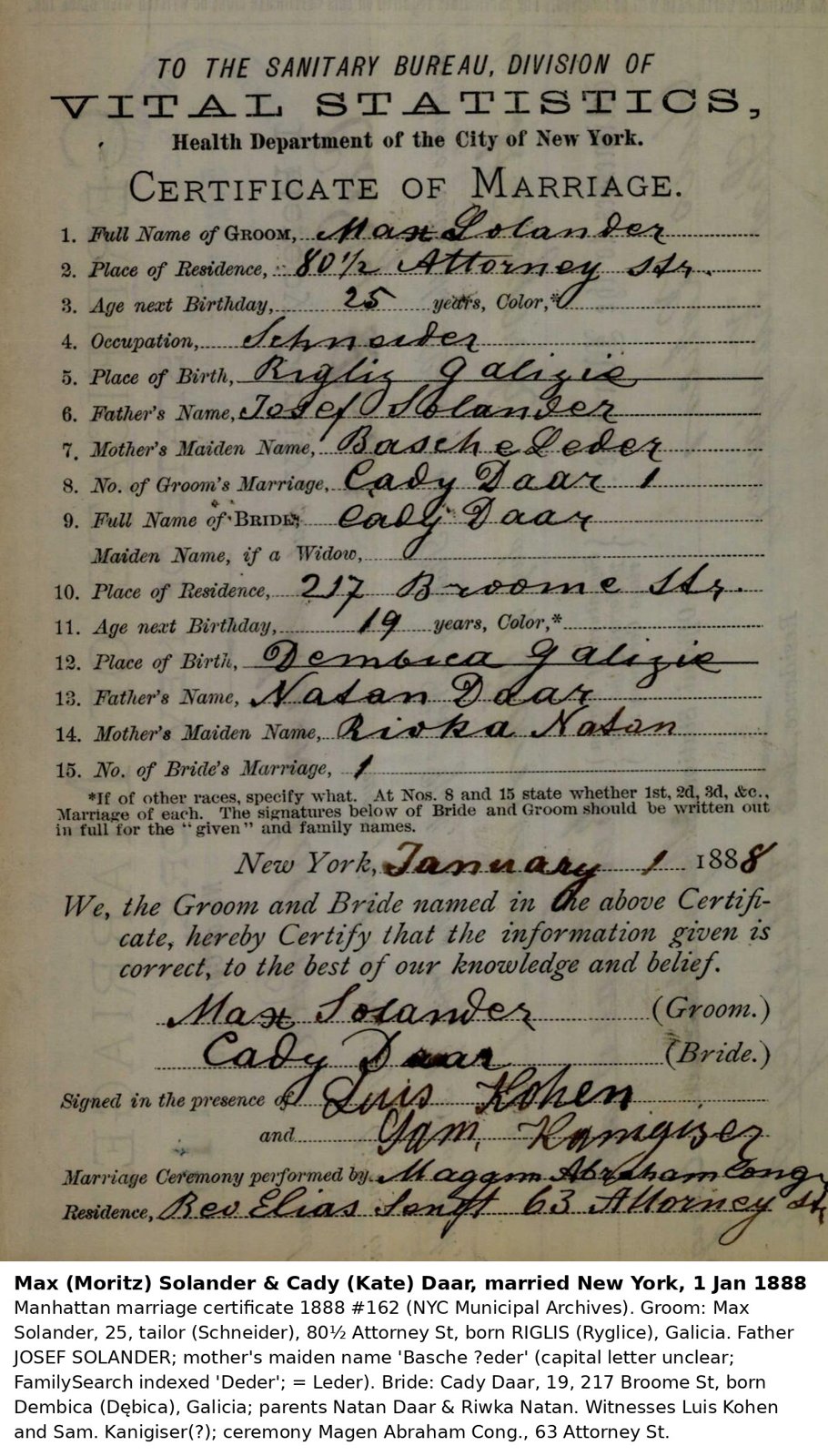
- His wedding record settles it. On 1 January 1888 “Max Solander”, 25, a tailor of 80½ Attorney Street, born in Ryglice, married Cady (Kate) Daar, 19, from Dębica. His parents: Josef Solander and Basche Leder, the same as Abraham’s. Confirmedrecord
- So Moritz was Abraham’s brother. Probable
- 80½ Attorney Street is the same address where Max’s son was born in 1885, so the two brothers lived in the same building. Confirmed
- The “Cohen” on his 1929 death certificate, given by his widow, was a mistake. One of the 1888 witnesses was a Luis Kohen, which might be where it came from. Guess
- A tailor born about 1860–63, in America since about 1883. He died at 1077 Fox Street in the Bronx on 22 April 1929. Confirmedrecord
- He came to America in 1882, two years after Max. In the 1900 census he was a cloak presser on Pitt Street, still an alien, married 13 years to Katie, with Sadie (1889), Solomon (1890) and Nathan (1892). The census indexed the name as “Sarlemder”. Confirmedrecord
- Wife Kate (Daar); children Sadie, Nathan and Charles, all born in New York around 1888–96. The “Solomon” of 1900 is probably Charles S. Guess
- In the 1920 census Moritz (listed as Max Solender, 58, of New York City) told the census taker he came in 1883 and became a citizen in 1887; his wife Katie is marked a citizen too. Earlier censuses (1900, 1910) called him an alien, so the 1887 date is Probable at best, and his court papers have not been found. Probable

One after another: Max came first. He probably landed in New York on 16 August 1883, on the S.S. India from Hamburg (below). Probablerecord In 1894 he swore it was August 1877, and the 1900 census says 1880. Confirmedrecord Moritz came in 1882 or 1883, and Abraham in May 1886 by his naturalization card (other records say 1887). Confirmedrecord
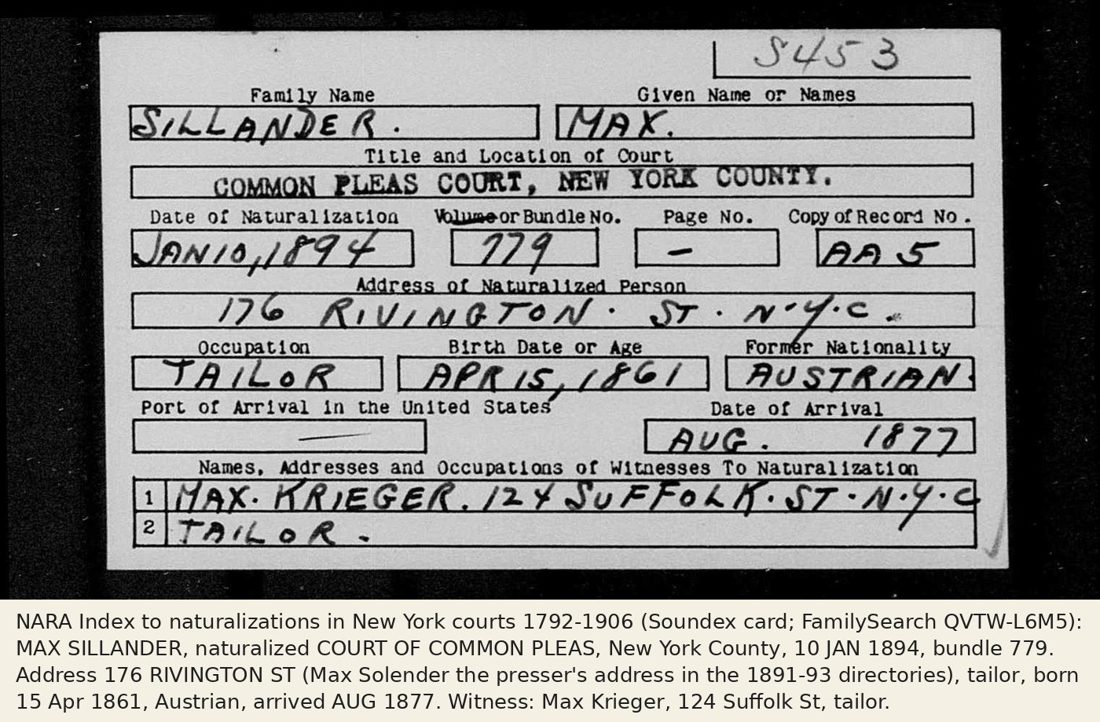
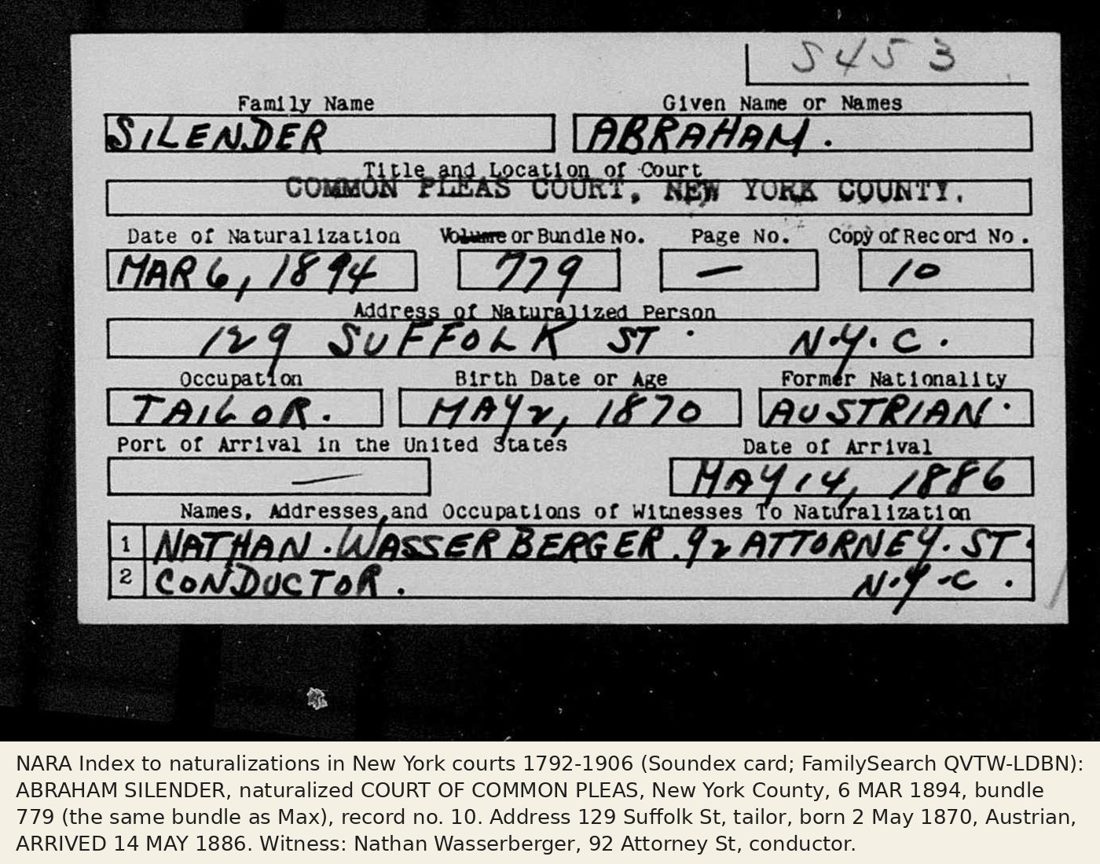
Side by side in court, 1894: filed under “Sillander” and “Silender”, which is why they were missed before, Max and Abraham were naturalized in the same court, the New York Court of Common Pleas, eight weeks apart, and their papers sit in the same bundle, no. 779. Confirmedrecord
- Max, 10 January 1894: “Max Sillander”, tailor, 176 Rivington St, born 15 April 1861 in Austria, arrived August 1877. Confirmedrecord 176 Rivington was Max Solender the presser’s address in the 1891–94 directories, so this is our Max. Probable
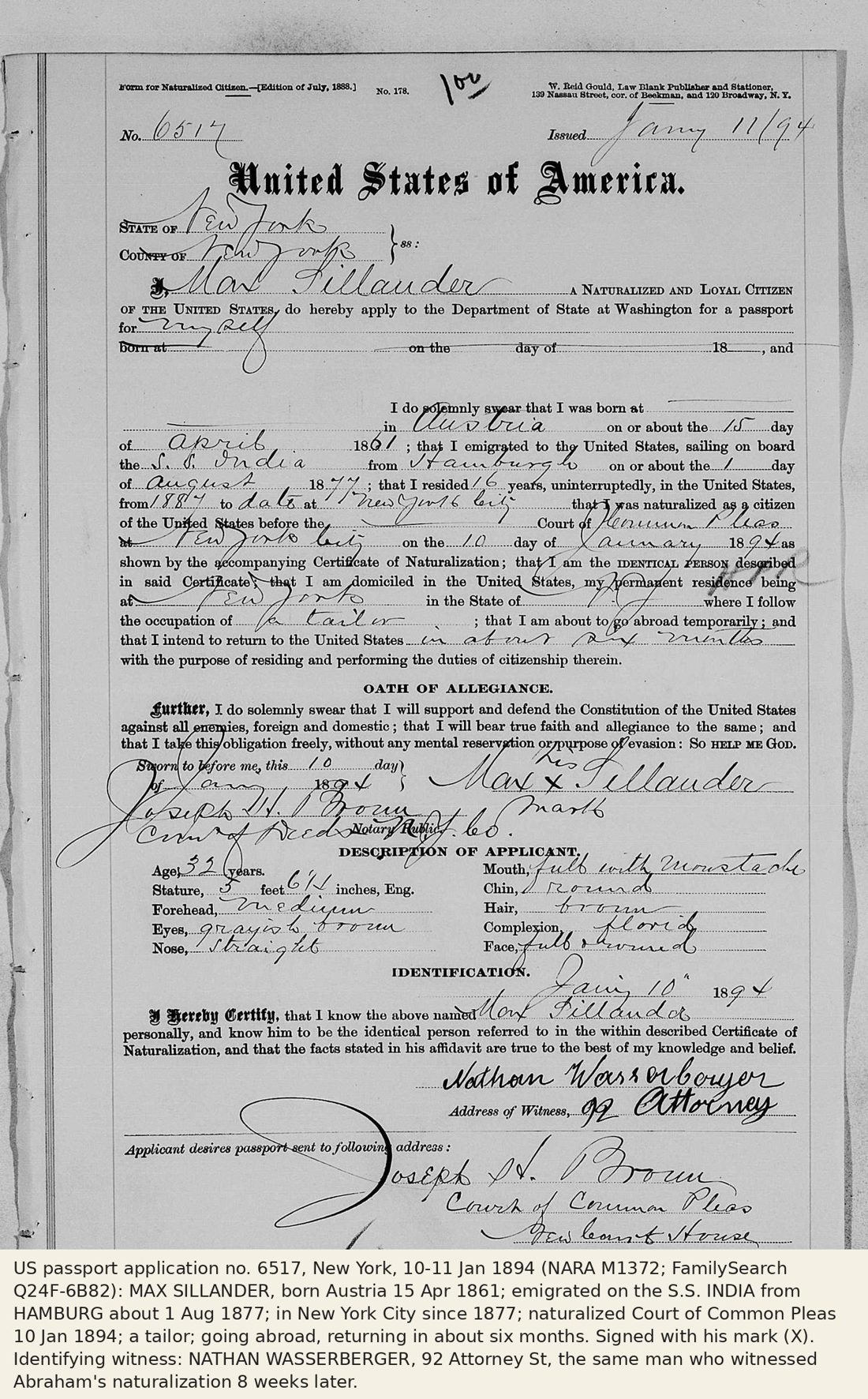
- Max’s passport, the next day: he applied for a US passport to go abroad for about six months. He swore he had sailed on the S.S. India from Hamburg about 1 August 1877, and he signed with his mark, an X. Confirmedrecord Where he went is not on the form; back home to Galicia is a guess. Guess
- Abraham, 6 March 1894: “Abraham Silender”, tailor, 129 Suffolk St, born 2 May 1870, arrived 14 May 1886. This is the citizenship the Supreme Court later cancelled over his age. Confirmedrecord
- The same witness: Nathan Wasserberger of 92 Attorney St, a conductor, vouched for Max on his passport and for Abraham in court. It is the first record that puts the two brothers side by side. Confirmedrecord
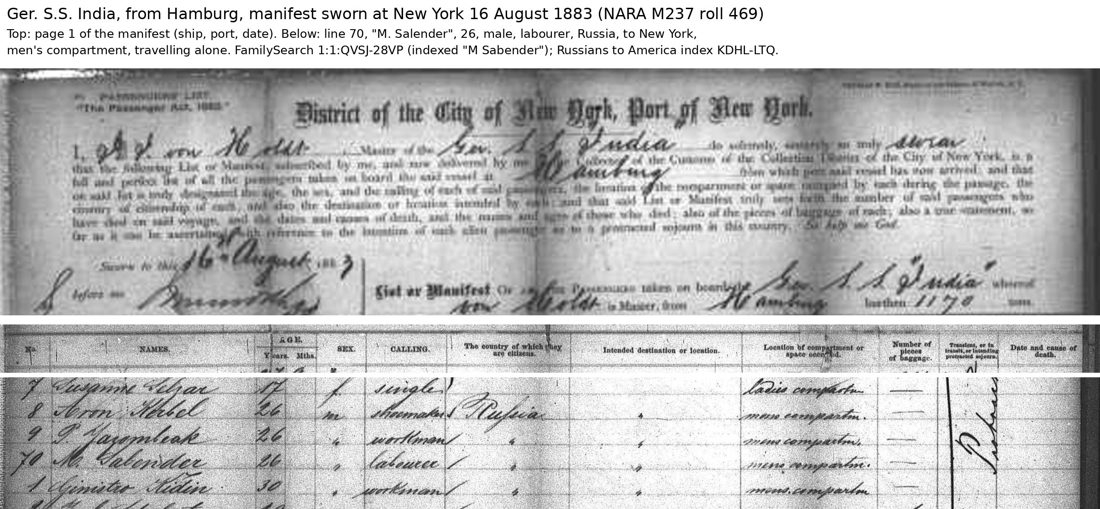
The S.S. India, August 1883: the ship Max named in 1894 is found, but in 1883, not 1877. On the S.S. India from Hamburg, which reached New York on 16 August 1883, line 70 is “M. Salender”, 26, a labourer, travelling alone. Confirmedrecord That he is our Max is probable: same ship, same port, same month as his sworn story. Probable
- Why 1883 fits: his son Joseph was born in Austria in January 1882, so Max was still in Galicia in 1881. The age, 26, fits his census birth year of 1855–57 better than the 1861 on his papers. No S.S. India reached New York in 1875–79 at all; that ship’s Hamburg crossings run from 1882 to 1887. Probablerecord
- Why he might have said 1877: in 1894 an immigrant who had arrived under 18 could become a citizen without filing first papers years before. Max swore to birth in 1861 and arrival in 1877, making him 16 on arrival; Abraham, eight weeks later, swore to birth in 1870 and arrival in 1886, also exactly 16. Both dates may have been shaped to fit that rule. Guess
- Could it be Moritz? He also came about 1883, and the list gives only “M.”. His age (25 at his 1888 wedding) fits less well, and the India is Max’s own ship, so Max is the better match. Guess
- Still not found: Max’s return from his 1894 trip (not in the Ellis Island index under any spelling tried), and a ship for Abraham on 14 May 1886 (the Ems from Bremen landed that day and the Wieland from Hamburg the next; neither has a Solender in the index). Open
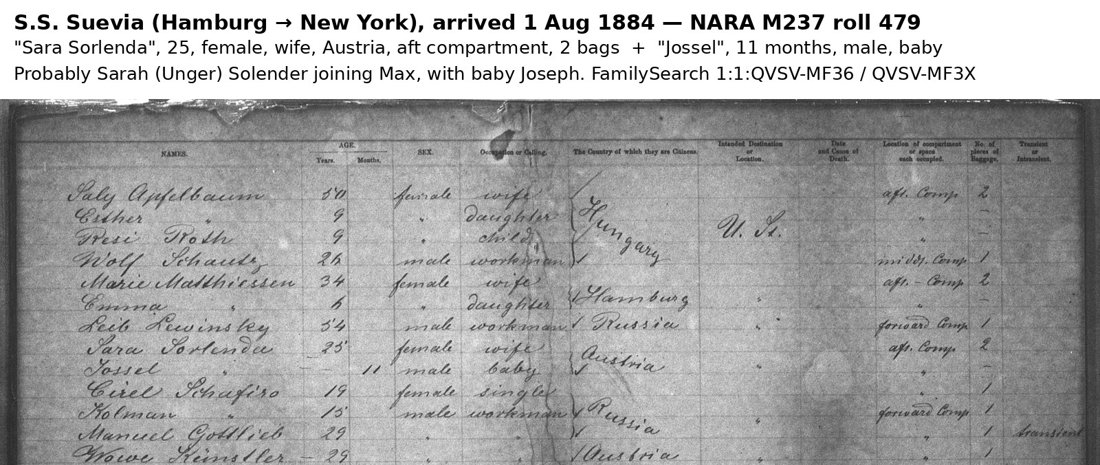
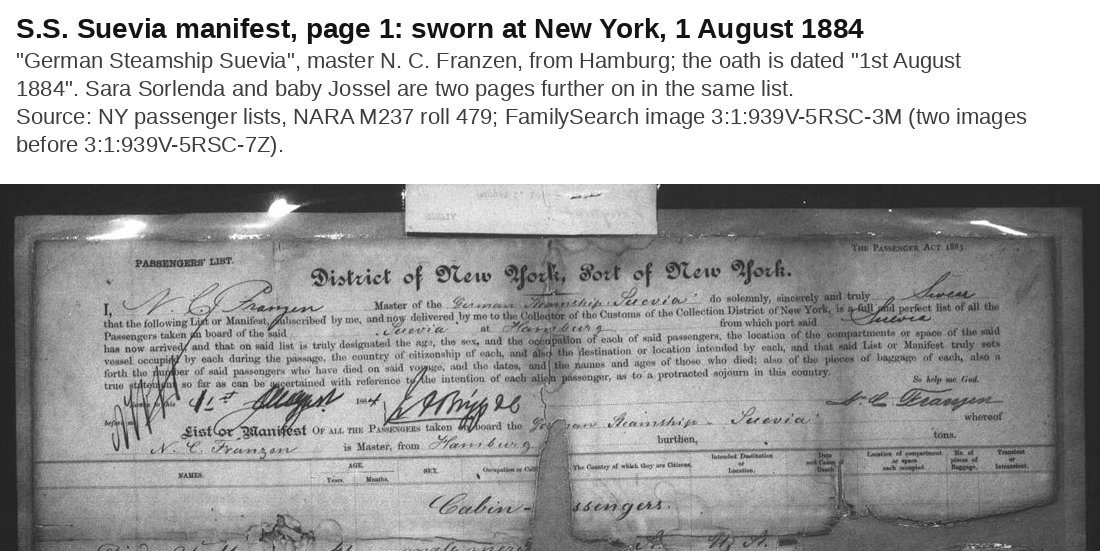
Sarah and baby Joseph follow, August 1884: a year after Max, on the S.S. Suevia from Hamburg, which reached New York on 1 August 1884, the list has “Sara Sorlenda”, 25, a wife from Austria, travelling with “Jossel”, a baby, and no husband. Confirmedrecord That they are Sarah (Unger) Solender and her son Joseph is probable. Probable
- Why it fits: she is 25 here and 26 on the May 1885 birth return; her 1910 death certificate says 26 years in the United States, which is 1884; “Jossel” is the Yiddish form of Joseph; and by May 1885 she and Max were at 80½ Attorney St. The 1900 census said 1883. Probable
- The baby’s age: the list says 11 months, but Joseph was born in January 1882, so he was about two and a half. Families often gave a child’s age as under one, because infants travelled almost free; a clerk’s mistake is also possible. Guess
- Why it was missed: the index spells the name “Sorlenda”; it turned up only by searching one ship at a time for a baby named Josef. Confirmed
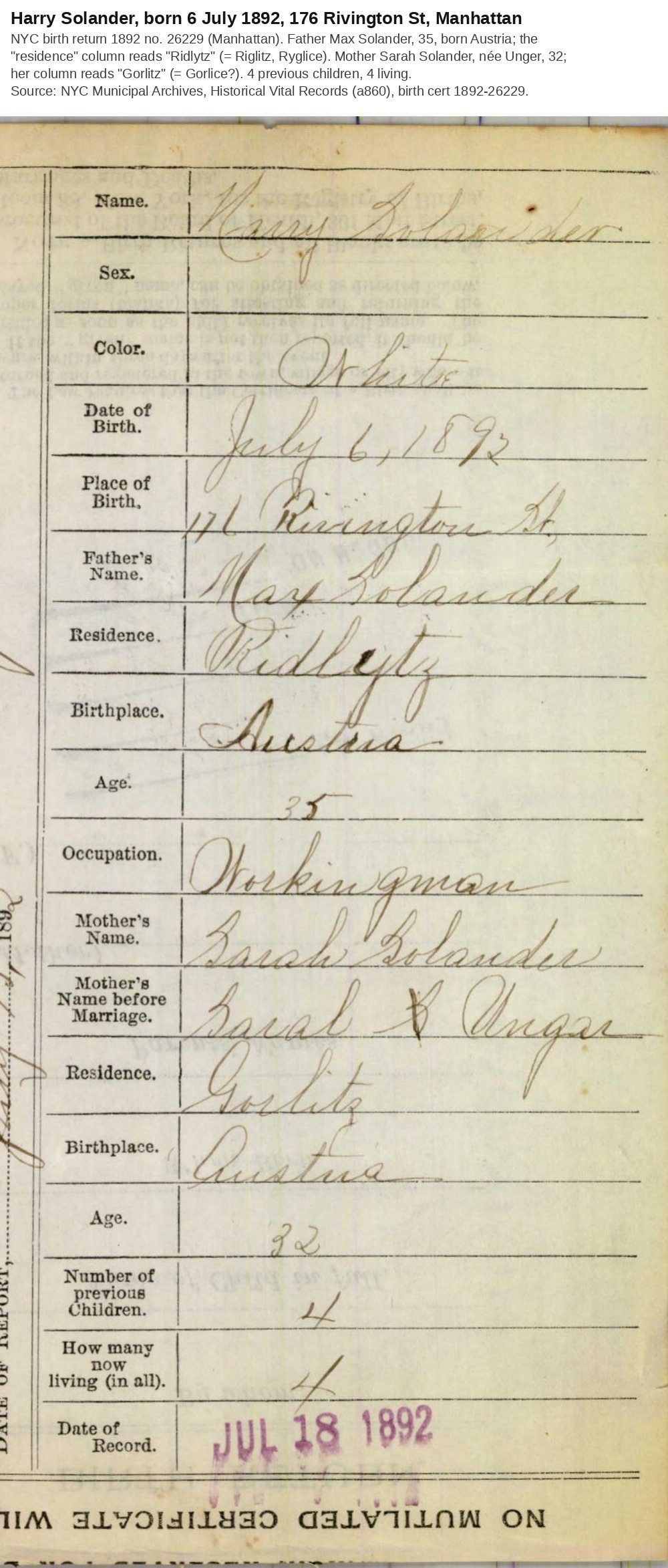
Their own towns: Ryglice and Gorlice: in 1892 the clerk who took Harry Solander’s birth return at 176 Rivington St wrote the parents’ hometowns in the residence column: “Ridlytz” for Max, 35, and “Gorlitz” for Sarah, née Unger, 32. Confirmedrecord “Ridlytz” is Riglitz, the Yiddish name of Ryglice, the same town Moritz gave at his 1888 wedding and Abraham gave on his son Nathan’s 1892 return. Probable “Gorlitz” is probably Gorlice, a Galician town about 35 km south of Ryglice; Sarah’s Unger family turns out to be from Biecz, in the same district (see below). Probable
- Max’s age: 35 in July 1892 means born about 1857, the same as the 26-year-old “M. Salender” on the 1883 S.S. India. Probable
- A baby who died: “Louis Salinder”, son of Marx and Sarah, died in Manhattan on 28 August 1886, aged 1. Confirmedindex He was very likely the boy born at 80½ Attorney St in May 1885, whose name we could not read (Leib, in English Louis). Probable
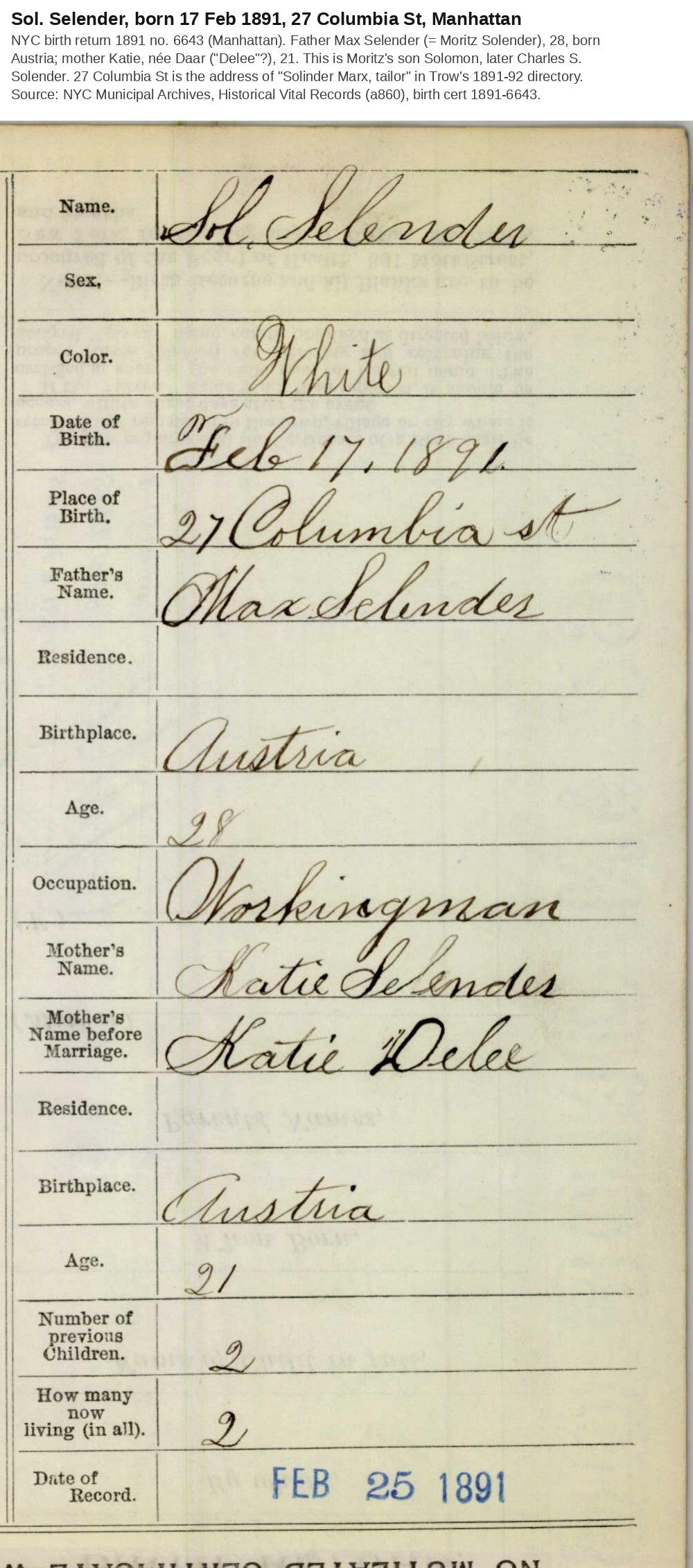
- Moritz at 27 Columbia St: his son “Sol. Selender” was born there on 17 February 1891, to Max (Moritz) Selender, 28, and Katie, 21. That is the address of “Solinder Marx, tailor” in the 1891–92 directory. Confirmedrecord Solomon is the son later called Charles S. Solender. Probable
- The Suevia’s date: page 1 of its manifest is sworn at New York on 1 August 1884, so the date of Sarah and Joseph’s arrival is now read on the record itself. Confirmed
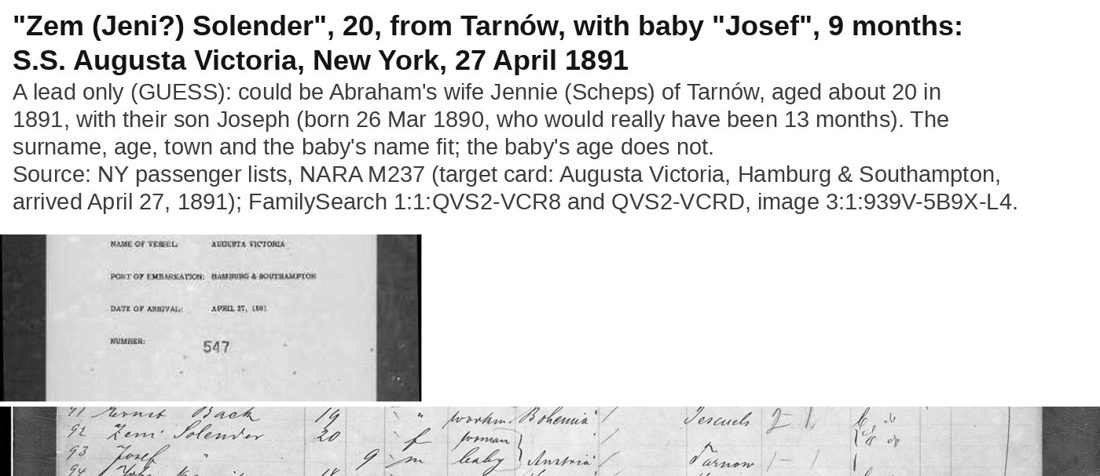
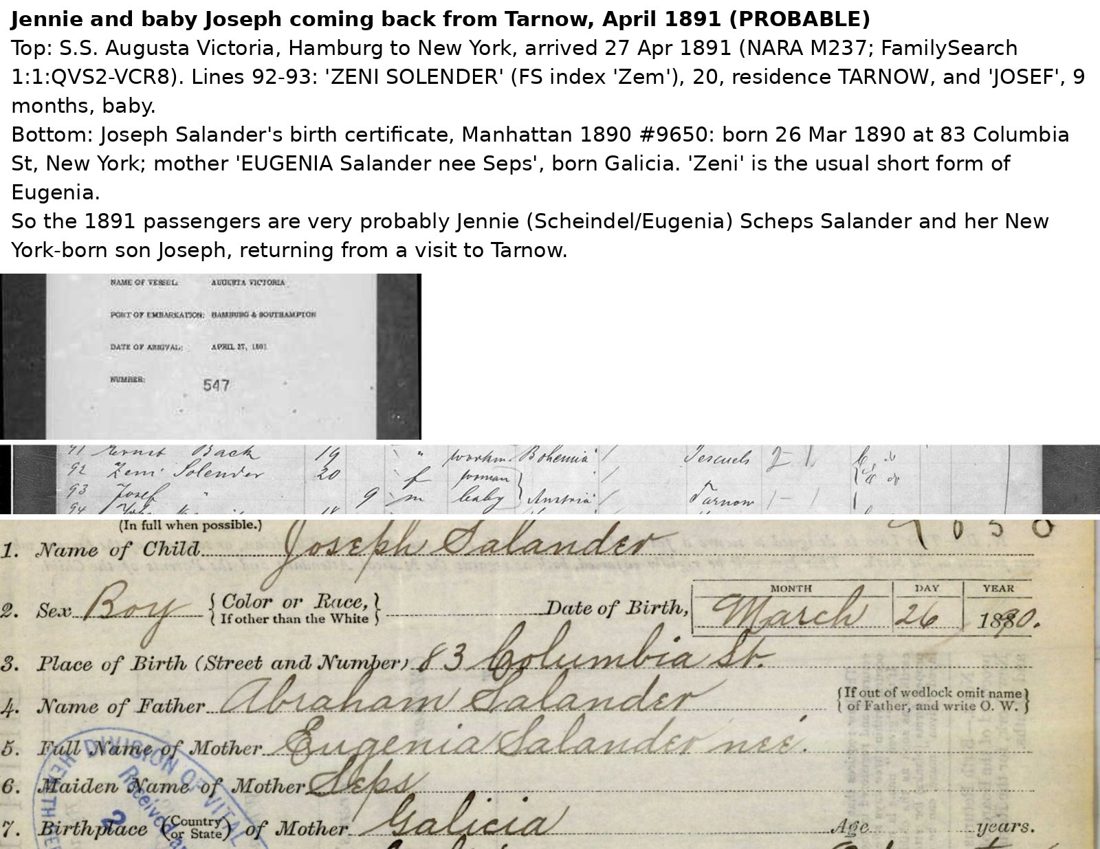
- A trip home in 1891: “Zeni Solender”, 20, from Tarnów, with a baby “Josef”, landed on 27 April 1891. It is now probably Abraham’s wife Jennie with their son Joseph, returning from a visit; see Jennie’s visit home below. Probable
- Josef and Basche after 1885: no trace. They are not in the New York death index for 1885–1916, no older Solender couple or widow appears on the New York passenger lists for 1885–1906, and they are not among the Tarnów Jewish deaths after 1877 (JRI-Poland), which list over twenty other Solenders and Leders. Gesher Galicia’s indexes have no death books from Ryglice, Tarnów or Jasło with Solenders. Open They most likely stayed and died in Ryglice, whose books are not online. Guess
Sarah’s family: the Ungers of Biecz: Biecz is a small town about 13 km from Gorlice, in the same Austrian district. Its Jewish birth register for 1857 has Sara, born in November at house no. 92, daughter of Salomon Unger and Feige. Confirmedrecord The surname is hard to read: the index has “Mager”, and it may be Unger. Either way it is one of the two names on Sarah’s 1910 death certificate, whose mother was “Fanny”, the usual English name for Feige. What makes it more than a name match is her brother. Probable
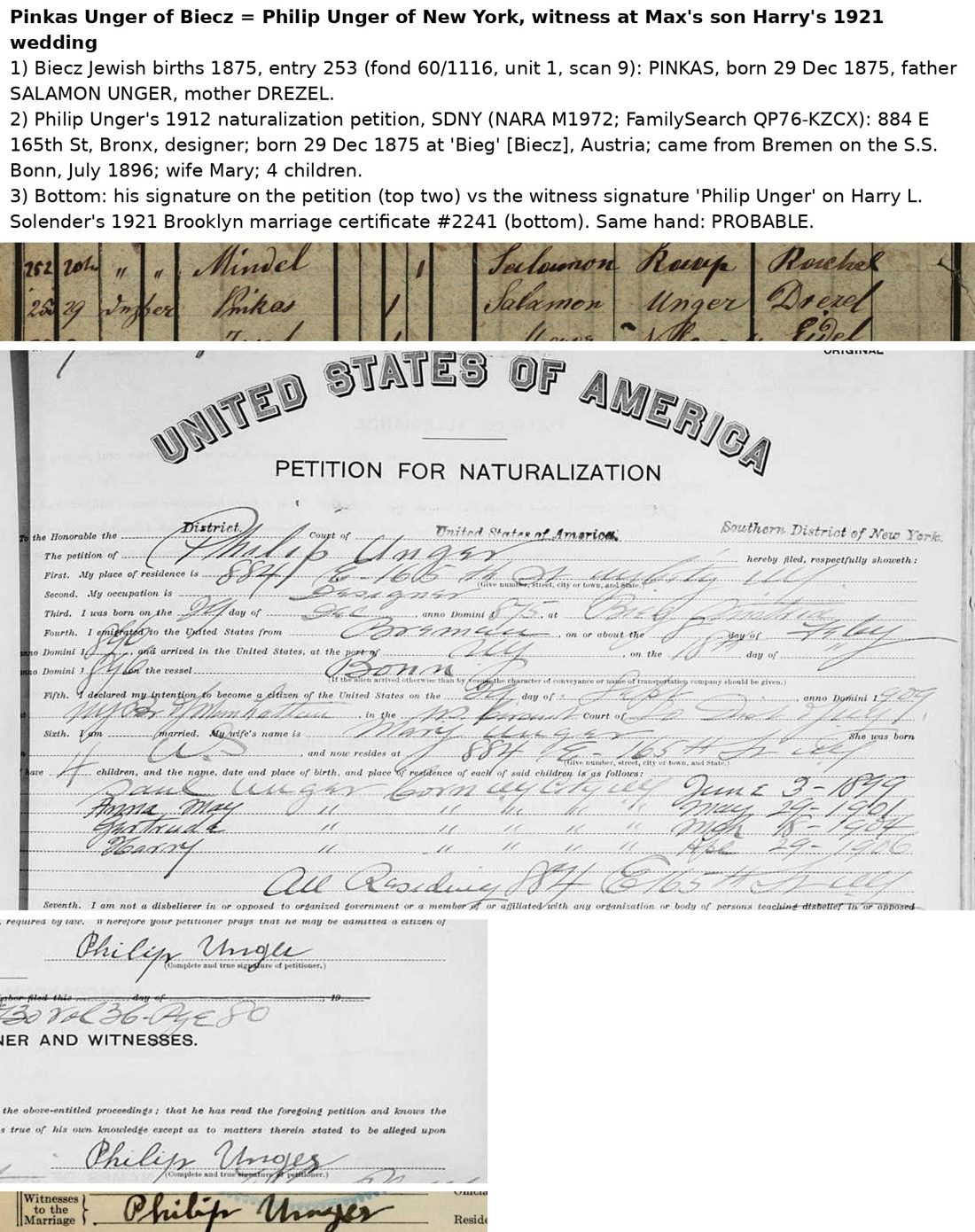
- Philip Unger, the 1921 witness: the Philip Unger who signed as a witness at Max’s son Harry’s wedding in 1921 was born in Biecz on 29 December 1875, according to his 1912 naturalization petition. He lived at 884 East 165th St in the Bronx, at the corner of Fox St, where Moritz and Max later died. Confirmedrecord His signature on the petition matches the witness’s signature on the 1921 certificate. Probable
- Pinkas son of Salomon: the Biecz register has Pinkas, born on that same day, 29 December 1875, to Salamon Unger and Drezel. Pinkas usually became Philip in America. Confirmedrecord So Philip was very likely Sarah’s younger half-brother: the same father, a different mother. Probable
- The name on her death certificate: it gives her father as Samuel, not Salomon. In America “Sam” often stood for a Salomon too. Guess
- “Gorlitz”: Biecz was in Gorlice district, which may be why the 1892 clerk wrote Gorlice for Sarah. Guess Gorlice’s own Jewish birth books are not indexed online. Confirmed
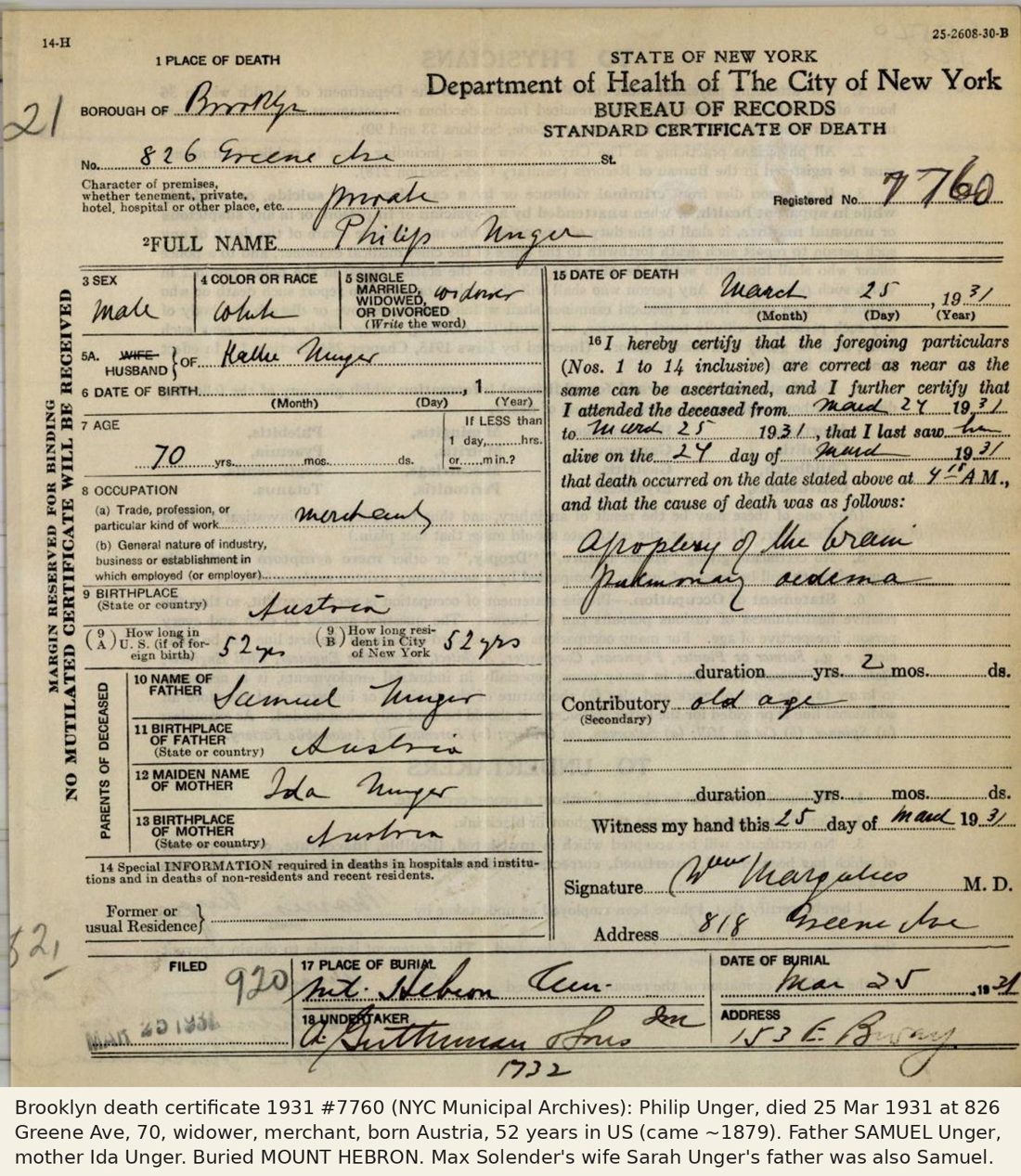
- A correction: an earlier round suggested the witness was the Philip Unger who died in Brooklyn in 1931. That man was born in 1861 and his mother was Ida, so he was someone else. Confirmed
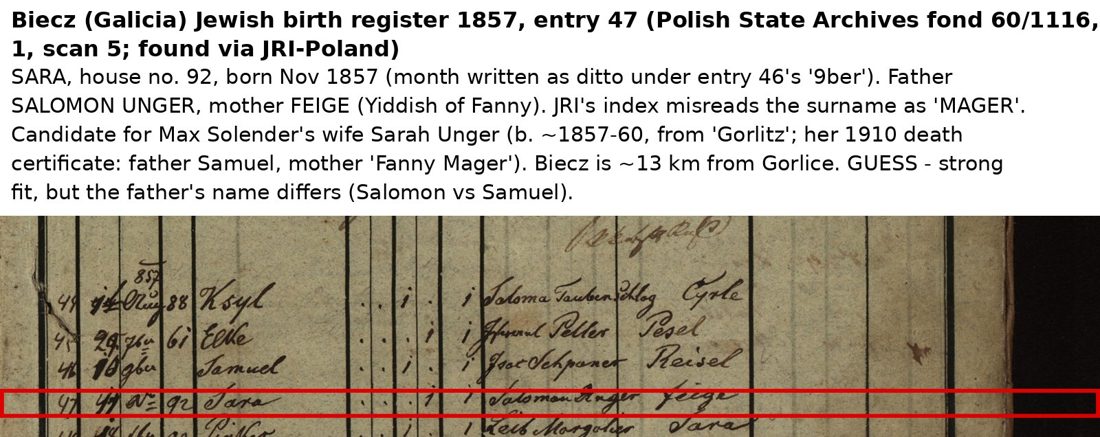
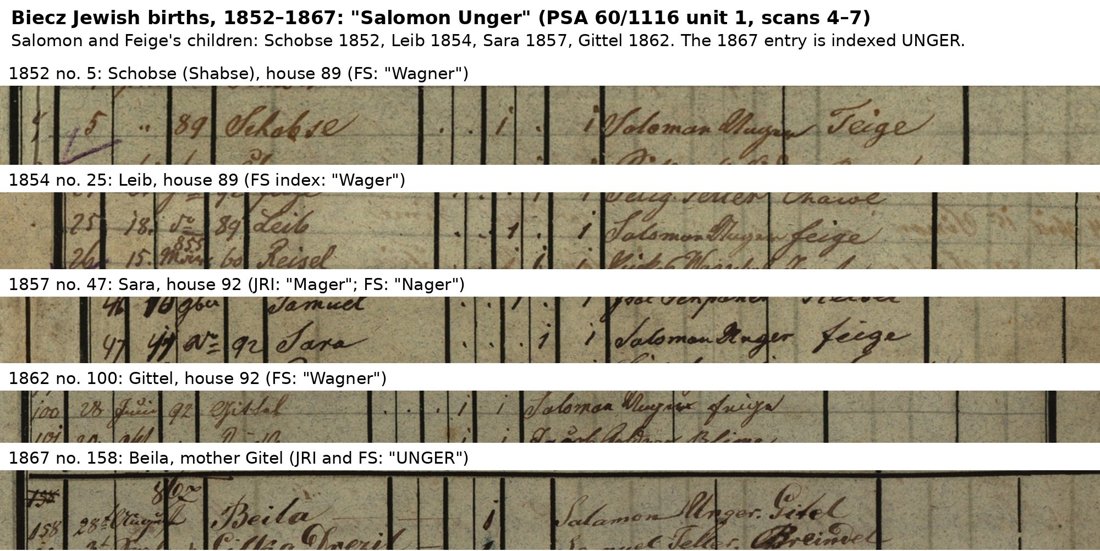
Sarah’s brothers and sister, and Philip’s crossing: the same Biecz register turns out to hold Sarah’s whole first family. Indexers read the surname as Wagner, Wager, Nager or Mager, which is why it was missed; on the pages it is written just as in an 1867 entry that both indexes read as Unger. Salomon Unger and Feige had Schobse (Shabse, 4 April 1852) and Leib (18 November 1854) at house no. 89, then Sara (11 November 1857) and Gittel (28 June 1862) at house no. 92. Confirmedrecord That these are one family, the Ungers, and Sarah’s full brothers and sister: Probable
- Her mother: Feige was alive in June 1862. A little Gittel Unger, aged 2, died in July 1864, and by October 1864 Salomon had a daughter, Chaie, with a second wife, Gitel. So Sarah probably lost her mother when she was about five or six. Guess Gitel died in 1871, aged 33 Confirmed, and Salomon married a third time, to Drezel Sturm, the mother of Philip and of children born up to 1885. Confirmed
- “Mager”: the surname Sarah’s death certificate gives her mother may have been Feige’s own maiden name, or a garbled Unger. Guess
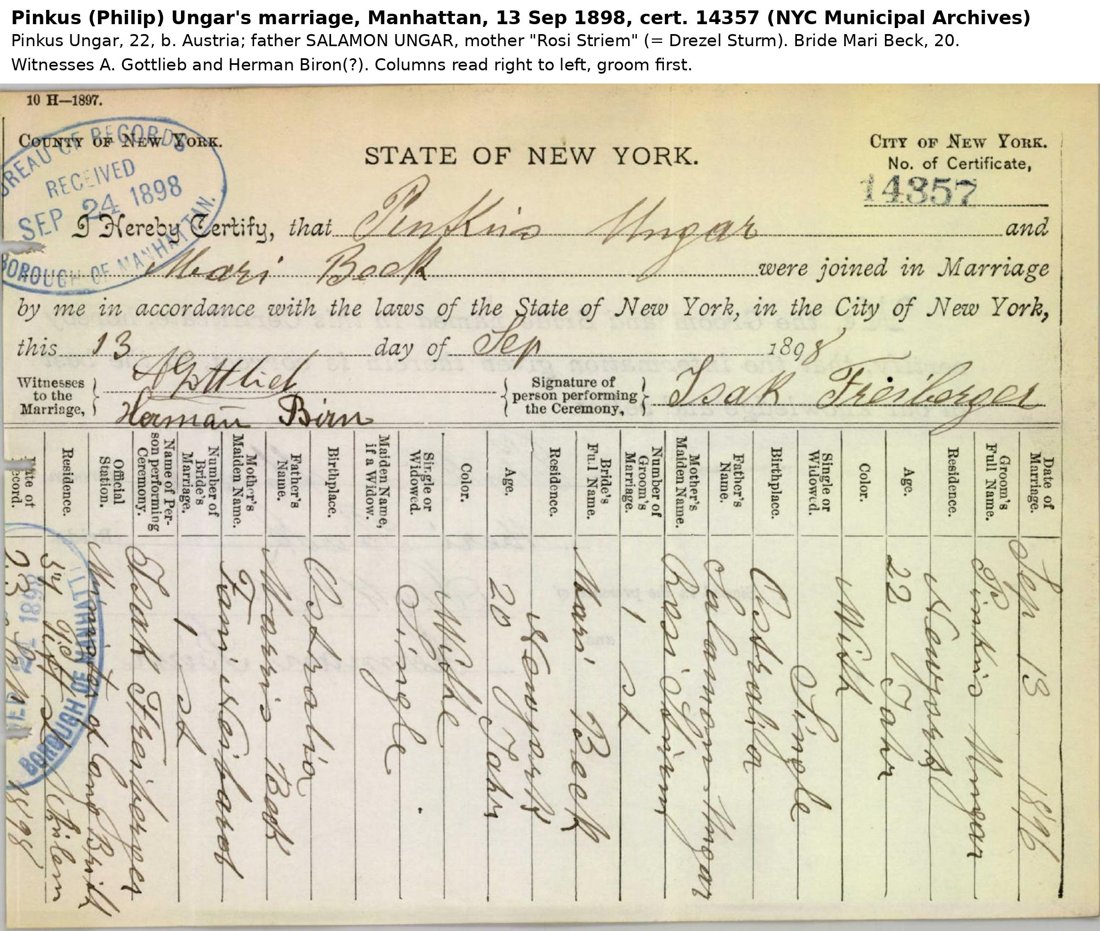
- Philip’s own wedding, 1898: “Pinkus Ungar”, 22, born in Austria, married Mari Beck in Manhattan on 13 September 1898. His father was Salamon Ungar and his mother “Rosi Striem”, which is Drezel Sturm. Confirmedrecord That settles that Philip was Salomon’s son. Probable
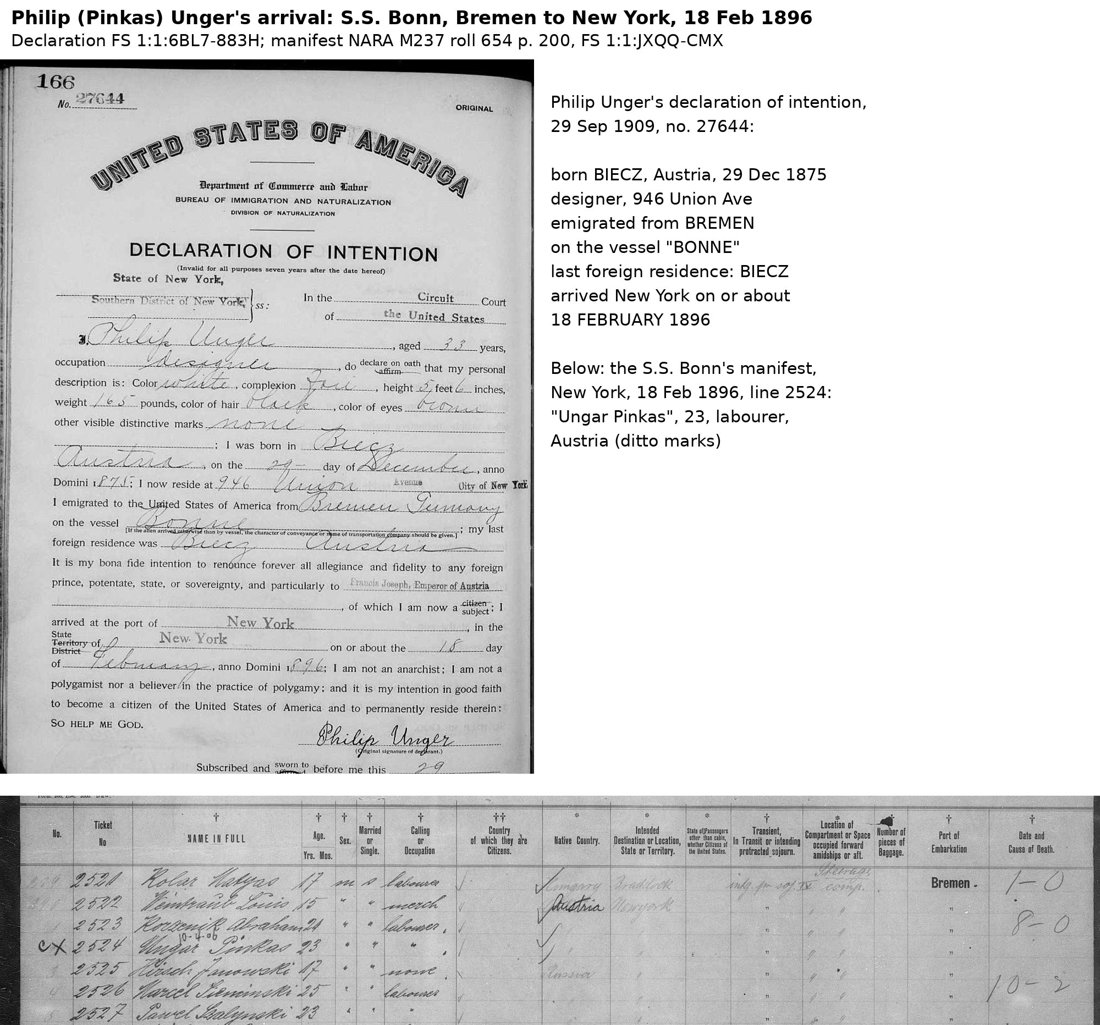
- His crossing, 1896: in his 1909 declaration Philip said he sailed from Bremen on the Bonn, his last home was Biecz, and he arrived in New York on about 18 February 1896. Confirmedrecord The Bonn’s list for that day has “Ungar Pinkas”, 23, labourer, from Austria. Probable The list says nothing about whose home he was going to: the New York lists of those years have no column for it. Confirmed
Jennie’s visit home, 1891: on 27 April 1891 the S.S. Augusta Victoria from Hamburg brought “Zeni Solender”, 20, from Tarnów, with a baby, “Josef”. Joseph’s own birth certificate names his mother Eugenia, née Seps, and Zeni is the usual short form of Eugenia. Confirmedrecord Joseph was born in New York in March 1890, so this was a trip back: Jennie had taken him to Tarnów, her home town, and was returning. Probable
- Her censuses: they give her arrival as 1886 (1900), 1890 (1920) and 1889 (1930), and she married Abraham in New York in May 1889. So 1891 could not have been her first crossing. Confirmed
- The baby’s age: the list says 9 months; Joseph was 13 months. It is the same understatement as Sarah’s “Jossel” in 1884, perhaps for the infant fare. Guess
- No other Josef: the Tarnów birth books have no Josef Solender born in 1889 or 1890, so the baby is unlikely to belong to one of the Tarnów Solender families. Confirmed
- Timing: Abraham stayed in New York (the 1891–92 directory lists him as a tailor), and their son Nathan was born in April 1892, about a year after she landed. Confirmed
Attorney Street: in 1885–88 Max and Moritz lived at no. 80½, and Moritz married at the Magen Abraham synagogue at no. 63, a year before Abraham’s own wedding.
Fox Street: Moritz died at no. 1077 in 1929, Max lived at no. 1101 in 1944, and Abraham lived nearby in the 1950 census. Three Solender tailors from Galicia, on one Bronx street, at the end of their lives.
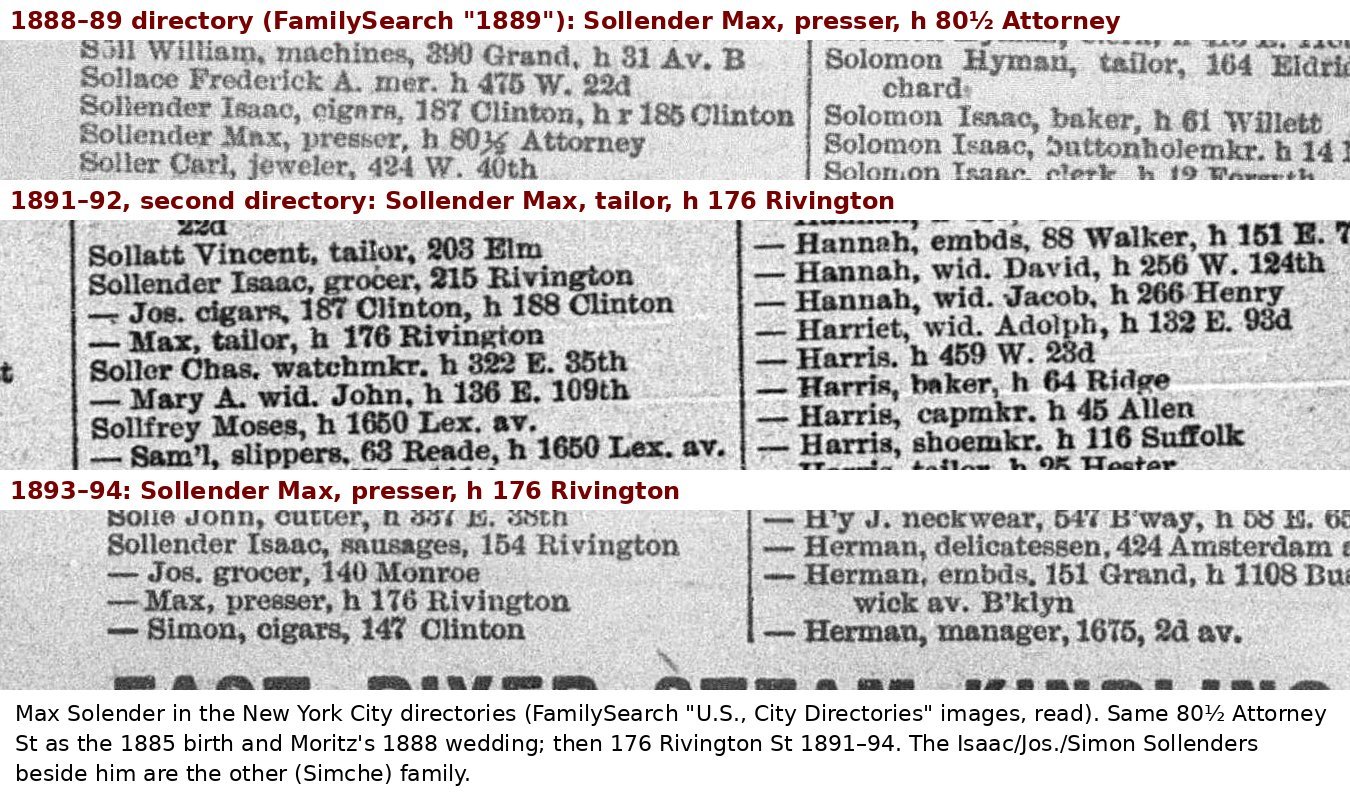
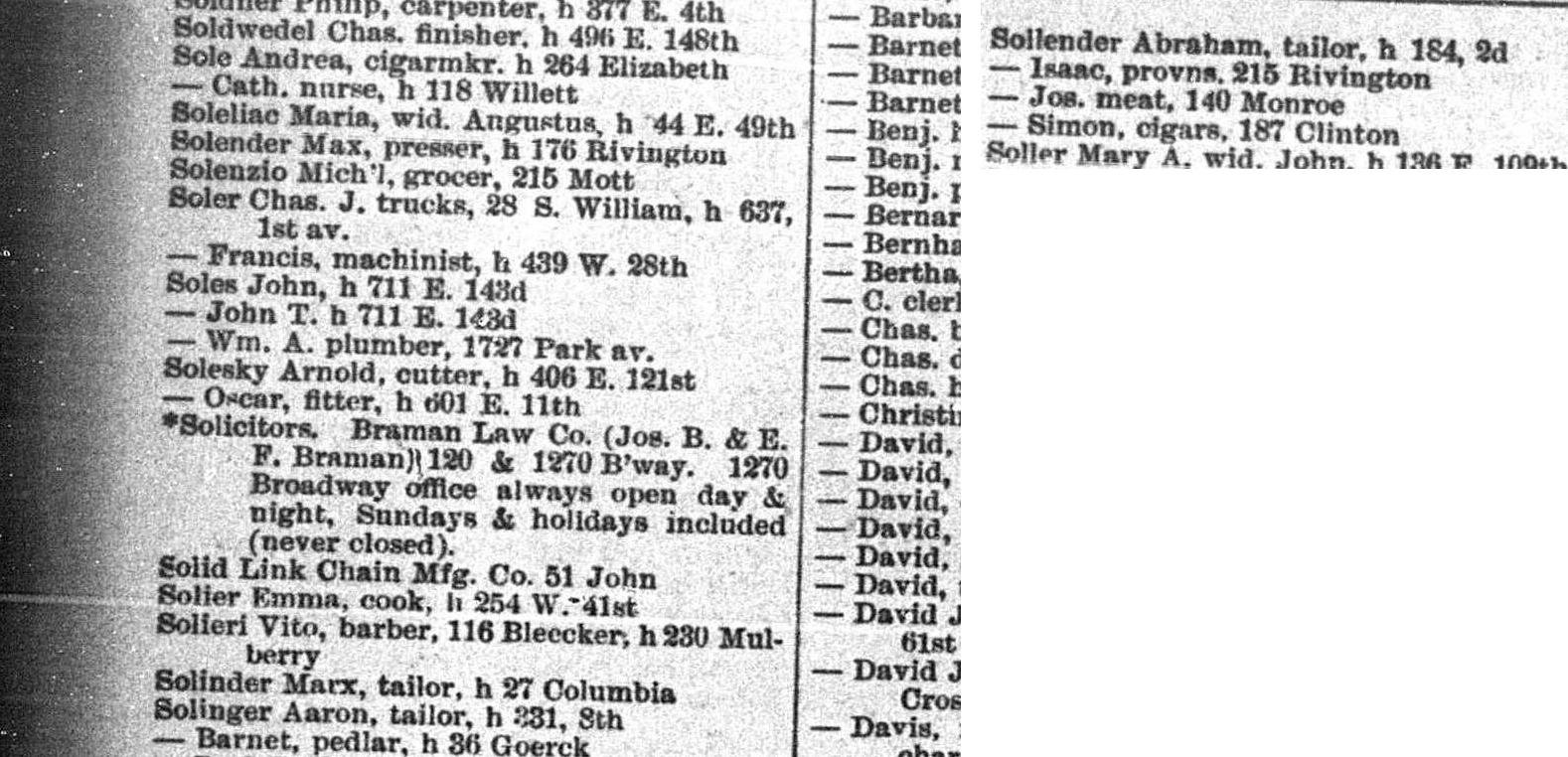
In the city directories: the 1888–89 directory lists “Sollender Max, presser, h 80½ Attorney”, the same building as in 1885 and 1888 Confirmedrecord. In 1891–92 it lists “Solender Max, presser, h 176 Rivington” and “Sollender Abraham, tailor, h 184, 2d”. Confirmedrecord A second 1891–92 directory and the 1893–94 one also list Max at 176 Rivington, so he lived there at least 1891–94. Confirmedrecord That these are our Max and Abraham: Probable. A “Solinder Marx, tailor, h 27 Columbia” on the same page is probably Moritz: his son Solomon was born at 27 Columbia St in February 1891 (below). Probable
Max’s first wife: “Sarah Solinder” died on 24 August 1910 at Lebanon Hospital, aged 52, living at 167 E 106th St, and was buried at Washington Cemetery. Confirmedrecord That she was Max’s wife Sarah Unger: Probable (her age matches the 1910 census, and Max was a widower by February 1911). Her maiden name, Unger, is now on three of her children’s records: Anna’s 1907 wedding, Harry’s 1921 wedding and Joseph’s 1929 death certificate. Confirmedrecord Max’s son Harry’s 1921 wedding was witnessed by a Philip Unger. A Philip Unger who died in Brooklyn in 1931, born in Austria about 1861 and in America since about 1879, was the son of a Samuel Unger, like Sarah, and is buried at Mount Hebron. Confirmedrecord That he was Sarah’s brother is a guess: his mother is named Ida, Sarah’s Fanny. Guess
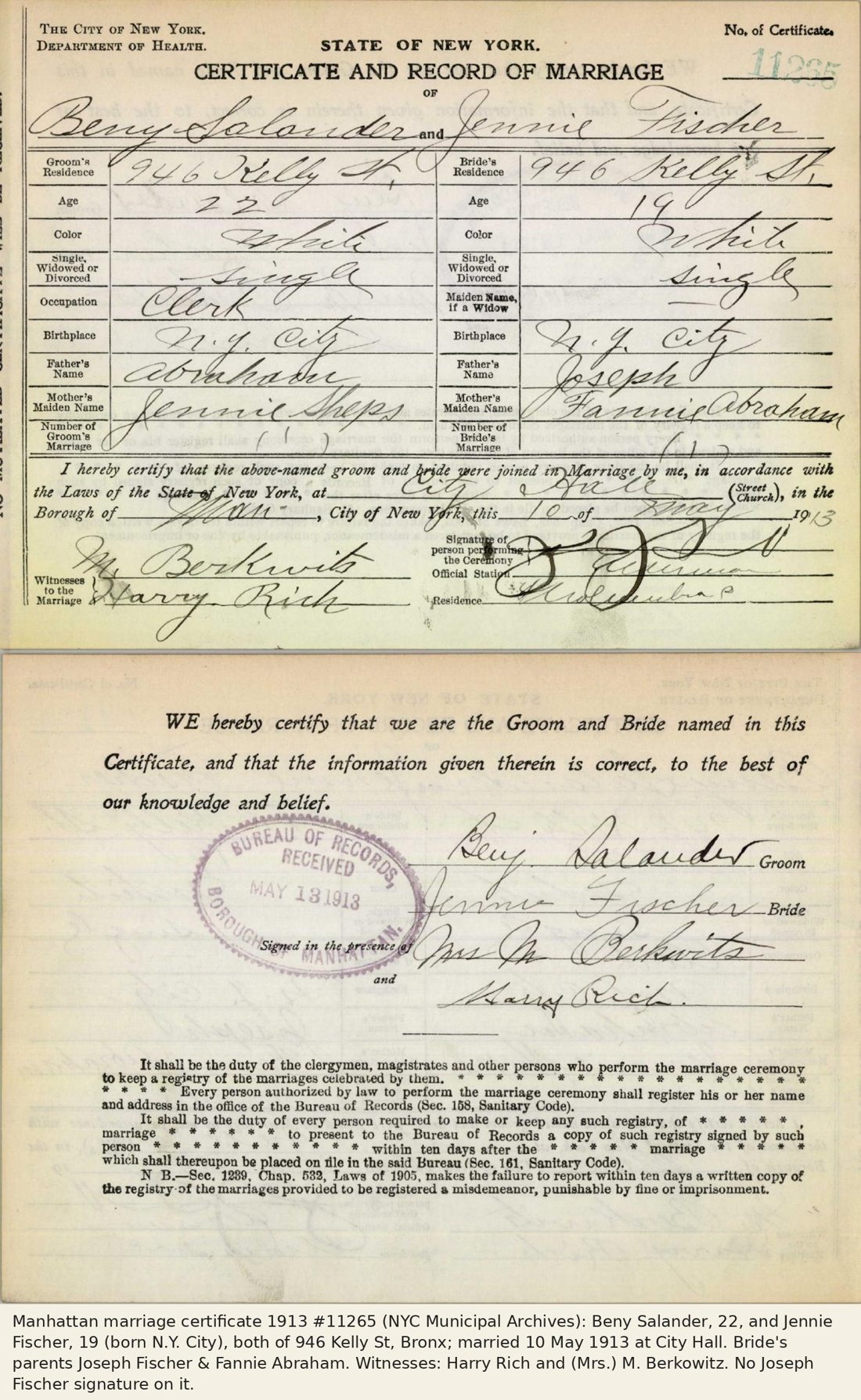
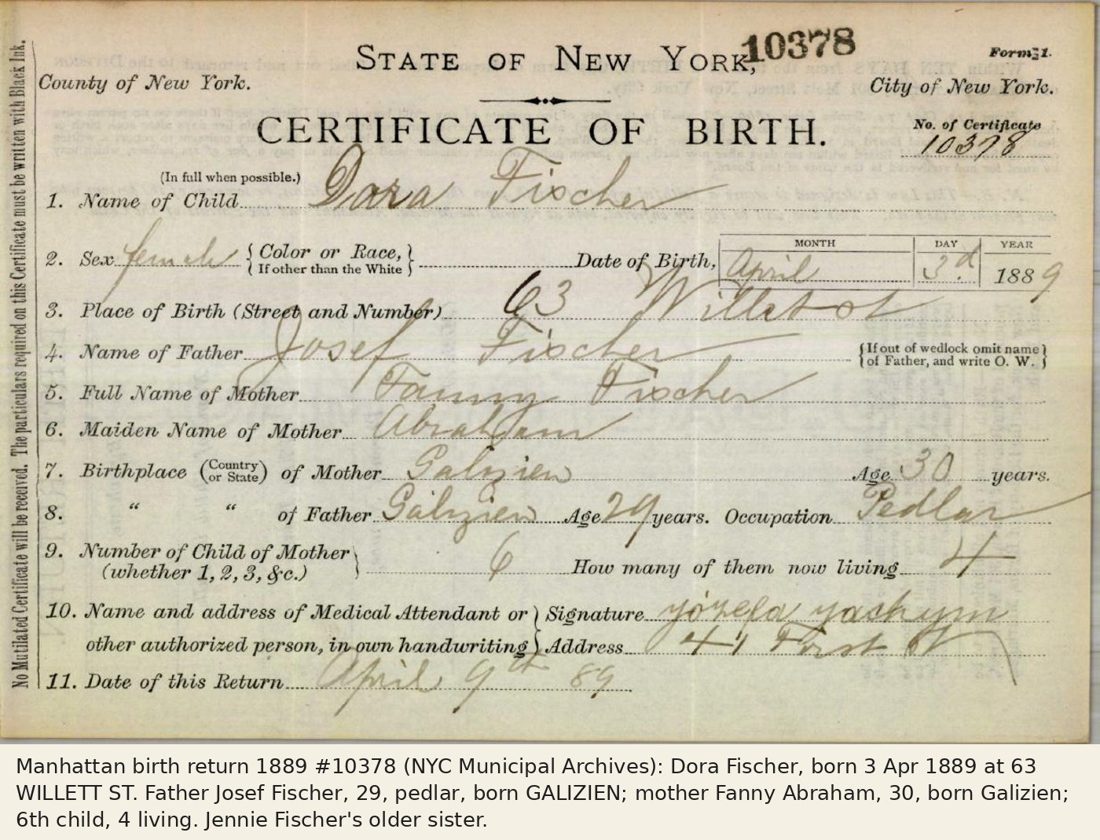
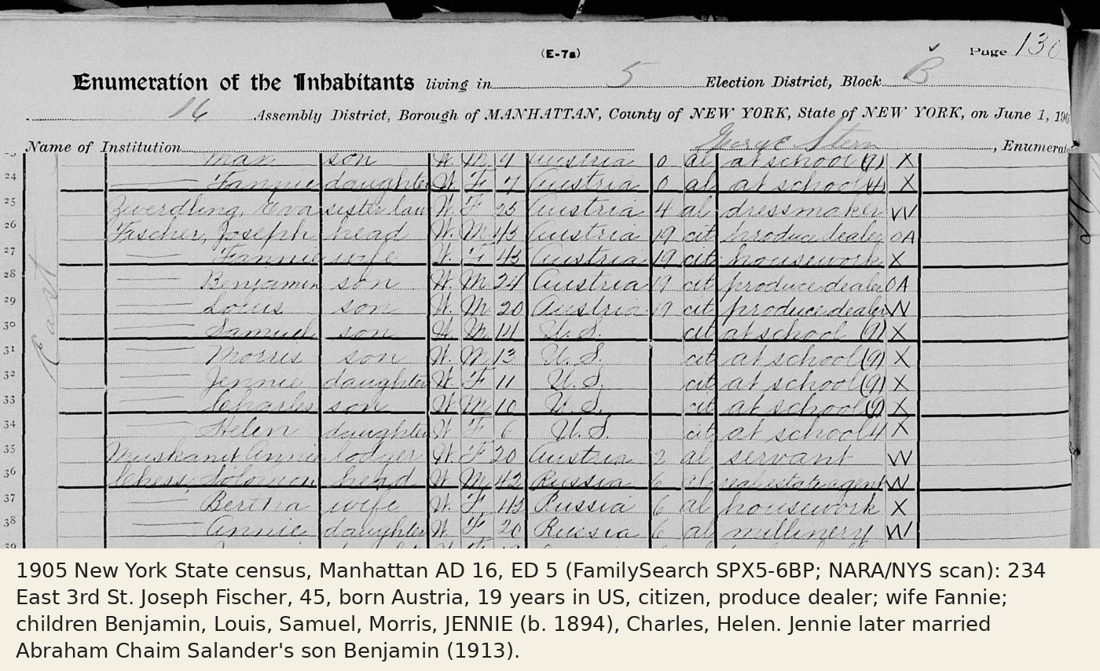
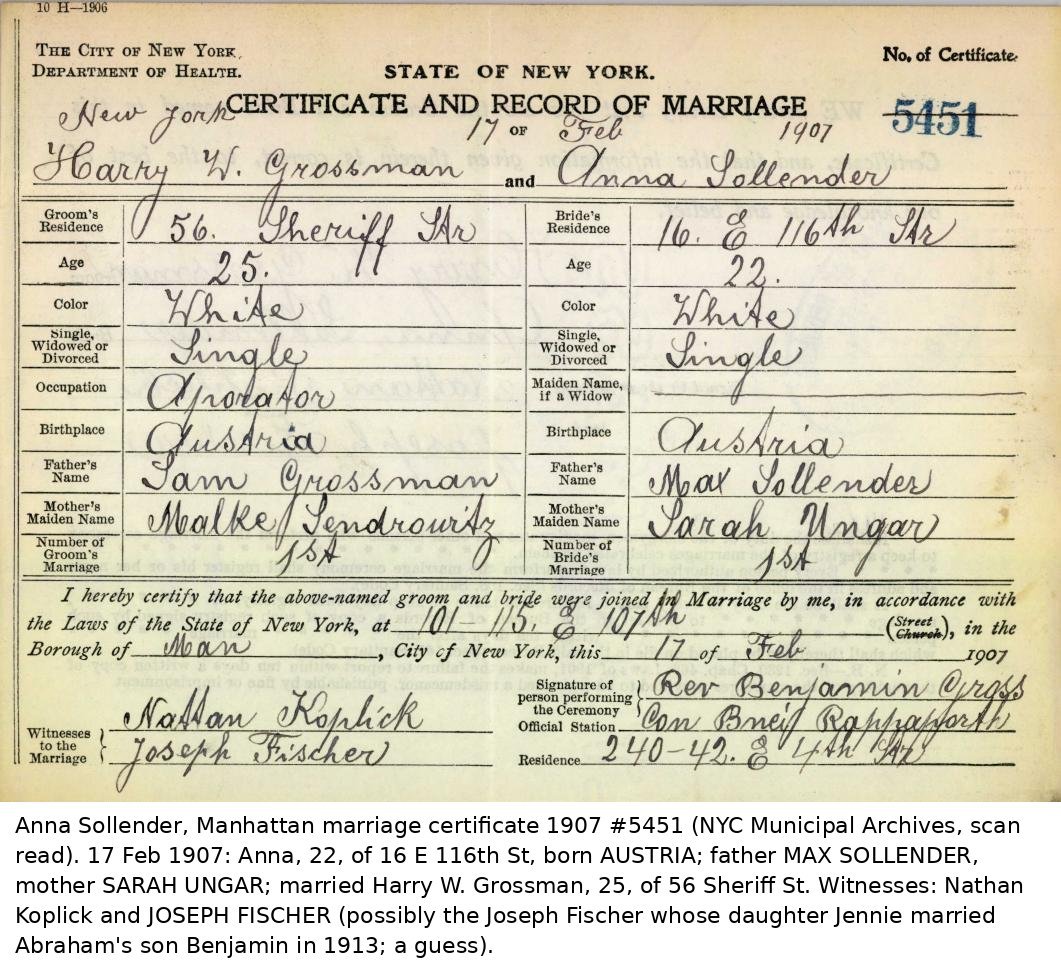
The children’s weddings: Max’s daughter Anna, born in Austria, married Harry W. Grossman on 17 February 1907 from 16 E 116th St. Confirmedrecord One of her witnesses was a Joseph Fischer. Abraham’s son Benjamin married Jennie Fischer, daughter of Joseph Fischer, in 1913, so this may be the same man, a friend of both brothers’ families. Guess (the name alone). Jennie’s family were Galician Jews like ours: her sister Dora was born in 1889 at 63 Willett St to Josef Fischer, a pedlar, and Fanny Abraham, both from Galicia; in 1905 they lived at 234 East 3rd St and in 1910 on Rodney St in Williamsburg, near Abraham’s family, and her brother Saul is buried at Mount Hebron. Confirmedrecord Benjamin and Jennie married at City Hall in 1913, both living at 946 Kelly St in the Bronx; their witnesses were Harry Rich and Mrs M. Berkowitz, and Joseph Fischer did not sign. Confirmedrecord So the witness of 1907 is still only a name match. Guess Moritz’s sons Nathan (1911) and Charles (1912) both married from 83 Lenox Ave and named their parents as Max (Moritz) and Kate Daar. Confirmedrecord Kate died in 1933 and is buried at Washington Cemetery, Moritz’s cemetery; Max’s second wife Anna died in 1945 at 1101 Fox St and is buried at Mount Hebron. Confirmedrecord None of these records names a town in Europe.
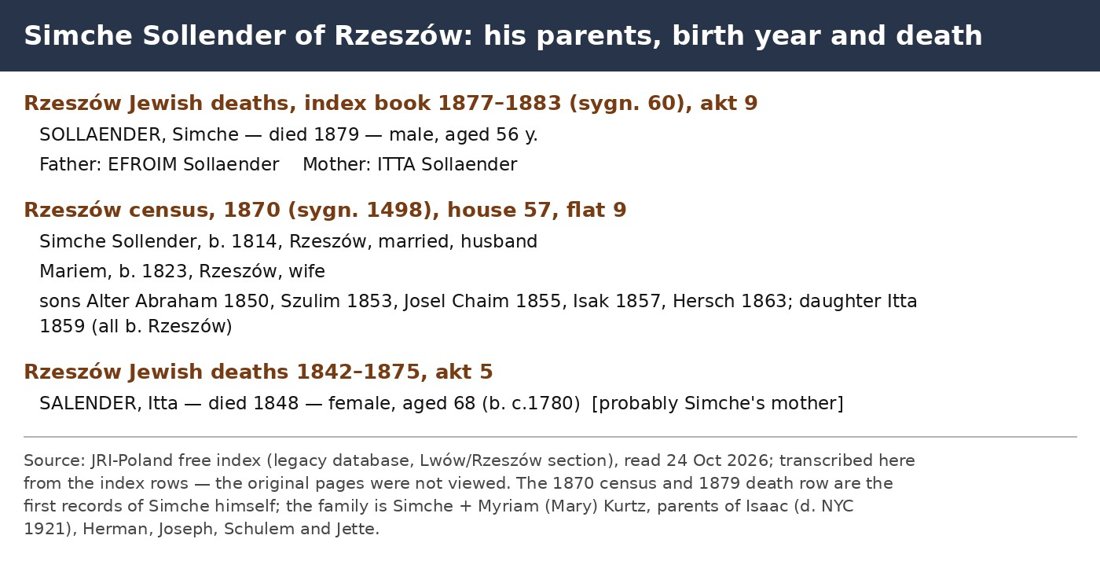
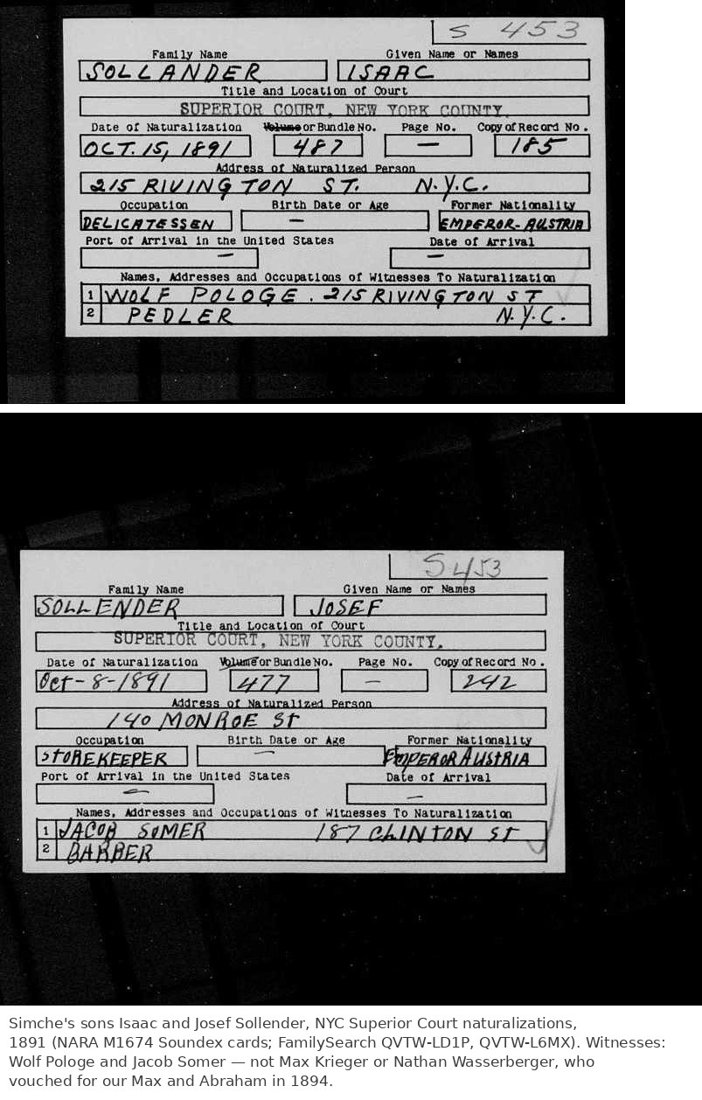
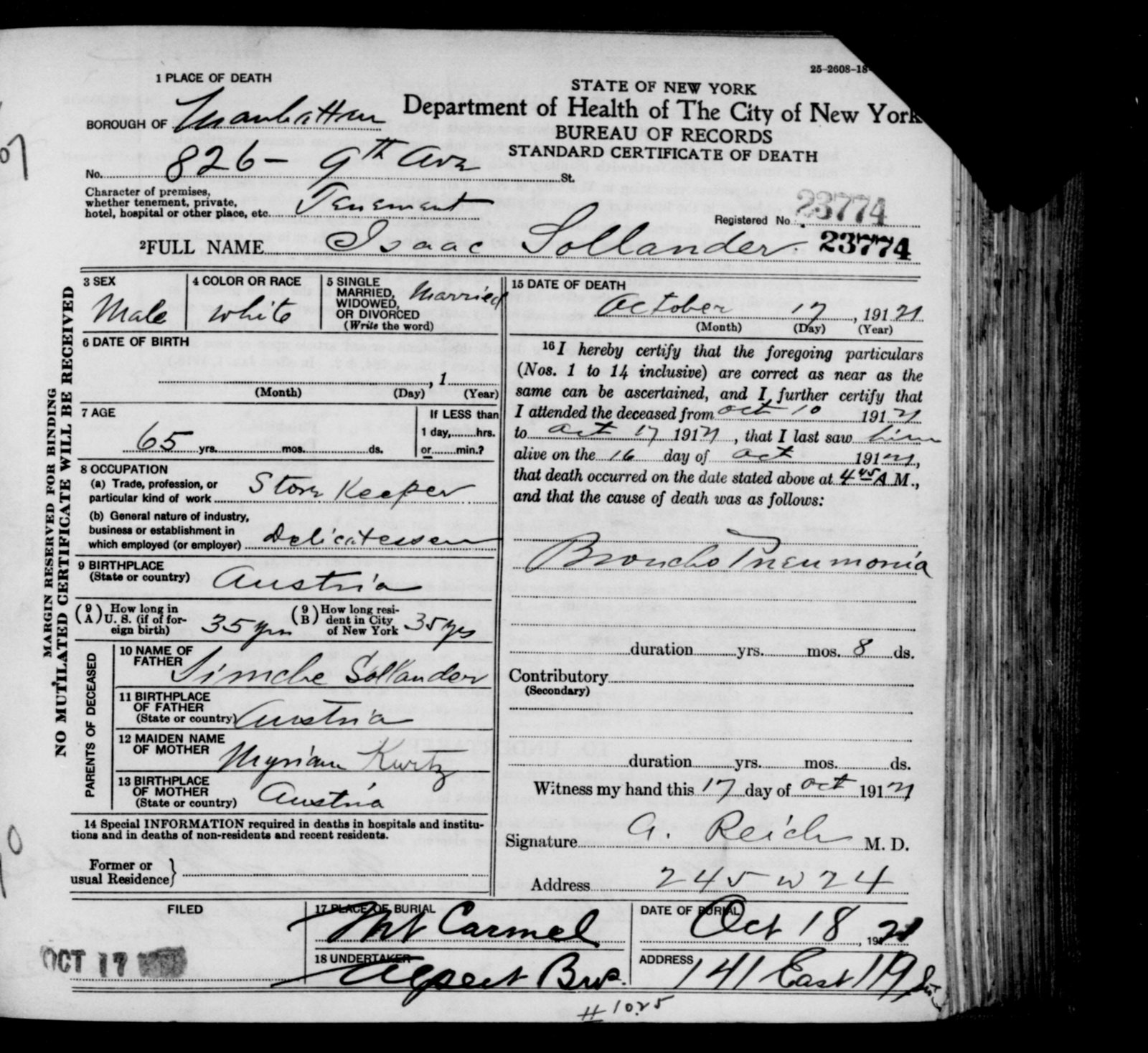
Not a fourth brother: Isaac Sollender (about 1856–1921), who also came over in the early 1880s, was the son of Simche Sollender and Myriam Kurtz, a different Sollender family on the same streets. He kept a delicatessen on 9th Avenue and is buried at Mt Carmel. Confirmedrecord The Rzeszów birth books list twelve children of Simche Salender and Mariem Kurtz between 1843 and 1865, among them Isac (1857), Jos. Chaim (1855), Szulim (1853), Itte (1859) and Hersz (1863), so that family came from Rzeszów, not Ryglice. Confirmed (index)index The “Ryczow” on their 1888 ship list is Rzeszów. Probable Whether the two families were related: Open More below
The Simche family of Rzeszów, and were they kin? Simche himself now turns up in the Rzeszów books. The 1870 census lists him at house no. 57, born in Rzeszów in 1814, with his wife Mariem (born 1823) and six of their children. Confirmed (index)index He died in Rzeszów in 1879, aged 56, and the death register names his parents: Efroim and Itta Sollender. Confirmed (index) So Myriam came to New York in 1888 as a widow (her 1905 death record says “widowed”), and her son Sholem (Schulem) died in Manhattan in 1894, aged 40. Confirmed (index)index The Itta Salender who died in Rzeszów in 1848, aged 68, was probably Simche’s mother. Guess
- A link to our Josef? No Josef appears in Efroim’s family in the Rzeszów books. But those books start in 1841 (plus 1835), too late for a Josef born about 1825–35, so the question can’t be settled from them. Open
- In New York the paths never cross on paper. Simche’s sons Isaac and Josef were vouched for at their 1891 naturalizations by Wolf Pologe and Jacob Somer; our Max and Abraham by Max Krieger and Nathan Wasserberger in 1894. Different courts, synagogues and cemeteries too. Confirmedrecord The nearest they come: Jette’s husband Leon Knecht lived at 185 Rivington St in 1892, a few doors from Max at 176 Rivington, and Myriam died in 1905 at 1446 Park Ave, a couple of blocks from where Max’s wife Sarah lived in 1910. Among thousands of Galician neighbors that proves nothing. Guess
- Verdict: no link found. Two Sollender families, from Rzeszów and from Ryglice, about 60 km apart. A kinship is possible, but nothing points to it. Open


II. 1887: the crossing
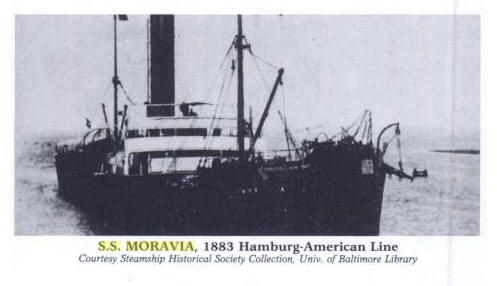
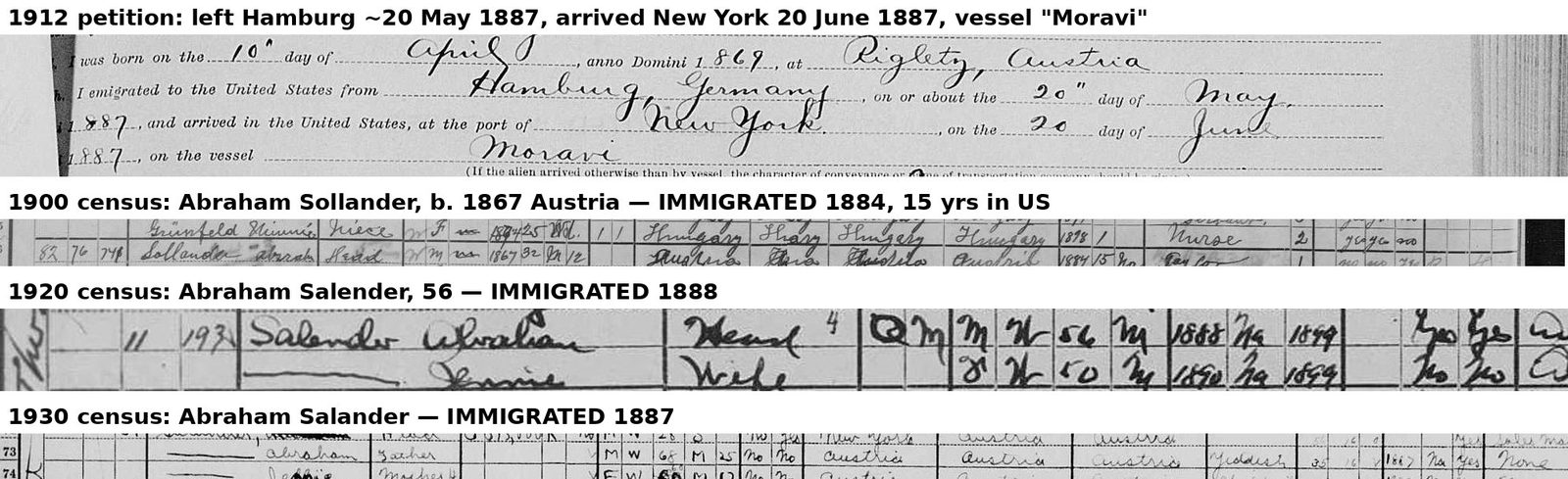
Abraham Chaim Solender was born in Ryglice on 10 April 1869. That is his own date. His gravestone gives no birth date, only “aged 90”; the 2 May 1870 date comes from an online index. Confirmedrecordheadstone Abraham declared he came on the Moravia from Hamburg, 20 June 1887 (1910 papers); an 1894 card says 14 May 1886. Ship list not yet found. Open
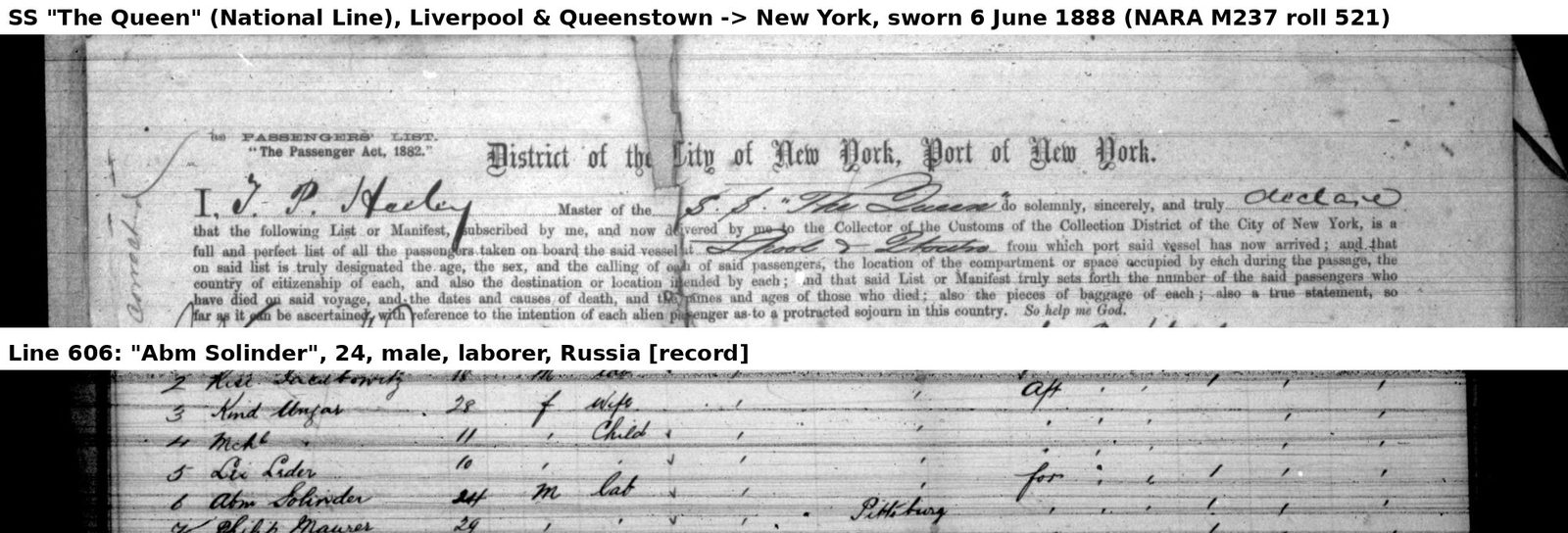
A possible match is The Queen, a National Line steamer from Liverpool, which reached New York on 6 June 1888 carrying an “Abm Solinder”, 24, laborer. Hamburg’s emigration index has an Abraham Solender, born about 1864, leaving Hamburg on 18 May 1888 for “Grimsby (North America via Liverpool)”: the cheap indirect route by sea to England, by train to Liverpool, then on to New York. That fits his 1920 census, which gives age 56 and arrival in 1888. Against it, the list says “Russia”, and his petition gives 1869 as his birth year. Also against it is the family story: he “came two years before the big snow” and made money shoveling it. The big snow was the Great Blizzard of 11–14 March 1888, three months before The Queen landed. Possiblefamilyrecordindexrecord Ellis Island did not exist yet. Immigrants came ashore at Castle Garden, at the tip of Manhattan.
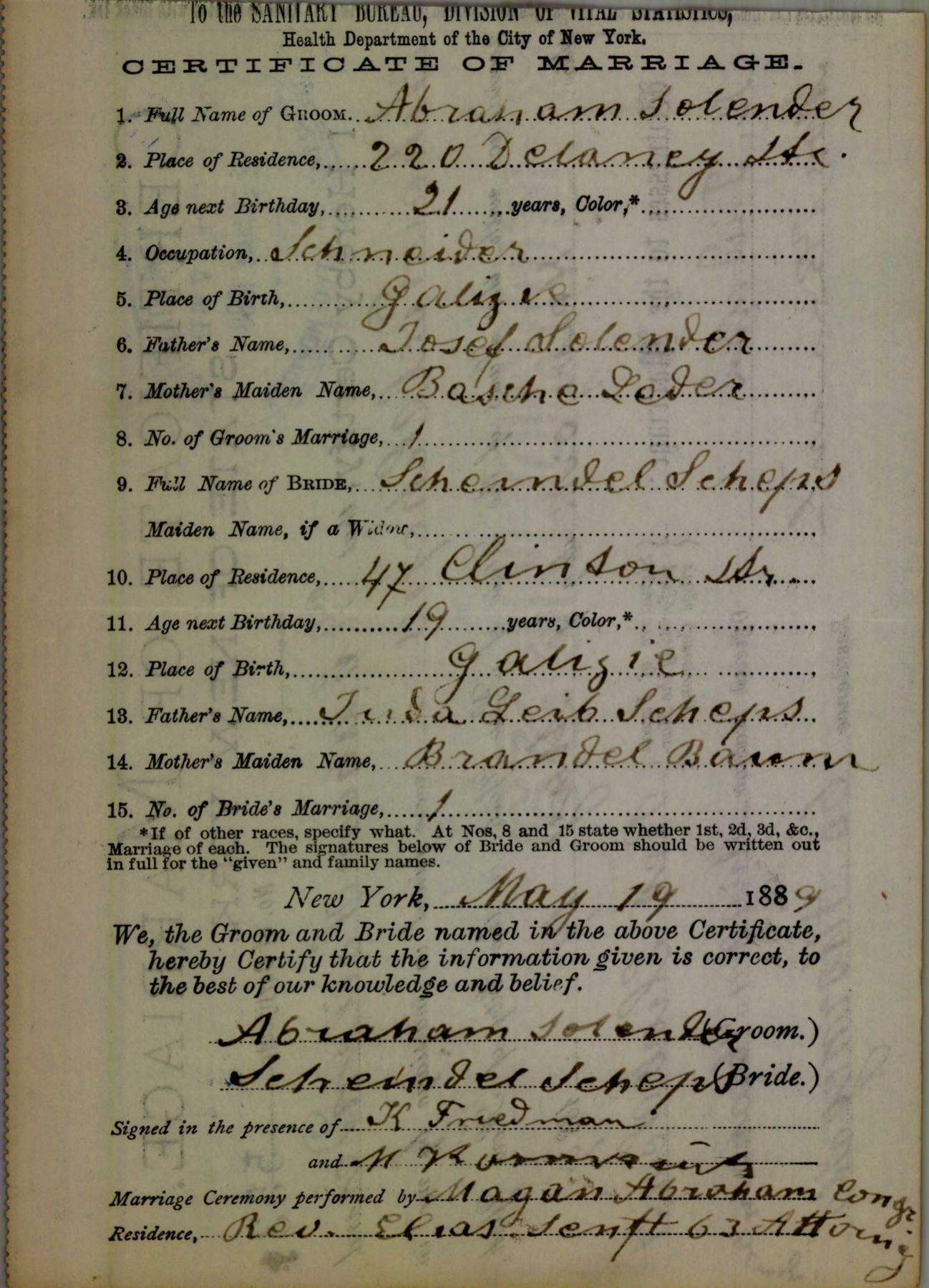
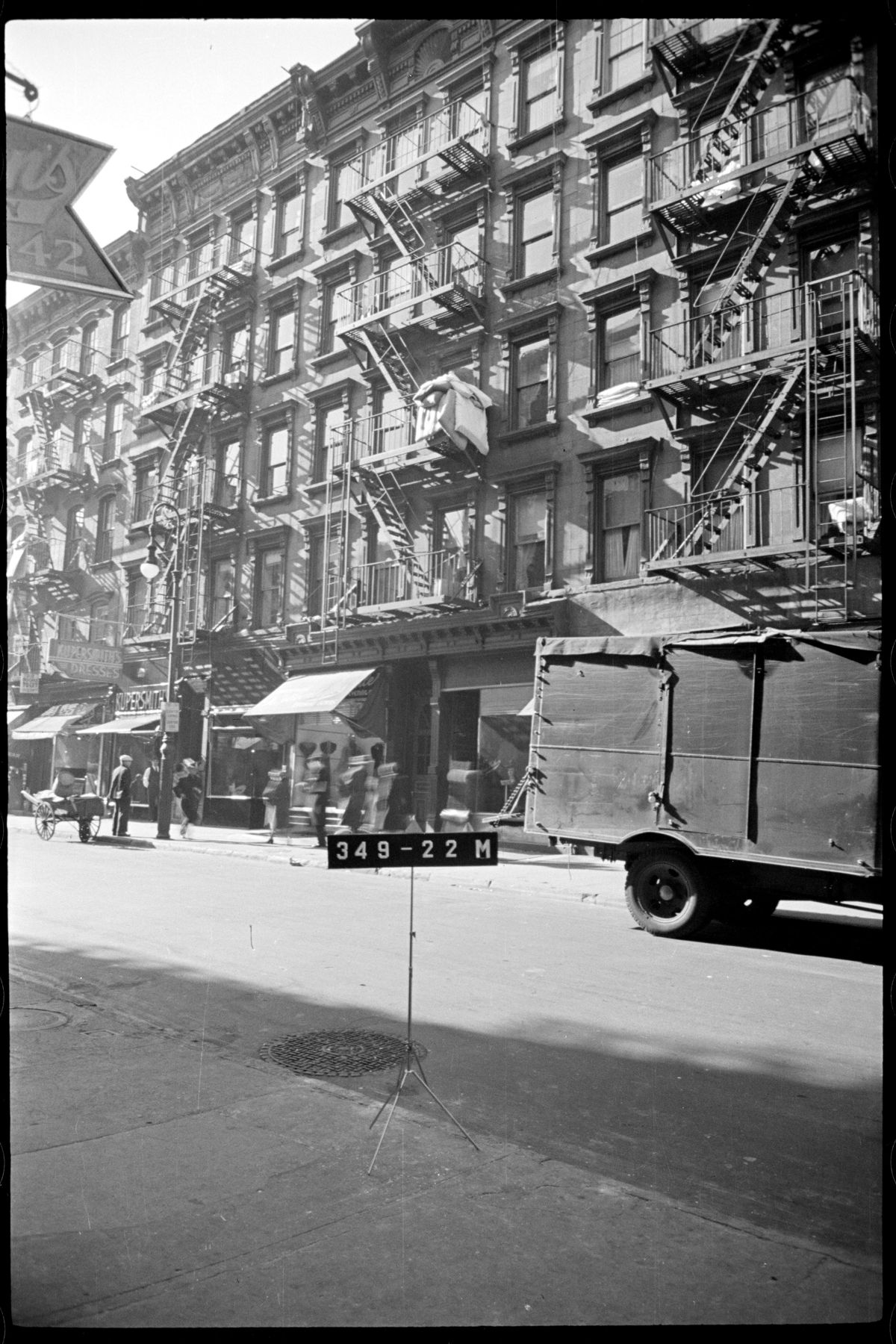
On 19 May 1889 he married Scheindel (Jennie) Scheps on the Lower East Side. He was living at 220 Delancey Street and she at 47 Clinton Street, four blocks apart. Confirmedrecord The clerk wrote the name Solender. Over the next twenty years it slid through Sollender, Sollander and Salender until it settled as Salander. No one changed it on purpose; it simply drifted. Confirmedrecordrecordrecord
III. From Delancey Street to Williamsburg
Their first son, Joseph, later called Herman Joseph, was born on 26 March 1890 at 83 Columbia Street. Confirmedrecord Seven more children followed. One died as a baby, and his or her name has not been found record. The others were Nathan, born at 174 Suffolk Street in 1892 to parents the clerk wrote as from “Ryglitz” and “Tarnow” record, who was touring as a stage actor by 1917 Confirmedrecord; Benjamin, a musician Confirmedrecord; Morris, who grew up to be Matthew Arthur Salander, a salesman who died in the Bronx in 1940 Confirmedrecord; Willie, born at 91 Lewis Street in January 1898, who died at eight months record; Lottie; and the youngest, Lewis Arthur, born 29 January 1902. Confirmedrecord His New York birth certificate is not in the city’s digitized 1902 birth index, so it may be in a register that has not been digitized. Confirmed (negative)index
Abraham worked as a tailor and then sold cutlery. In the late 1890s he had his own clothing and tailoring business at 91 Lewis Street, where the family also lived in 1898, before moving to 102 Cannon Street and then 82 Lewis. Confirmedrecord By 1905 the family lived at 293 Stanton Street. Confirmedrecord The family followed the Williamsburg Bridge across the East River to Brooklyn: 377 South 1st Street by 1910, a house of their own on South 3rd Street in 1920, then 142 Ross Street. Confirmedrecordrecordrecord He had first become a citizen on 6 March 1894, in the New York Court of Common Pleas (filed as “Abraham Silender”, of 129 Suffolk St, eight weeks after his brother Max), but in 1909 the Supreme Court cancelled it “on account of error in age”, so he started again. Confirmedrecord Abraham became a citizen in 1913. Confirmedrecord Jennie died at Ross Street on 9 June 1931. Confirmedrecord Abraham lived another thirty-one years. He spent time with Lottie and her husband, Dr. Israel Fleiss, in Mount Vernon, then lived in the Bronx. He died on 6 November 1962 and lies beside Jennie at Mount Hebron, Queens. Confirmedrecordrecordheadstone
IV. Meanwhile, in Roś
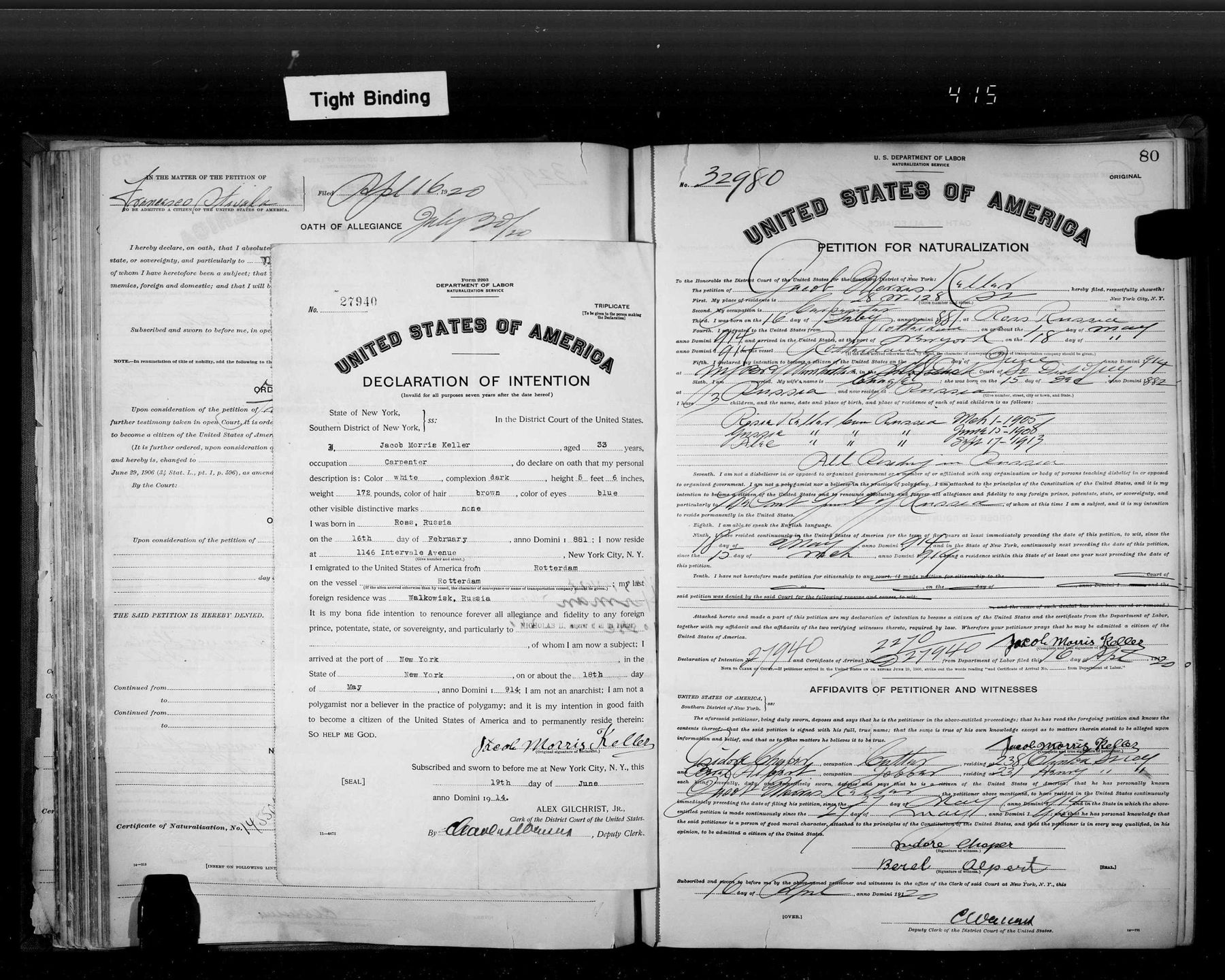
Seven hundred kilometres to the north-east, in Roś, a shtetl near Wołkowysk in Grodno province (today Ros', Belarus), lived Menashe Rubinstein and his wife Rose. Confirmedrecordheadstone Their daughter Chaya (Ida) was born on 7 December 1882. Confirmedrecord She married Jacob Morris Keller, a carpenter born in Roś in 1881. His parents, by a 1936 index, were Hirsch Keller and Gittel Malsky; his gravestone gives his father’s Hebrew name, Tzvi Aryeh (Hirsch Leib). Confirmedrecord Probableindex He died in Manhattan on 14 March 1949 and lies at Beth-El Cemetery in Paramus, New Jersey. Confirmedindexheadstone Roś, about 12 km from Wołkowysk, was also the birthplace of Rabbi Yitzchak Elchanan Spektor (1817–1896), later the Rav of Kovno. Confirmedpublished
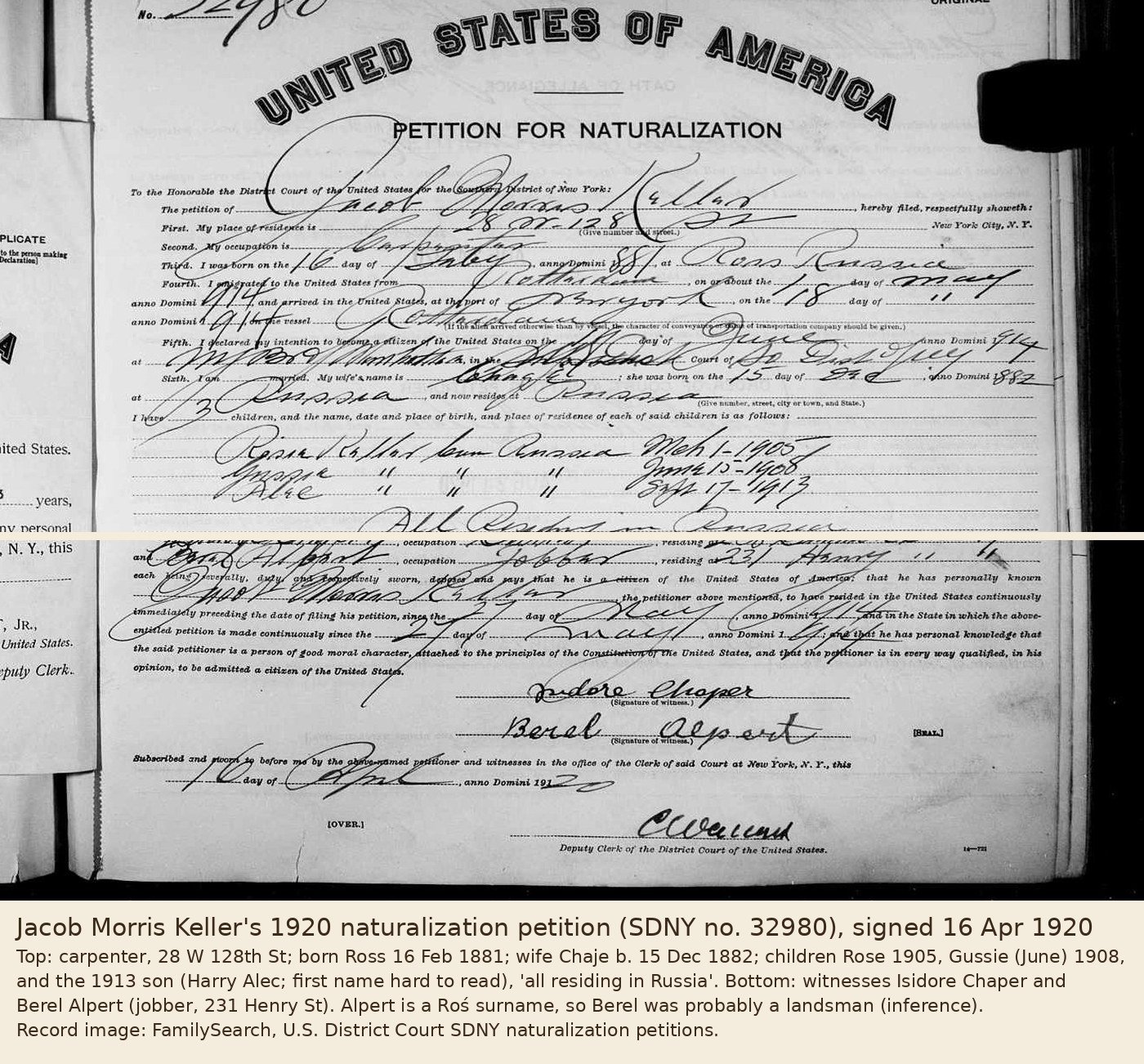
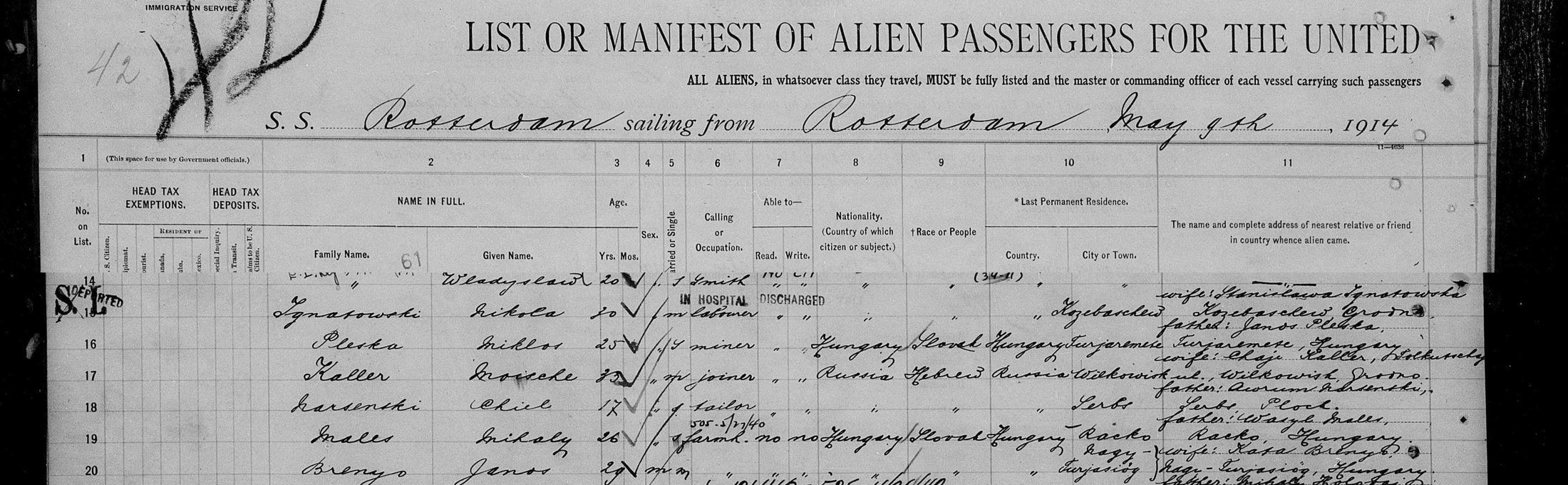
Jacob sailed alone from Rotterdam and landed at Ellis Island on 18 May 1914. The list calls him “Moische Kaller”, a joiner of Wołkowysk, leaving behind his wife Chaje. Confirmedrecordrecord A note on the second page says he had been in America once before, in Denver, 1909–13. Confirmedrecord Ida was expecting. Then the First World War closed the road. Ida and the children, Rosie, Gussie (later June) and Harry, lived through German occupation and then the Polish–Soviet war. In the summer of 1920, with the front passing over Roś, they sailed from Rotterdam on the Holland-America liner Rijndam and reached Ellis Island on 12 August: “Chaja Kaller”, 36, born in Roś, with Rosa, 14, “Niessa”, 11 (June), and Hersz, 6 (Harry). They were going to “husband Morris Kaller” in Harlem. Confirmedrecord Jacob had become a citizen two weeks earlier. Confirmedrecord
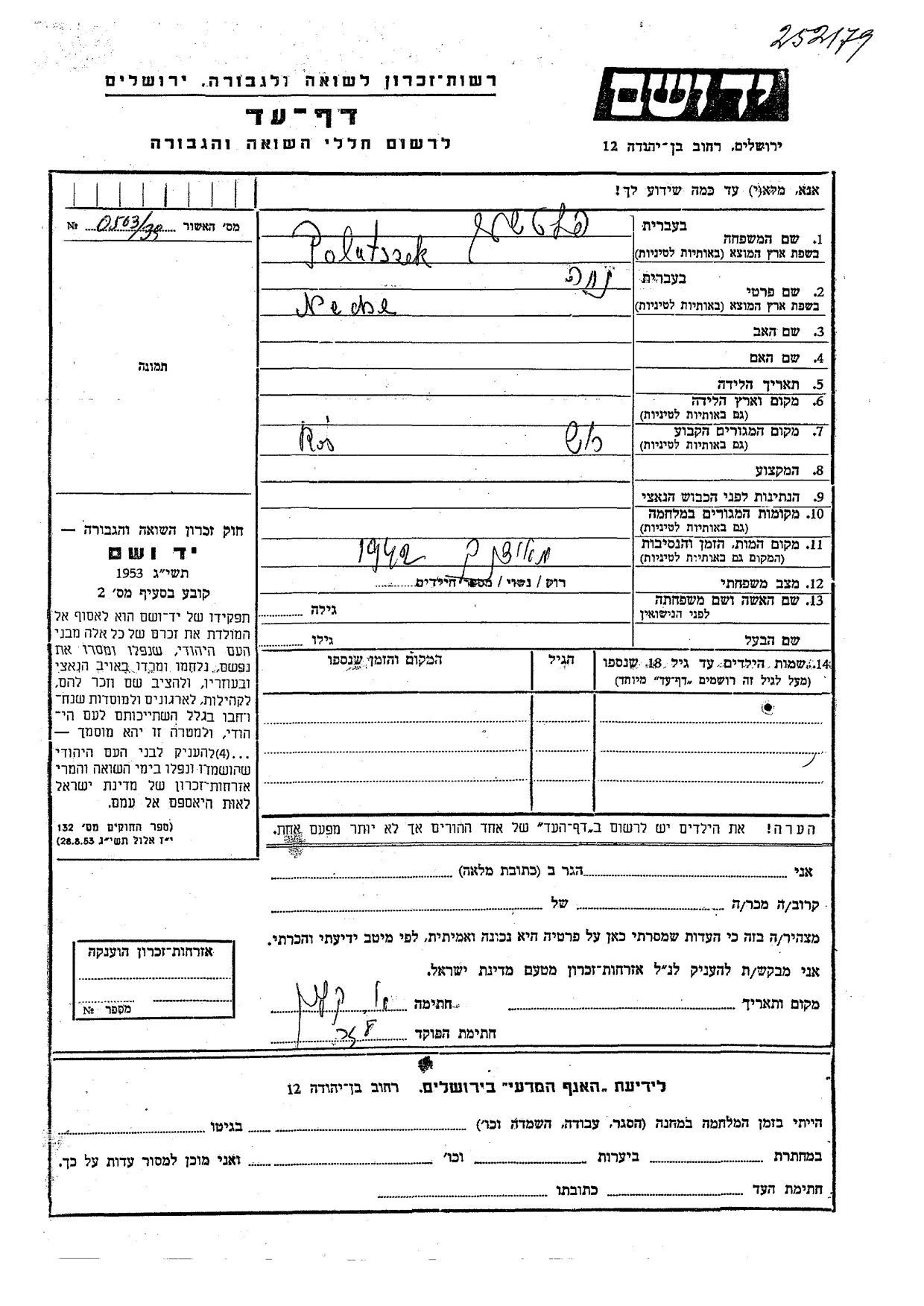
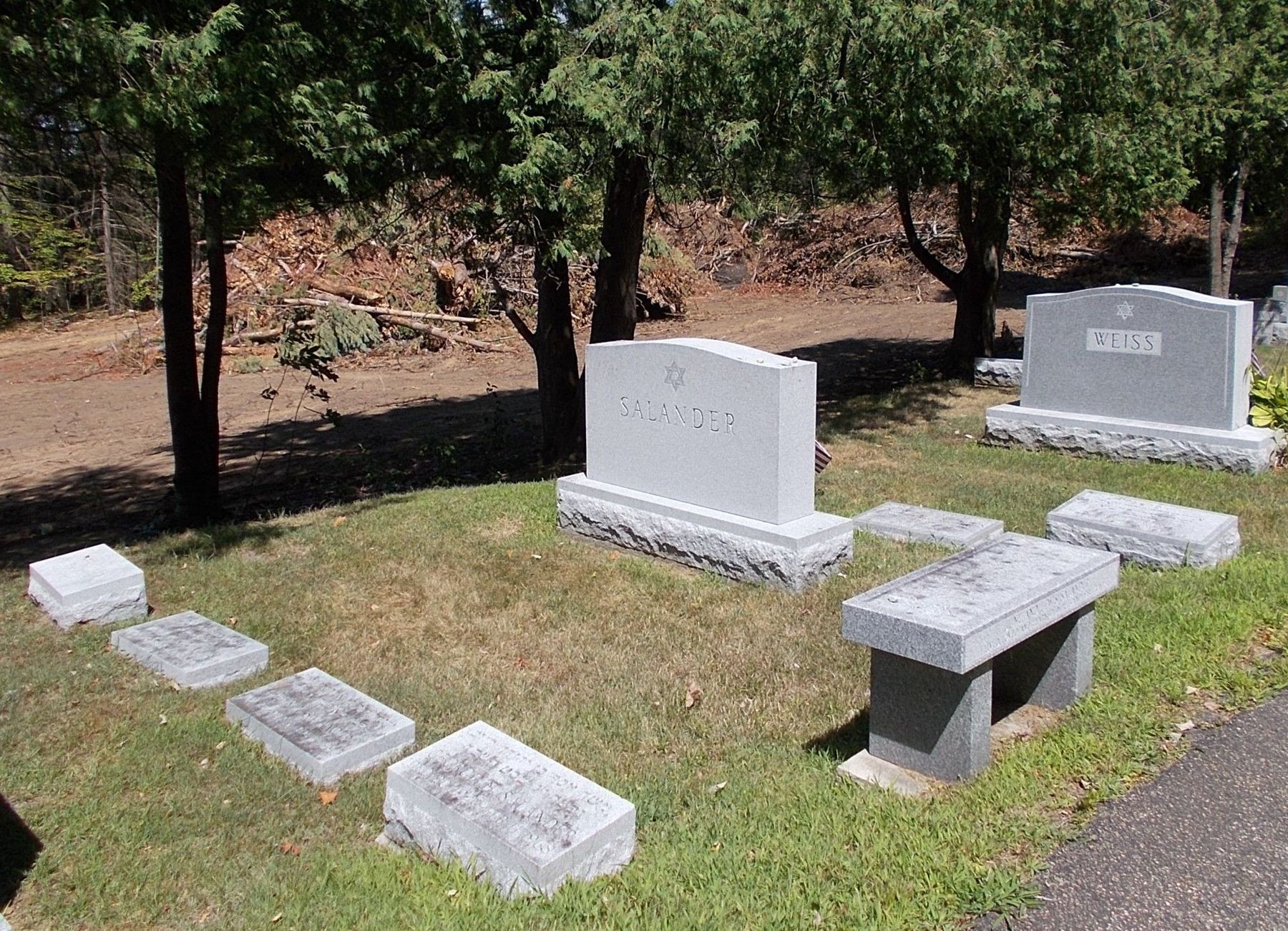
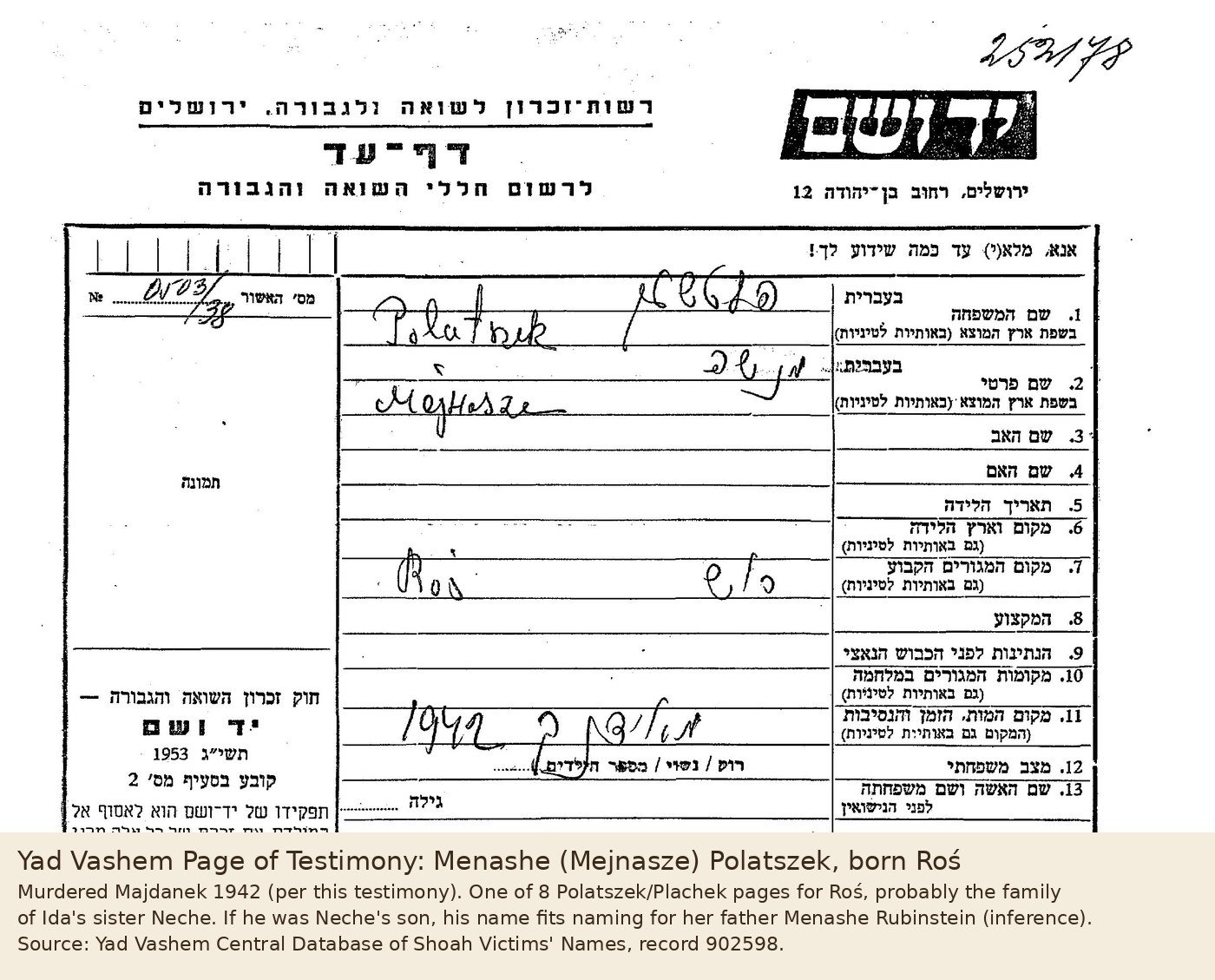
Ida had a sister who stayed. On that same 1920 list, the relative Ida left behind is “Sister Neche Polaczik”. Confirmedrecord A bench in the family plot in Rutland remembers Necha Rubenstein Polacheck and her family, murdered in the Holocaust. Confirmedheadstone Yad Vashem holds Pages of Testimony, filed by townsmen, for a Polatszek family of Roś murdered at Majdanek in 1942. Among the eight is a Mejnasze, which is Menashe (the pages give no ages or relationships). With the sisterhood now on record, this is very probably the same family. Probabletestimonytestimony
Roś: the Keller & Rubinstein shtetl
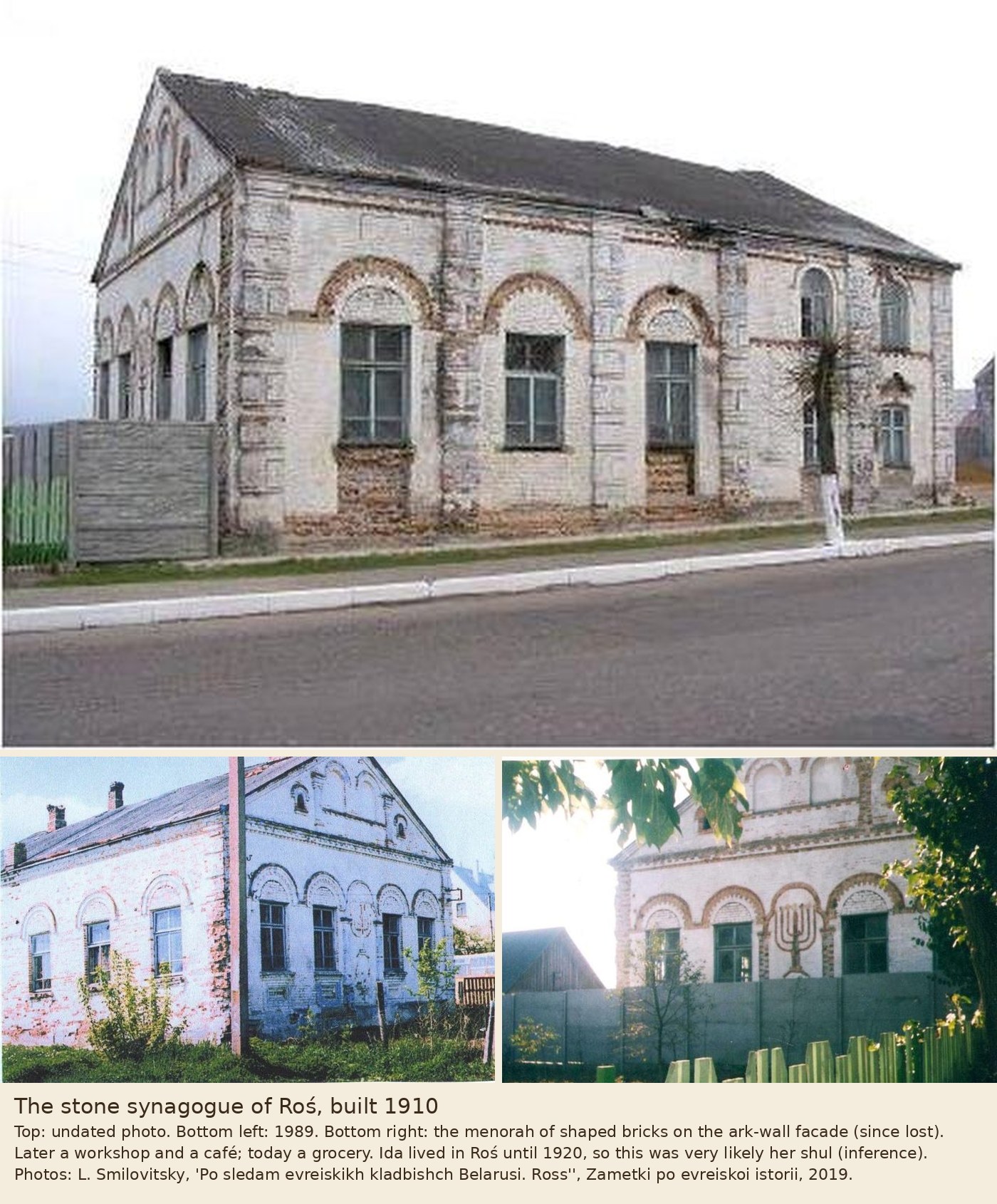
The town
- Where: Roś (Ros’), a small shtetl about 12 km from Wołkowysk (Volkovysk) and 80 km east of Białystok, in Grodno province of the Russian Empire; Polish between the wars; today western Belarus. Confirmedpublishedpublished
- How big: 307 Jews in 1765 and 287 in 1847; in 1878, 434 of its 794 people (55%) were Jews. By 1897 the whole town had about 1,030 people in 137 households, and in 1921 there were 389 Jews. (This page used to say “287 Jews in 1897”; 287 was the 1847 count.) Confirmedpublishedpublished
- Making a living, 1897: 13 shops, 13 shoemakers’ and 8 tailors’ workshops, 5 smithies and 3 taverns. On the estate nearby were a turpentine works and a water-powered flour mill. Confirmedpublished
- Famous son: Rabbi Yitzchak Elchanan Spektor (1817–1896), later the Rav of Kovno, was born there. Confirmedpublished
- What was going on: Jacob left in May 1914, just before World War I. In 1915 the Germans took Wołkowysk and held the area to the end of the war; then it became Polish. In July 1920 the Bolsheviks took Wołkowysk. That summer American relief delegates brought money to relatives in Wołkowysk “and its vicinity”. Confirmedpublished
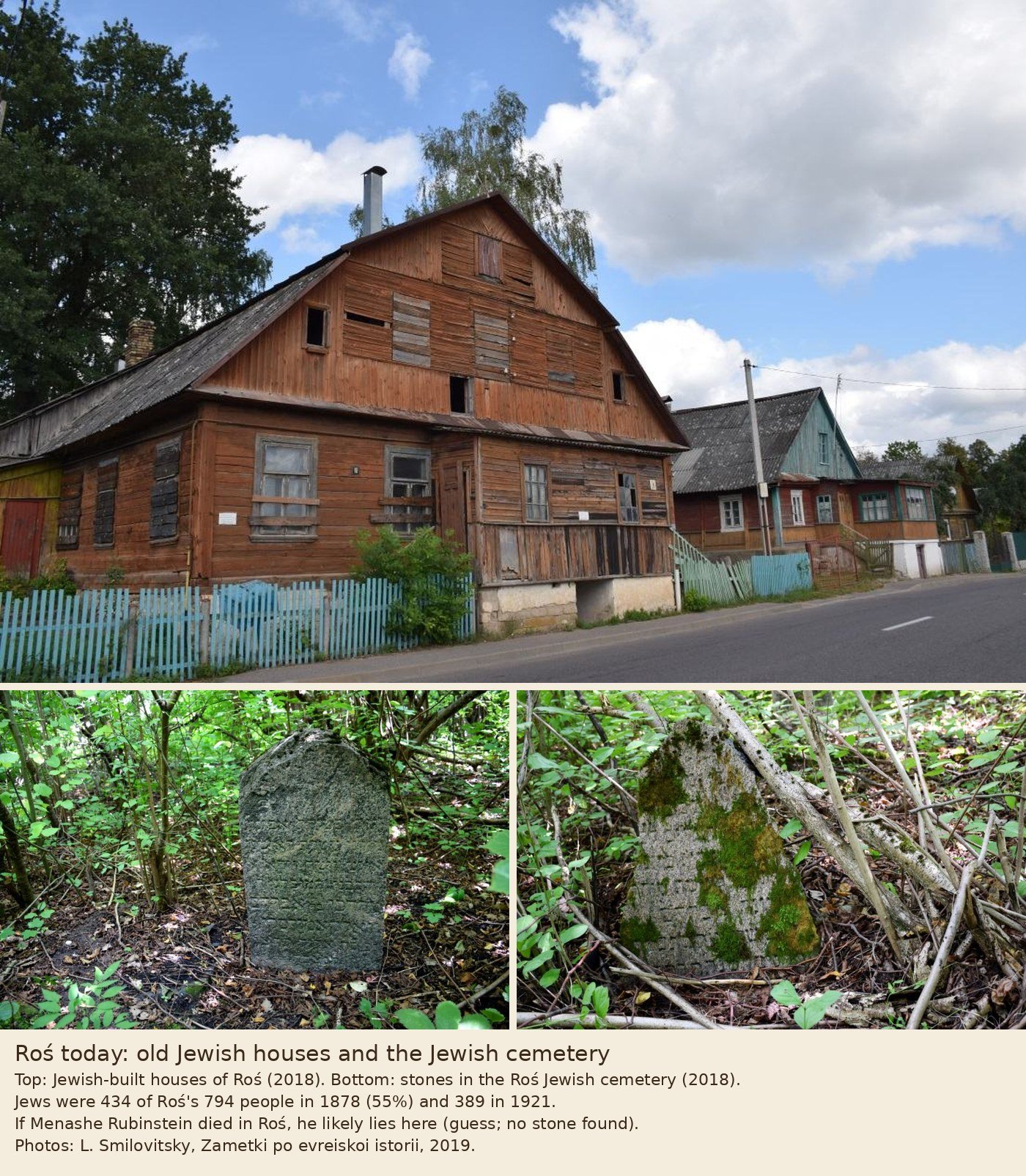
Faith, rabbis and learning
- The synagogue: Roś had a prayer house by 1886, and the stone synagogue in the photo above was built in 1910. Confirmedpublishedpublished
- The rabbis: R’ Shmuel, a disciple of R’ Chaim Haikel of Amdur, in the late 1700s; R’ Israel Isser Spektor, father of R’ Yitzchak Elchanan, in the early 1800s (Wikipedia says he “leaned toward Hasidism”); and the last rav, R’ Eliezer Szubowski, born 1913, murdered in the Holocaust. Confirmedpublishedpublishedtestimony Who was rav in Jacob and Ida’s years, about 1880–1920, has not been found. Open
- A famous son of Roś: R’ Yitzchak Elchanan Spektor (1817–1896), later the rav of Kovno and the leading posek of his generation, the rabbi Yeshiva University’s rabbinical school (RIETS) is named after, was born in Roś. His father, R’ Yisrael Isser, was rav and moreh tzedek there. His parents are buried in Roś, and he used to travel through Wołkowysk to visit their graves. He was a generation before the Kellers: Jacob Keller was born in 1881, and Spektor died in Kovno in 1896. Confirmedpublished
- Rabbi of Roś in 1840: Szmuel Łuniew. The Wołkowysk magistrate tried to fine him that year for serving as rabbi of Roś without registering. Probablepublished
- Who was rav from 1880 to 1920 is still not found. Open
- Chasidish or Litvish? A 2019 history says Roś’s Jews were Amdur (Indura) Chasidim, but that is about the late 1700s. The wider Wołkowysk area was strongly Litvish. Whether Roś was still Chasidic around 1900 is unknown. Probablepublishedpublished
- Our family: Observant and traditional. Both stones carry Hebrew names (“Chaya bat Menashe”, “Ya’akov Moshe bar Tzvi Aryeh”). June said her mother kept kosher, her father sent her to Hebrew school every day, and “we didn’t mingle with non-Jews”. There is no evidence either way that the family was Chasidish. Confirmedtestimonyheadstoneheadstone
- Where they learned: A Roś boy who went on to learn would most likely have gone to the Wołkowysk Yeshiva, founded 1887 by R’ Boruch Mordechai Lifschitz: about 300 students in 5 classes under R’ Abba Yaakov Borukhov (rav 1903–1923), with young men from the surrounding towns. This is what the region shows, not a record of our family. Possiblepublished
Jacob and Ida
- Jacob Morris Keller: born in Roś on 16 February 1881; a carpenter (“joiner” on his ship list). Arrived in New York on 18 May 1914, sailing from Rotterdam. His gravestone at Paramus reads “Yaakov Moshe bar Tzvi Aryeh”; that it is his is probable, not proven. Confirmedrecordrecord Probableheadstone
- Ida (Chaje) Rubinstein Keller: born in Roś on 7 December 1882; died in Rutland, Vermont, on 27 December 1980. Daughter of Menashe and Rose Rubinstein. Confirmedrecord
- What they looked like: Jacob in 1914: 5 ft 6, black hair, brown eyes. Ida in 1920: 5 ft 4, black hair, grey eyes. Rosa, 14, in 1920: 5 ft 1, brown hair, grey eyes. Confirmedrecordrecord
- Waiting in Wołkowysk: When Jacob sailed in 1914 he gave his wife “Chaje Kaller” at a street address in Wołkowysk, so Ida and the children were probably living in the town by then. Probablerecord
- The 1920 crossing: Ida with Rosa, “Niessa” (June) and Hersz (Harry), SS Rijndam, Rotterdam 31 July → Ellis Island, 12 August 1920. She paid her own fare, showed $75, and was going to her husband “Morris Kaller” at 28 West 128th Street. Her sister Neche Polaczik stayed behind. Confirmedrecordrecord
- Why then: She sailed the same month the Bolsheviks took Wołkowysk, so she got out just as the Red Army came. The timing is on the records; that it is why she left is our inference. Probablerecordpublished
- A landsman in New York: One of the two witnesses on Jacob’s 1920 citizenship petition was Berel Alpert, a jobber of 231 Henry Street. Alpert is a Roś family name (seven Roś Alperts are in Yad Vashem), so he was probably a landsman. Confirmedrecord Probabletestimony
- Jacob’s death: The New York City index has a Jacob Keller, 73, who died in Manhattan on 14 March 1949, the same date as the Paramus stone (13 Adar 5709). That it is ours is probable; the certificate has to be ordered. Probableindexheadstone
- A brother? An Abraham Keller born 10 September 1897 in “Ross, Russia” registered for the draft in the Bronx in 1942. He might be Jacob’s youngest brother; that is only a guess. Possibleindex
- A name carried on: Grandpa Jim’s Hebrew name, Menashe Yaakov, carries the name of Ida’s father, Menashe Rubinstein. Probable
- Our inference, not a record: Jacob and Ida, born under two years apart in so small a town, almost certainly knew each other before they married. Possible
Neighbours, and the family left behind
- Their neighbours: Yad Vashem has 252 victims who lived in Roś. The families include Kaplan (25 people), Lulew, Berg, Jelinowicz, Pernat, Izraelski, Alpert, Srebnik, Polatszek, Efron, Nowik and Kremer. Their trades: tailors, merchants, carpenters, a plasterer, a shoemaker, a butcher, a grocer, a baker and a teacher. Confirmedtestimony
- Neche’s family: Eight Pages of Testimony for Polatszeks of Roś, filed by townsmen: Neche, Mote Welwl, Iankl (a plasterer), Szoszke, Etel, Itke, Chana and Menashe (Mejnasze). They give no ages or relationships, and all say “murdered at Majdanek, 1942”. That this is Ida’s sister’s household is probable. Probabletestimonytestimony
- The name Menashe: If that Menashe was Neche’s son, he was very likely named for her father, Menashe Rubinstein, which would mean Menashe had died by then. Our inference. Possible
- November 1942: The Jews of Roś were gathered in the market square, where the Germans burned their books, then taken to the Wołkowysk ghetto, and from there to Treblinka. This differs from “Majdanek” on the Pages of Testimony; both are kept here. Confirmedpublishedpublished
New, 23 Oct: the Kellers, round two
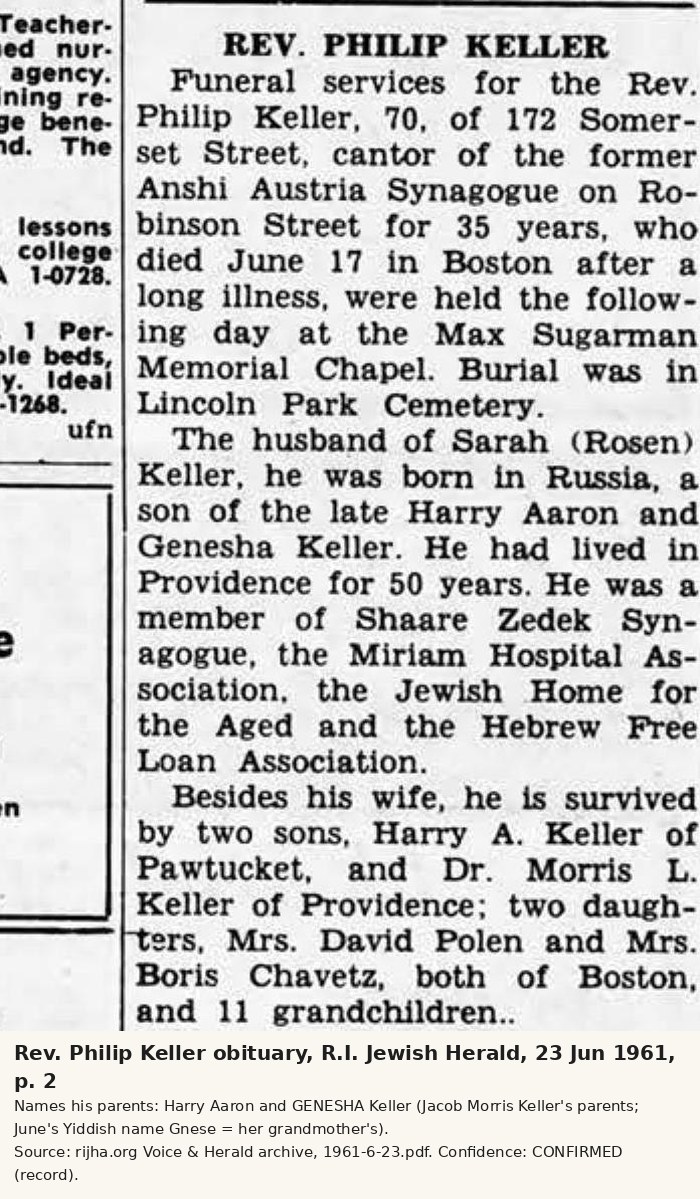
- Jacob’s parents, by name. Philip Keller’s obituary in the Rhode Island Jewish Herald, 23 June 1961, calls him the cantor of the former Anshi Austria Synagogue and “son of the late Harry Aaron and Genesha Keller”. These are Jacob Morris Keller’s parents too: Tzvi Aryeh = Harry Aaron, and Genesha is the “Gussie” of the family’s records. Confirmedrecord
- June’s Yiddish name Gnese was probably for this grandmother, Genesha. Our inference. Guessrecord
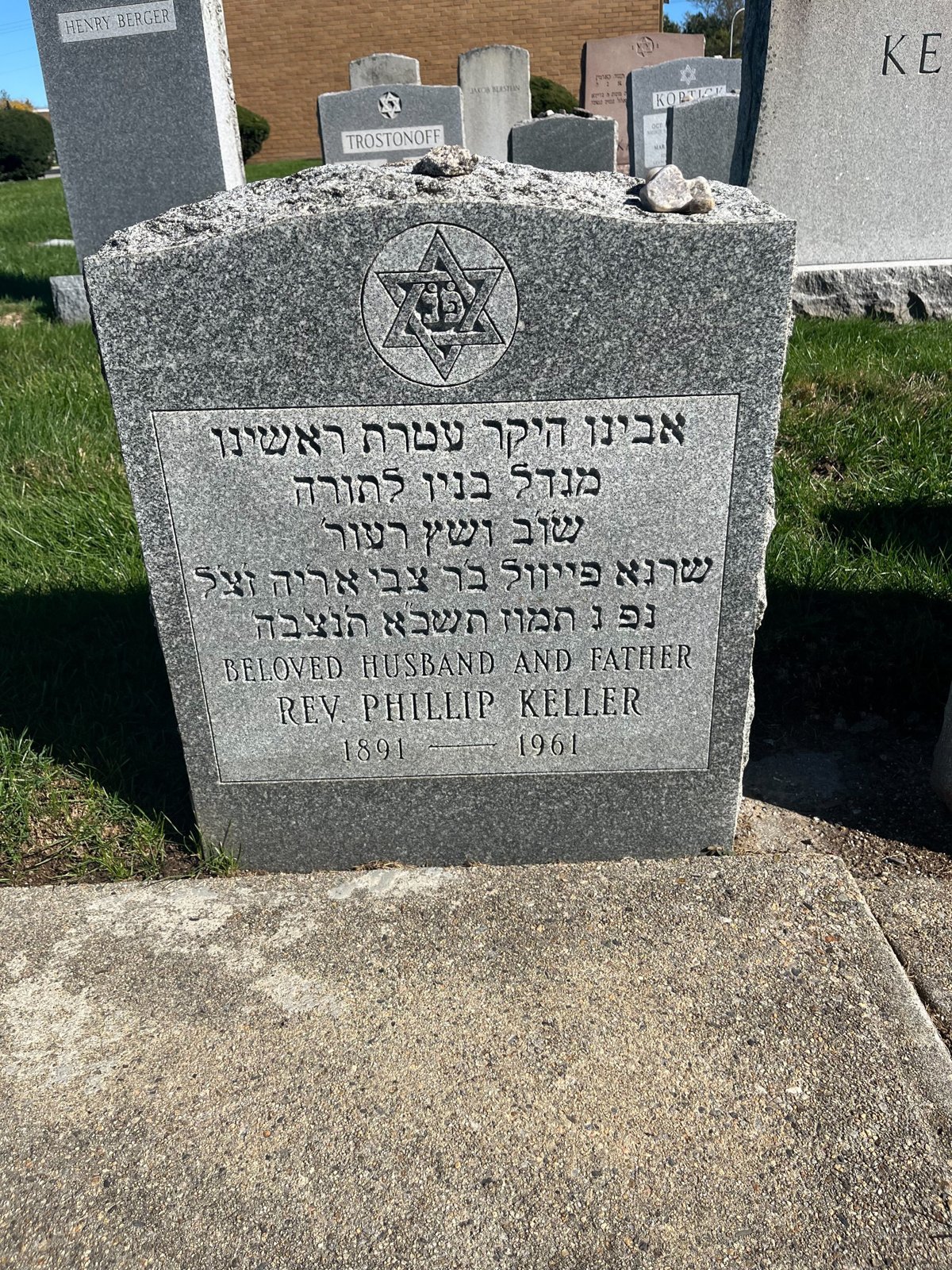
- Uncle Philip was a shochet and a chazzan. Philip Keller, Jacob’s brother, was a shochet (ritual slaughterer) and a cantor. Jacob’s brother Philip’s stone in Warwick, Rhode Island reads “Rev. Cantor Phillip ‘Shraga Feivel’ Keller”, 1891 – 17 June 1961. The Hebrew says “Shraga Feivel bar Tzvi Aryeh”, that he raised his sons to Torah, and that he was a shochet and chazzan (“shu”b v’sh”tz”). Confirmedheadstone He was born in “Ross, Russia”, came to Rhode Island by 1913, became a citizen in Providence in 1921, and his WWII draft card calls him “Reverend”. Confirmedindex
- So Jacob’s stone is very likely ours. Philip is a second Keller from Roś who was “bar Tzvi Aryeh”, and Jacob’s stone in Paramus reads “Yaakov Moshe bar Tzvi Aryeh”. His 1949 death certificate would settle it. Probable
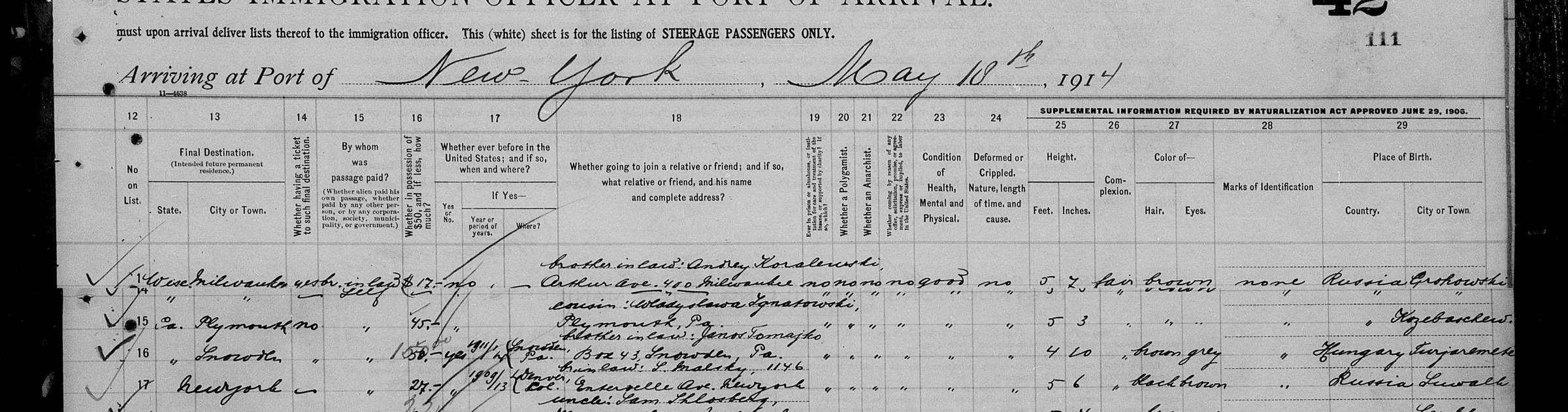
- Jacob had lived in America before, in Denver. Both pages of his 1914 ship list have now been read from the full images. In the column “ever before in the US” it says “1909/13, Denver, Col.” He showed $27 and was going to his brother-in-law S. Malsky (Simon, husband of his sister Rose) at 1146 Intervale Ave, in the Bronx. Confirmedrecord So he went home to Roś about 1912 (Harry was born in September 1913) and came back in 1914. Our inference. Probable
- “Suwalk” was a clerk’s mistake. The birthplace column says “Russia, Suwalk”, but the same list gives his home as Wilkowisk (Wołkowysk), Grodno, and all his own papers say Roś. The clerk probably mixed up Wołkowysk with Wyłkowyszki, a town in Suwałki province. Confirmedrecord Why it happened: Guess
- Denver, 1910: a Jacob Keller, 29, born 1881 in Russia, married but living without a wife, was a roomer with the Ginsberg family in Denver. That is probably him. Probableindex
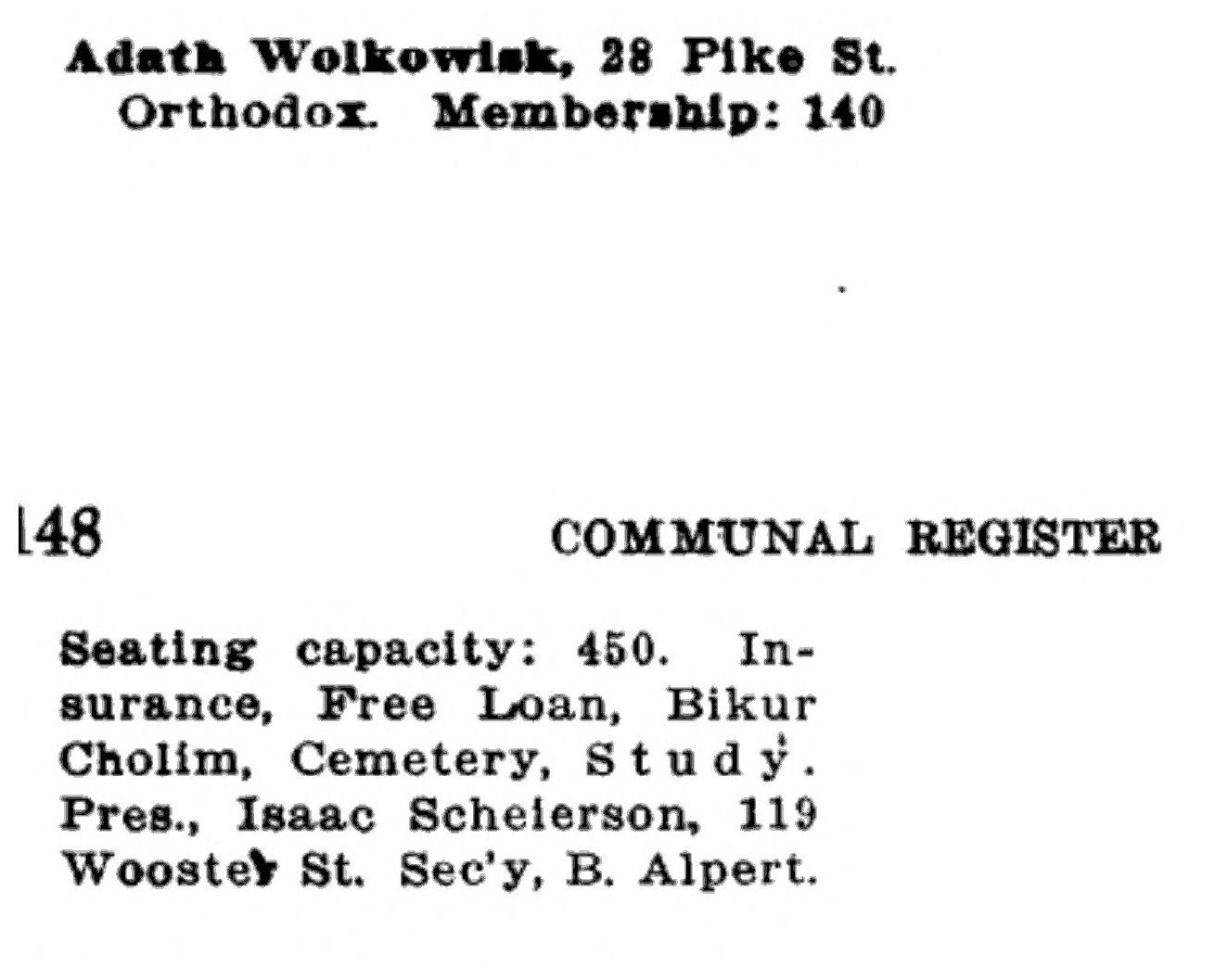
- The Wołkowysk shul in New York: In 1917 Adath Wolkowisk, an Orthodox shul at 28 Pike Street on the Lower East Side, had 140 members, a free-loan fund, sick care and a cemetery. Its secretary was B. Alpert, probably the same Berel Alpert who witnessed Jacob’s citizenship papers in 1920. Confirmedpublished Same man: Probable
- Anna Rubinstein, 22, born in Poland, lived with Rosa and Jack Jaffe in the Bronx in 1930, listed as a “cousin”. She was probably a niece of Ida’s. Confirmedindex Ida’s niece: Probable
- Abraham Keller (1897–1964, born in “Ross”) is still only a guess as Jacob’s youngest brother; no record of his names his parents. Guess
Still open: the rav of Roś around 1900, Jacob’s 1949 death certificate, Ida’s obituary, and whether Abraham Keller was his brother. See Open questions.
V. Lew and June
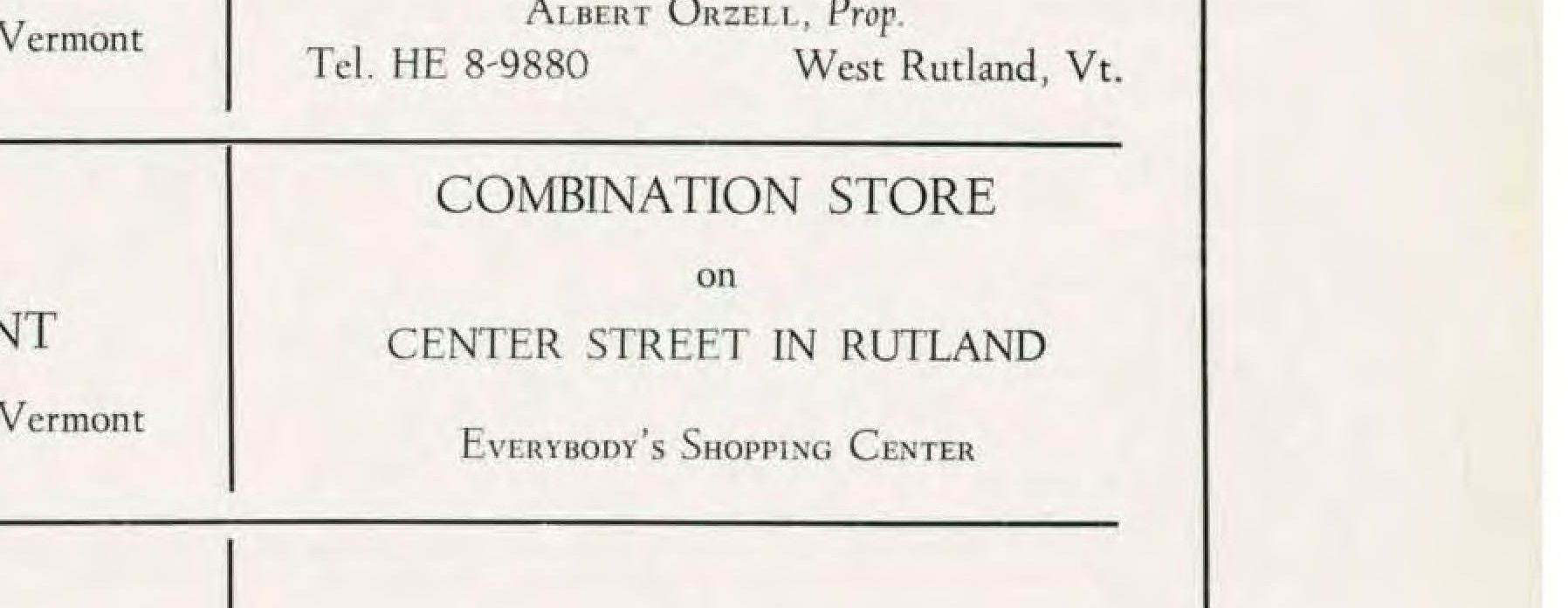
Lew left Brooklyn's wholesale dry-goods trade for Rutland, Vermont, where he became president of the Combination Dry Goods Company on Center Street. The family dates it to 1931; the directories list him from 1935. Confirmedrecordrecordheadstone On a buying trip to New York, a doctor's office at 44 Park Avenue introduced him to a young secretary from Washington Heights. In June's own telling, the doctor called him “an overgrown Boy Scout”. Probabletestimony The doctor was very probably his brother-in-law, Dr. Fleiss. Probablepublished
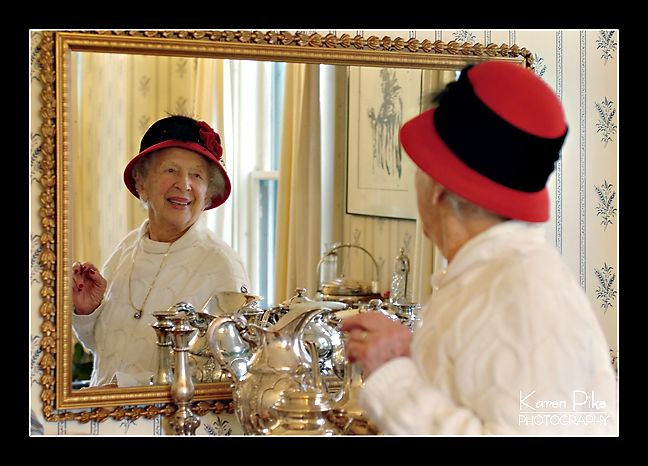
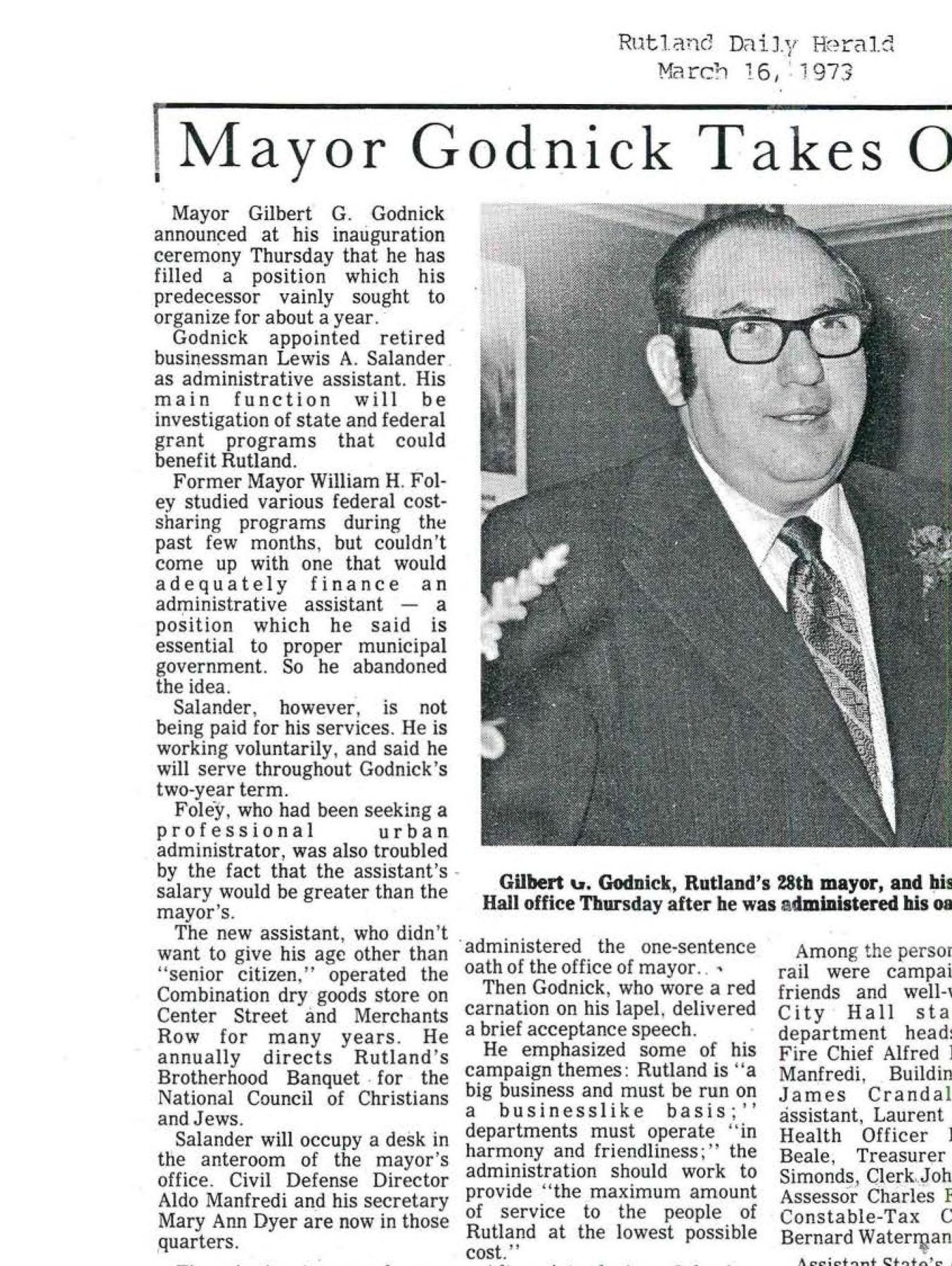
They married on 9 March 1941. Probabletestimony June taught Hebrew school at the Rutland Jewish Center for thirty years. Confirmedpublished Lew was the Center's president in 1946. On Yom Kippur 1973 he climbed the bimah to announce that Israel had been attacked. Confirmedpublished At 75 he became the mayor's unpaid administrative assistant. Confirmedrecord Lew died in 1996, and June in 2010, aged 101. Their stone reads: “Lived, loved and learned in Rutland, 1931–2010.” Confirmedheadstoneheadstone Their sons were George M. Salander (1941–1968) and Dr. James Salander, whose Hebrew name, Menashe Yaakov, carries June's grandfather and her father. Probableheadstonefamily
See this side’s tree → · The journeys on a map → · Over to my mother’s side →